“The 12 Timeless Rules for Making a Good Publication” A lesson for web video content: “A sound editor never has a three-months’ full supply in his cupboard. When you over-buy, you narrow your future choice.” (The Atlantic)
“‘Tiny Furniture,’ Awfully Big Questions” Recent graduate makes a film about being a recent graduate … a meta cliche that actually works, thanks to the talented 24-year old writer/director/actress Lena Dunham. (NPR)
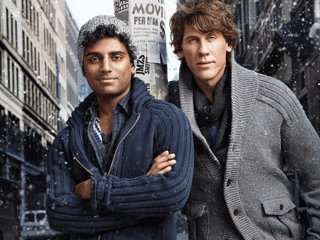
Coming out of a crowdsourcing snafu with a failed new logo, GAP emerges today with a sharp photo and video campaign. While snapping stills in New York of notable actors, Foursquare founders, and style bloggers, the talent spends their down time talking about charitable giving, answering “if you could give anything in the world, what would it be?”
With the emergence of low-cost and high-quality DSLRs, for better or worse, it’s increasingly common for photographers to shoot video and filmmakers to shoot stills. Sometimes companies hire two different teams to shoot the same material; other times, it’s a two-for-one gig. In this case, the video takes a back seat to the stills, although the behind-the-scenes themed spot is now running on television.
Media convergence is nothing new. The merger of print, broadcast, web, mobile and even radio for a team’s single message just requires a lot of players and their distributions platforms shooting for the same goal.
GAP’s multi-faceted campaign does just that, plus some specialized context where appropriate. For example, the online video gives something itself: a code word (Viral30) for a 30% in-store discount plus a Facebook-linked way to connect “likes” to $1 of corporate giving to a group of charities. Pretty smart move, GAP.
True to her Twitter bio, Janine Saunders is indeed a producer of awesome things in New York City. She works for RADAR, an ongoing series of community documentaries for WorkBook Project, who funds the program partly intended for mobile consumption.
In between her non-stop, multi-day, 15-hour productions, I caught up with her through filmmaker Florica Vlad, with whom she collaborated on a short promotional film for Douglas Rushkoff’s book, “Life Inc.” For RADAR’s fourth season, she’s “the producer but also 50 other things. It’s part of working at a DIY based production house / agency.”
The latest episode, “Dickchicken,” premiers tomorrow, Wednesday November 10. [UPDATE: Watch it below.]
What is RADAR and how does it relate to the Workbook Project?
Janine Saunders RADAR is a web-series, now in it’s 4th season, that focuses on creativity and storytelling. Each episode is a short form documentary / narrative that highlights innovative projects and events across many different creative disciplines, hangs with creators and founders, and digs deep into the process, method and participation of art. What’s great about RADAR is the high production value of each episode and the finesse that we put into each piece. It’s really important that we tell the artists story in the most accurate manner, while giving it a life of it’s own on the internet. RADAR pieces are truly timely.
RADAR is produced by WBPLabs, the production house and creative agency of WorkBook Project. Labs has also produced other series, such as Inspired By Design and our latest, Inside Design (TBR).
What’s your day-to-day work on RADAR?
JS All RADAR episodes start with curation, which comes from our AMAZING interns, Chloe Stites, and anything myself or our Series Producer, Josh Cramer, finds. Each episode of RADAR has to fit within our curatorial guide-lines which focus on projects with multiple aspects of creation.
We normally shoot each week or every other week, which can be very hectic. We go into the edit right after the piece is shot, so everything has to be in place in order to operate smoothly. Personally I do a lot of the coordination between our “contributors” (those who are featured) and work out all logistic, creative decision from the director, art department, etc. We work on tight budgets, so we always have to be very creative about how we approach each shoot. I always refer to it as “producing boot-camp”.
What came first, the content or the channel? What’s the evolution of this project?
JSBabelgum, the channel RADAR platforms on, came first. Although the creators of RADAR, Lance Weiler and Alex Johnson, had been developing the idea for a while before Babelgum approached them with an opportunity to create content for their channel. We are not affiliated with Babelgum other than producing content for their channel.
If you watch all the RADAR episodes, you’ll definitely notice an evolution in style and concept. In season 2 and 3 we started creating narratives around the content as opposed to just documenting it. Check out Missed Connections, Poetry Brothel, I Hate Perfume and Before I Die for examples of a narrative approach to a project or art-work.
Another evolution would be the launch of RADAR NYC, which is a weekly blog highlighting new project, music, events, and articles by past contributors OR projects that meet RADAR’s theme. This was a way to extend our reach and keep up the energy between seasons.
Season 1 Episode 12
What are some of the successes with the show?
JS Successes would be all the amazing responses we get from people we have featured or inspired. For me, the point of RADAR is to tell a story about the creative process and to evoke a sense of spirit that is often hard to find in everyday media. I’m also a fan of documentary, and we have really captured some of the most unique projects happening in NYC from 2008 till now. It will be very fascinating to look back at these episodes 20 years from now.
What else does Workbook Project do?
JS WorkBook Project is amazing. There are 5 current projects within WBP:
DIYDAYS which is a traveling film conference centered around DIY media and transmedia. It’s free to the public, streams live, and has been in cities such as Philly, NYC, LA, and Boston.
WBPLabs – our production house / creative agency
RADAR – on-going series about creative projects in NYC
New Breed and Culture Hacker – editorial section of the site that focuses on new media, innovative projects, transmedia, podcast, and project development.
Where do you see short-form online content like this headed next?
JS Depends on the future of technology, in my opinion. RADAR was partly conceived to be watched via mobile devices, which effects the perimeter of our development. Right now the internet is more cluttered than ever and it’s going to be important for platforms to developed that can facilitate short-form content. Channels like Babelgum are a great idea, and give creators of short-form content a place to platform. There needs to be more curated channels like that. I was working on a project a year ago which was a film festival located at Sundance that was based around a mini projector that connected to a mobile device – the projection was 100×100 HD which was fantastic. This is incredible, because all of the sudden we have a way to throw DIY film festivals, parties, gatherings, with an emphasis on short films.
Featured on today’s episode of KCRW’s talk program, The Business, host Matt Holzman spoke with British filmmaker Gareth Edwards, whose film “Monsters” opens this weekend after staying abuzz with sci-fi/horror audiences since its premiere at SXSW.
Having fund-raised and made his first feature film for $250,000* using his visual effects chops and a mix of guerrilla-style filmmaking plus do-it-yourself tenacity, he learned two lessons: the constraints of a small budget leads to smarter decisions and the lack of control leads to creative surprises. In the interview with KCRW, which begins 19 minutes into the program, Edwards shares a unique story of how a scene with cows came to be: they were just in his way to another location.
After collaborating on post and doing the visual effects himself, he ended up making the money back on foreign sales and just took 50 meetings over a 2-week visit in Los Angeles, which led to a development deal from Timur Bekmambetov, the director of “Wanted.”
His feature, starring Whitney Able and Scoot McNairy, opens in limited release on October 29, 2010. It is also currently streaming on Amazon ($9.99). The film has multipleofficial websites, including one in Russian.
https://www.youtube.com/watch?v=_IshZoIwz_o
(* Budget according to the interview. IMDb notes $15,000.)
Louis Vuitton and Nordstrom both try to catch eyes with their filmmaking. But in each respective campaign, they shoot for different goals: one strives to bolster brand awareness, while the other aims to create conversation. So which one works?
Louis Vuitton
“What is a journey? A journey is not a trip. It’s not a vacation. It’s a process. A discovery. It’s a process of self-discovery.” With that introduction, Louis Vuitton lays the framework for a spot directed by Bruno Aveillan in 2008. “A Journey,” which runs 90-seconds, premiered in theaters as well as television as part of their Core Values advertising campaign. According to its press release, the commercial “captured some of the most quintessential moments that we have all but experienced at one point in time when we travel, where our senses and sense of awe are surpassed by the absolute beauty of a place, of a moment.” It continues to be shared and cited online as one of the most beautiful ads around. And in a show of disinterest in social media, Vuitton doesn’t even host the ad. In one bootleg on YouTube, it’s reached over 250,000 views.
In tandem with a website redesign made in-house this month, Nordstrom introduced video conversations which feature archetypes of their customers talking about their looks. According to WWD quoting Jamie Nordstrom, president of Nordstrom Direct, the strategy is to talk to customers “in a more conversational way,” which include videos with designers, customers, store managers and sales people on seasonal topics like trends and top-sellers.
https://www.youtube.com/watch?v=onoXFUVOa5Q
One oversight is that some videos feature clothing that isn’t available on the site, which an interested customer queried in the comments below the video on Nordstrom.com. Their comments are almost a shot in the dark: Nordstrom staff took eight days to reply to one dialog they’ve indirectly encouraged, but the reply fortunately linked up two in-stock replacements to the missing orange dress.
In the end, these are videos are useful attempts to push specifics. The approach of conversations, even if it’s scripted, attempts to provide what all websites lack: a personal shopping guide, with a confident opinion you expect to get when you’re in a store.
With both Louis Vuitton and Nordstrom, you either need to understand the tools before you use them–or have a brand so strong it doesn’t need much help to begin with, which you’d think Nordstrom’s already has.
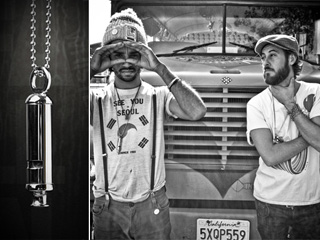
Falling Whistles is a movement that began with journalist Sean Carasso’s blog post about boys being sent to the frontlines of the war in Congo with only a whistle. Readers asked him how they could help. By designing a whistle you can wear around your neck, supporters can show solidarity and help fundraise, where “proceeds go to rehabilitate and advocate for war-affected children.” Now, the movement is touring the country. Volunteers host “speakeasies” to spread awareness. Unpaid internships are coveted by motivated youth. Falling Whistles also just released two films that quickly communicate their message and leave you feeling wide-eyed.
Music has played an important role in the cinema since piano accompaniment during the silent era. From the first recorded sounds in The Jazz Singer (1927) to the point where soundtracks out-sold the films themselves [Xanadu (1980), anyone?], it’s clear: music matters.
Coming up this weekend, as The Social Network hits theaters, we’ll get to see and hear the collaboration between David Fincher and Trent Reznor. Pitchfork published the following interview with the duo and you can check out a track at the bottom. It is Trent Reznor and Atticus Ross’ update on an old number: “In the Hall of the Mountain King,” originally composed by Edvard Grieg.
(You can also download a 5-track sampler EP at Reznor’s Null Corporation site or listen below. The official soundtrack was released yesterday, with digital purchases available September 30.)
“Waiting for Superman” is an emotional crash course in the state of public education in the U.S. Using powerful narratives and a sprinkling of statistics and animations, director Davis Guggenheim left me with tears welling up in my eyes. Instead of painting a black and white picture and pointing a finger at an evil villain, the film acknowledges the complexities of the problem with our educational system and highlights a few inspirational programs that are working.
Guggenheim tips his hat to Errol Morris by using black and white archival footage of old Superman episodes in trying to add another layer of depth to the film. He does a poor job incorporating the Superman analogy throughout the film and felt it was a Guggenheim’s attempt at trying to be profound.
The film is backed by a strong social action campaign and every theater goer who watches it is rewarded with a $15 gift certificate to apply to an educational charity. Incredible, seeing as my ticket was only $13.
Bottom line, this was an excellent politically charged bipartisan film that I feel will be a turning point in public education. It took Sundance by storm and I’m sure it will land the Oscar for best documentary.
Part of a series of posts about great film, web, or design artists and their work abuzz online and in-person.
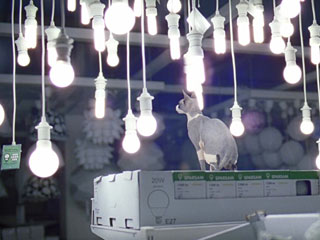
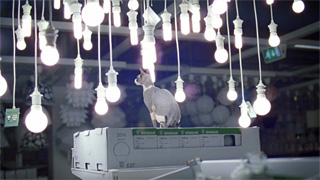
What do you get when IKEA uses a hundred cats and five camera crews for a new ad running in the U.K.? “Happy Inside,” another TV advert-turned-viral. Director Adam Berg — the force behind Phillips’ “Carousel” ad — and agency Mother London put it together.
The campaign also involved Cake who’s using a Facebook page to handle a contest for people guessing which furniture attracts the most kitties.
Also take a look at the behind-the-scenes video, which has clocked about 2,000,000 views in a week.
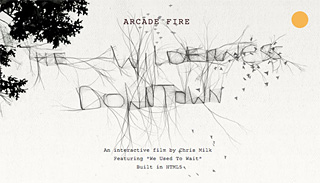
Koblin describes it as “an interactive HTML5 short created with data and images related to your own childhood. Set to Arcade Fire’s song ‘We Used to Wait,’ the experience takes place through choreographed browser windows and utilizes many modern browser features.”
Also check out Creativity’s behind-the-scenes interview and storyboards.
(Better than the above embed, visit the official video site for a more personalized experience with the video.)
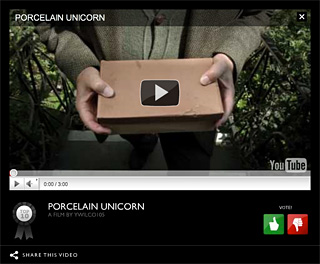
[UPDATED 9/20/2010 — “Porcelain Unicorn” won the contest and earned Ridley Scott’s praise!]
[UPDATED 9/6/2010 — “Porcelain Unicorn” was voted into the Top 5. Voting continues until 9/17 at youtube.com/philipscinema under the “Gallery” tab, where the video with the most thumbs-up votes wins.]
Phillips’ Parallel Lines, originally a 5-film series from RSA Films released this last April to promote a television, is in the middle of another line of online film. This go-round is the “Tell It Your Way” competition where 3-minute works from filmmakers all around the world keep the same 6-line script about a unicorn.
No stranger to a challenge, Keegan Wilcox took the reigns. He has worked in the entertainment industry in varying capacities for over six years after graduating from the Dodge College of Film and Media Arts in 2005. He is now owner/operator of his own commercial production company called 100to1 Productions, which has been in business for three years.
From the over 600 entries, Wilcox’s film “Porcelain Unicorn” is currently in the top ten.
Of all the contests to enter, why this one?
Keegan Wilcox Truth be told, I dislike competitions. I think they’re the antithesis of what allows a good film to be made. They eliminate a filmmaker’s most valuable asset: time. However, when I found out this one was engineered by Ridley Scott, I couldn’t resist. I’m a huge fan of his and would love nothing more than for him to acknowledge our work.
Which of the five original films from RSA inspired you the most and why?
KW That’s a tough question. Much like this competition, all five films had their own significant qualities. I admired “The Gift” for its technical ingenuity and visual craftsmanship. I admired “El Secreto de Mateo” the most for its powerful story and brilliant take on dialogue. I would probably be the most indecisive judge in a competition.
You’re usually producing commercials but here you wrote and directed. What was your process for creating your entry, “Porcelain Unicorn?”
KW Well, I’ve dipped into the directing pot before on several commercials, more recently in the last two years. Really, I’ve been doing this since I was about 14, so it’s engrained in my psyche. For me, the most important part of the process — and also the hardest part — is finding a good story worth communicating. That’s where I really focus my efforts, because once we have that, it’s simply about how to pull it off. My business partner and I spent a full week developing ideas, throwing most of them in the trash, and then spent another week writing three of our top choices. We sent our scripts out to friends and colleagues whose valuable input helped us decide which one to produce. A week-and-a-half of pre-production, two shoot days and ten post-production days later, our film was ready to submit… one hour before the deadline.
Usually contests like this are juried. But via YouTube, this one asks anyone (signed into YouTube.com or not) to vote for the best ten before they officially see the eyes of director Sir Ridley Scott. What are the challenges you face with marketing your contest entry?
KW The biggest challenge for us has been strategy. No one really has had a simple answer on how to maximize online exposure, especially with a film like ours. It quickly becomes labeled as just another “Holocaust or World War II short film.” There’s a billion out there and most of them suck, so why watch another one? Forget that when people see it, they love it — first we need them to know it exists. So part of our “strategy” has been asking people with large online followings to promote our film and encourage their followers to vote. We’ve reached out to dozens of blogs, radio stations and newspapers, but it’s difficult to monitor those results, because the competition runners keep the tally hidden until September 6th.
You’re working with limiting your time production and post with strict deadlines, balancing a fixed script with your wild imagination, reaching a potentially wide exposure (albeit online), and maybe making a buck or two. Do you think this the future of short films?
KW If this was the future of short films, I think it would have happened already. The short film medium will always be there to fulfill a multitude of needs, whether that be advertising, online or artistic self-promotion. Competitions are just another exhibition where fledgling filmmakers can strut their stuff, as they have always been.
You need to vote by this Sunday, September 5th for you to get to the next round. How can readers help and what happens next?
KW Yes, the clock is ticking! If you want to see an excellent three-minute short film, you can visit our website at porcelainunicorn.com, and click on the link to vote. You can also check out the competition website directly at youtube.com/philipscinema, where you’ll find the top ten contestants listed under “Gallery.” The five films with the most public votes move on to the third and final round, where the winner will be selected by Sir Ridley Scott himself. We have until 3pm on Sunday to accumulate the most votes! I believe we’re only one of two US entries.
Photo by Axel Bührmann. (Used under Creative Commons license.)
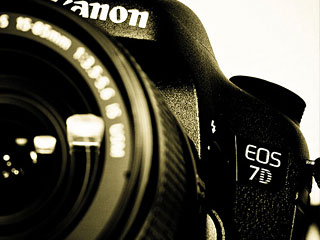
Earlier this month I had the opportunity to spend some testing time with a collection of Canon 5Ds and 7Ds that belong to one of my clients. I learned a couple of thing that others may find useful.
Formatting cards
The format of the cards is different in the 5D and 7D. Each of the cameras will read and write to a card formatted on the other model but it appears to be ill-advised. The differences slow down the write performance on either camera, the 7D in particular. The write performance, as evidenced by the “busy” bar on the display, definitely improves if the card is formatted directly on the camera it is intended for. We discovered this as were were switching cameras for lens testing and wanted to keep the files on the same card.
On a related note, just deleting files on a PC or Mac is also a bad ideal. Files on the flash media do not appear to actually get deleted, rather they are marked as deleted in the directory and the clusters can be reused. This causes old style file fragmentation on the card and appears to degrade write performance.
Card speed and type
The cards we were using on the shoot were fast but they were not UDMA cards. UDMA cards, in addition to being simply faster, also perform some of the disk io operations directly on the card. The standard cards do not do this so the CPU in the camera has to this work. This can increase the risk of overheating and in the worst case stall the camera. We tested outside in the bright sun and were able to repeatedly overheat cameras with non UDMA cards that performed fine when a UDMA card was substituted. This is particularly important on the 5D. It was also very evident when running in 60p for slo-mo on the 7D.
The performance difference also shows up in still frame motor drive mode. In the 5D we got 3 frames per second with the slow cards and 3.9 with the UDMA cards. On the 7D we got 6.5 frames per second on the old cards and the full rated 8 frames per second with the UDMA cards.
So, buy UDMA cards for video and save non UDMA cards for audio recording or low frame rate still photo use.
Part of a series of posts about up-and-coming artists, projects or movements across film, web, or design in cinema that go the extra mile for their audience.
Great work from Adrien Merigeau, Old Fangs is an animated short about three forest-friends going on a coming-of-age journey so one can confront the father he hasn’t seen since he was a child.
The film was an Official Selection in the 2010 Sundance Film Festival. It may be cute, but the story is adult and full of heartache and loss.
[UPDATE: Video at https://www.youtube.com/watch?v=q6sQTkt2xoU no longer available.]
An archive of our collective blog on creatives and their work in film, web, and design.
Browse our topics or explore the archive of 385 articles since 2007–2020.