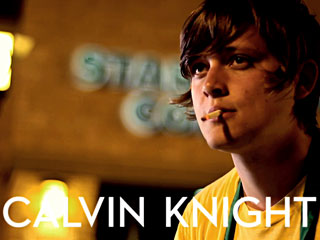
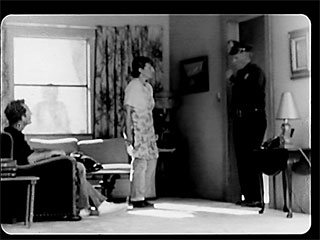
“Only when I made Coffee And Cigarettes, but even then, I would often write the dialogue the night before. Generally, my other films have had more of a conventional script, but I’ve always also been open to taking detours off the roadmap if they presented themselves and seemed strong. This is the first time I didn’t shoot with basically a conventional script.” — Jarmusch
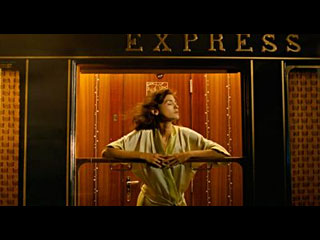
Released today (5/5, special for Chanel), the 2:20 spot was directed by Amelie filmmaker Jean-Pierre Jeunet, stars actress Audrey Tatou (who is also playing the role of Coco Chanel in the upcoming biopic “Coco avant Chanel”), and features Billie Holiday’s “I’m a Fool to Love You.”
Previous ads for Chanel have gone long, such as a 3-minute 2006 spot directed by Baz Luhrman and starring Nicole Kidman. (Making of also available.)
Wieden + Kennedy Amsterdam partnered with Vimeo.com to break the limits of the video player and gracefully take over the screen. (Making of also available.)
[vimeo]http://vimeo.com/4281939[/vimeo]
Best experienced on Vimeo rather than the embed above.
Back in 2003, Honda had a 2-minute spot called “Cog,” directed by Antoine Bardou-Jacquet and created by Wieden+Kennedy London.
Trumping their new 21:9 television, this Gotham-inspired seamless film directed by Adam Berg and created by Tribal DDB and Stink Digital. Online, the user interacts with playback slightly more than usual: to freeze frame, to jump over to a making-of examination of three key moments, or to play as normal.
You can also view the film at Stink Digital (link no longer available).
Previously, Philips had Wong Kar-wai do a long-form ad for their Aurea television, “There’s Only One Sun.”
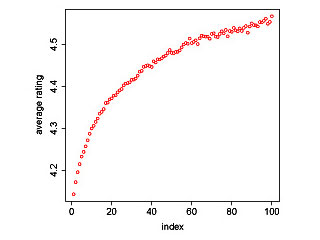
Figure 5: (a) Average rating of videos with different submission index. A producer’s first video has index 1, second video has index 2, and so on. Source
According to new research highlighted in the MIT Technology Review, as a result of the quantity of user-generated content, the odds of making the top percentile any given day is a game of collective attention, independent of quality or quantity.
“[A]n analysis of the production histories and success dynamics of 10 million videos from YouTube revealed that the more frequently an individual uploads content the less likely it is that it will reach a success threshold. This paradoxical result is further compounded by the fact that the average quality of submissions does increase with the number of uploads, with the likelihood of success less than that of playing a lottery.”
In today’s “attention economy” as a content-producing filmmaker interested in audience and profit numbers (but often not responsible for marketing any of it), I think success can be defined in two new ways:
Success: not just making it to the top of the charts, but doing it again (and again)
Success: not just high numbers (views/popularity), but long-tail numbers (followers/subscribers)
I also think I’m motivated to game the crowd by doing one or both of the following:
Deliberately stagger the release of each work and then promote the hell out of each effort, preferably on a single, momentous day
Be unpredictable, specifically in terms of timing, subject and/or tone, while staying true to industry-grade professionalism and a kick-ass personal standard
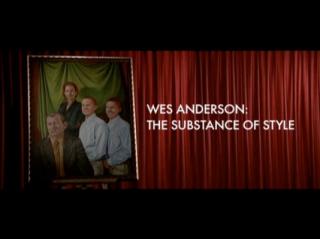
Moving Image Source, a web project from the Museum of the Moving Image, posted the final installment of “The Substance of Style,” a 5-part video essay analyzing Wes Anderson’s key influences.
Focused on “the alchemy of creation,” author/narrator/editor Matt Zoller Seitz breaks it down:
Part 1: Bill Melendez (“wisdom and naivete of Charlie Brown”), Orson Welles (“decline and failure … dynamic and often flamboyant visuals”), and François Truffaut (“fascination with childhood and it’s persistence in adulthood”)
Part 2: Martin Scorsese (“slo-mo to italicize … God’s-eye-view insert shot … whip pans that split the difference between first person and third”), Richard Lester (“buoyant, engaged editing”), and Mike Nichols (“generic structure with nearly unlimited emotional range”)
Part 3: Hal Ashby (“ability to jump from genre to genre with impunity and to make almost any situation seem perfectly natural”)
Part 4: J.D. Salinger (“self-aggrandizing lost soul … neurotic, depressive, hyperachieving”)
Part 5: Prologue to The Royal Tenenbaums, annotated
Related, check out the director’s consistent use of the typeface Futura, created by Paul Renner in 1928 and widely used in the 1960’s. Not just in most of his film’s opening titles but also throughout the art direction, which typographer Mark Simonson notes in screenshot form. Director Stanley Kubrick was also a fan of the font.
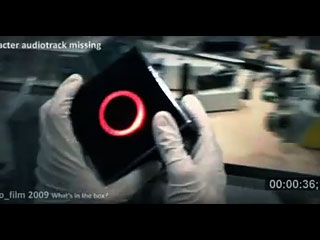
What’s In The Box?, a short “demo” from Tim Smit and Steven Roeters, may be a glorified homage to the popular video game Half-Life. But it’s an awful good one.
In case you haven’t heard, with just a 9-minute video and recently a mysterious official site, it’s been a viral hit for the last month. Clocking the success on just the YouTube embed (above), it’s been seen by over a million and counting.
But there’s more than just a one-off video. With “Box,” there’s a whole story behind the “magic box” and “Babel Research” which involves cryptic images, jumbled audio and fake sites that require some serious deciphering.
Fortunately for you and your spare time, it’s all pretty exposed now. Of all the crowd-sourced sleuthing online — pages and pages worth at UnFiction and Gizmodo — the posts at Wikibruce and The Sudden Curve have the most complete research and walk-thru of all the images, sounds and links.
Related, the project is similar in style as J.J. Abrams’ 2008 film Cloverfield, whose marketing strategy included planted viral videos online prior to the film’s release. Abrams also talked about a “mystery box” at TED; “Box” apparently borrows some of the sounds from the TV show “Lost,” which Abrams co-created.
In an anonymous comment on BoingBoing, according to a Dutch TV report, the project began as a hobby and ended on a budget of 150 Euro. “[I]f you can do this with 150 euro imagine what he could do with a multi million dollar budget.”
Smit and Roeters are Natural Science students at Radboud University in the Netherlands.
With just a trailer shot last weekend, the buzz blitz is on for the Searching for Sonny, a new action/comedy live-action feature yet-to-be-filmed on the Canon 5D Mark II, the 21.1-megapixel DSLR that shoots 1920 x 1080 video in H.264 format.
Of course planning a feature and finishing a feature are vastly different. Stop-motion films like Coraline were shot digitally (using Redlake 4K DSLR camera with Canon lenses), but regardless of who’s first, it’s already blowing up online. Popular tech blog Engadget and others were on the horn this morning.
(Since time of original publication, film trailer is unavailable.)
Check out the comments on Vimeo for some Q&A with the filmmakers, now that tens of thousands of people are watching the trailer there.
The camera, which questioned everything when it came out in November 2008 for just about $3k, has it’s share of problems, much in the same way as the Red did (and still does). For “Sonny,” they had to shoot in 30p instead of 24 and used an adapter to use Nikon lenses, getting around a focus and aperture problem. The production also recorded sound separately, though the 5D has a mono-channel microphone.
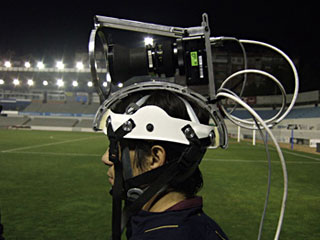
Let’s say you’ve got a gig that involves a camera rigged to a helmet for some point-of-view dynamism. (I do.) Where do you go if your web or your rolodex doesn’t have the answer?
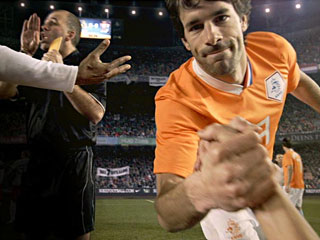
Turn to a professional online community like the CML (Cinematography Mailing List), a list since 1996 originally for 60 cinematographers created by Geoff Boyle. (They now have over two dozen lists, “4 with over 4,000 members and 17 with over 2,500 members worldwide.”) Mix that caliber of group with Guy Richie’s 2-minute Nike Soccer spot, “Take It To The Next Level,” which epitomizes the use of modern helmet-rigged, first-person perspective camera work:
(View it bigger at Nike.com.Update: Nike no longer hosts the spot.)
How about some answers from the camera crew? No problem. Check out these excerpts from a four-day flurry of messages:
Sun, Feb 15, 2009 at 2:59 PM — D A Oldis wrote:
One of my clients saw a Nike soccer spot directed by Guy Ritchie. (Soccer spot for U.S. readers. Football spot for everyone else.) … The client wants me to shoot something similar. … Does anyone know how they mounted the camera onto the player’s shoulder? If so, using what kind of rig and what camera/lens?
Sun, Feb 15, 2009 at 3:37 PM — Jason Rodriguez (Post Production Artist, Virginia Beach, VA) wrote:
That Nike spot called “Take it to the next level” was shot with an SI-2K MINI mounted to the head of the player.
You can read more information here: http://axisfilms.co.uk/news…
Sun, Feb 15, 2009 at 5:48 PM — Mitch Gross (Applications Specialist, Abel Cine Tech) wrote:
The spot is all digital. The vast majority of it shot on an SI-Mini mounted to sit right in front of the operator’s face. There’s one high speed shot done on the Phantom HD and some stadium background plate from an Arri D-21. It’s a great spot posted through The Mill.
Mon, Feb 16, 2009 at 10:24 PM — Jason Rodriguez (Post Production Artist, Virginia Beach, VA) wrote:
So the player carried (“backpacked”) the laptop while on the field? No issues with lost data from the jostling?
Keep in mind that in addition to the SI-2K MINI’s optional ethernet tether to a remote recording station, there are now readily available options for solid-state recording that strongly mitigate the risks of data-loss incurred during physical activity when compared to normal mechanical hard-disk drives.
Mon, Feb 16, 2009 at 7:40 AM — David Higgs BSC (London) wrote:
One of my clients saw a Nike soccer spot directed by Guy Ritchie. (Soccer spot for U.S. readers. Football spot for everyone else.)
I shot this spot. It was 95% shot with helmet cam, the camera being an SI-Mini tethered to a laptop. Quite complicated to monitor “live” as well, and quite heavy on crew levels. It always seems to be two people per laptop. Though it looks “cheap” in practice it isn’t.
Tue, Feb 17, 2009 at 7:11 PM — James Eggleton (Imaging R&D, Digilab London) wrote:
I was one of the two SI-2K camera techs on the Nike commercial, so I thought I’d wade in…
The brief was to allow the “hero” footballer complete freedom to run around the pitch.
Our solution was to put all the recording equipment in a rucksack that could be worn by the footballer, and control everything by remote control from the edge of the pitch.
It proved a little difficult to run whilst wearing both the helmet cam and the recording rucksack, so the footballer wore the helmet, while a Grip trailed very closely behind wearing the recording rucksack.
The recording system… A heavily customized baby-carrier containing:
2.6Ghz Macbook Pro laptop (running Windows XP and the Silicon DVR recording software)
DVI->CVBS converter, to convert the monitor output of the laptop to composite video.
CVBS video transmitter and 2 aerials, to send a live video feed to video village.
Fast Compact Flash card writer.
IDX 12V battery to power the transmitter and camera head.
20ft cable loom to provide power and data connectivity to the SI-2K camera head.
Two complete recording systems were built so that one could be off the field being rigged while the other was in use. … We used the highest quality Cineform RAW compression setting that was available. All data was recorded to 8GB Compact Flash cards (slotted into the card writer in the backpack), giving us about 7 mins of recording time per card. There were 8 compact flash cards that were cycled during the shoot. It would not have been possible to record to hard drives due to the intense shocks and vibrations.
It was an extremely challenging shoot, primarily because we were completely reliant on wireless communication. Great fun though.
Wed, Feb 18, 2009 at 11:38 PM — Peter Marsden (Film & Digital AC, London, United Kingdom) wrote:
I was the other SI-2K camera tech on the Nike commercial alongside James.
I have a selection of pictures from the shoot here. [Editor’s Note: links no longer available.]
Since Nike, I have done two more commercials in the similar style, one for the British Heart Foundation with David Higgs — http://www.2minutes.org.uk. We used the ‘Nike Helmet’ but it was a much simpler setup, no fancy wireless required.
“7 Days in the Navy” spot Client: Royal Australian Navy Camera: SI2K Gear: Lemac Australia DP: Nigel Bluck Focus: Peter Marsden Data: Tim Schumann
…
One thing not mentioned yet is lenses. For Nike camera tests, Kinoptic 5.7 was used, but it was decided that it difficult to get the camera mount shimmed properly to get it sharp. Next came the Century 6mm, which with a bit of effort a camera mount was shimmed (it was done on location without a collimator). After two days, some of the new Arri Ultra 16 primes arrived, and we never looked back. Most of Nike is the 6mm, and some 8mm shots.
…
Hope this all helps!
Yes, that does all help indeed. Never stop learning and cheers to the power of professional, online communities.
LOVE this newyorker article putting low budget hipster films into genre of “mumblecore” cinema:
You’re about twenty-five years old, and you’re no more than, shall we say, intermittently employed, so you spend a great deal of time talking with friends about trivial things or about love affairs that ended or never quite happened; and sometimes, if you’re lucky, you fall into bed, or almost fall into bed and just enjoy the flirtation, with someone in the group. This chatty sitting around, with sex occasionally added, is not the sole subject of “mumblecore,” a recent genre of micro-budget independent movies, but it’s a dominant one. Mumblecore movies are made by buddies, casual and serious lovers, and networks of friends, and they’re about college-educated men and women who aren’t driven by ideas or by passions or even by a desire to make their way in the world.
…
[T]he style wasn’t named until 2005, when the sound mixer Eric Masunaga, having a drink at a bar during the South by Southwest Film Festival (SXSW), in Austin, used the term to describe an independent film he had worked on. The sobriquet stuck, even though the filmmakers dislike it. In the films I’ve seen, however, the sound is quite clear. It’s the emotions that mumble.
When film reached it’s 100th anniversary in the late 1990’s, a Frenchman who had an original Lumiere Brothers camera had an idea to involve 40 filmmakers from all around the world in a creative collaboration. But they were given the hand-cranked wooden camera to shoot within certain restrictions:
55 seconds of single-sprocket, acetate 35mm film
3 takes
Natural light
Non-sync sound
Cannot stop the hand-crank camera
Famed writer/director/producer of television (“Twin Peaks”) and film (“Mulholland Dr.,” “Lost Highway,” “Eraserhead”), David Lynch, came up with this short [NSFW]:
https://www.youtube.com/watch?v=LvWAonuoMaY
His commentary is also available to watch:
https://www.youtube.com/watch?v=eknapHWJ1Ws
The end result was a feature film called “Lumiere & Company,” released in 1995. It’s also available on the DVD, “The Short Films of David Lynch.” For comparison, check out some of the first films from 1895 by the Lumieres:
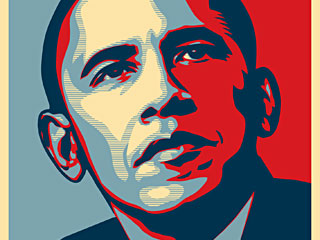
I just listened to Terry Gross’ interview with both Shepard Fairey and the photographer (an AP stringer, Mannie Garcia) that took the photo that Shepard used to make his Obama HOPE poster. The situation is getting pretty interesting. The AP demanded Shepard pay for his use of the photo, Shepard agreed but when the AP demanded royalties PLUS damages. Shepard instead decided to file a preemptive lawsuit, claiming he used the photo under the copyright Fair Use Act. On the other side, Mannie Garcia is also having a legal battle with the AP over who holds the original copyright, and therefor who is allowed to profit from it.
My opinion is conflicted, because although my selfish initial reaction is that the rights of the photographer should be protected no matter what, I really think that Shepard has a strong case, for the following reasons:
He digitally modified the photo and then hand drew the poster.
He took all of the proceeds from the poster and put them into the Obama campaign and making more posters, which questions whether or not it was a commercial application.
He changed the INTENT of the photo. The original photo was news coverage of a press event with George Clooney about Darfur, Shepard clearly was making a bigger political statement.
But most importantly, he didn’t diminish the value of the photo. In fact, the absolute opposite: the National Portrait Gallery asked to hang the original Mannie Garcia/AP photo (next to Shepard’s poster, already hanging), and according to the interview, the Danziger Projects gallery in NYC is selling signed prints for a “handsome sum.” (I tried finding out how much, but couldn’t.)
If it wasn’t for Shepard, that photo would’ve been just like thousands of others, and fallen into obscurity. If anything, I think Mannie should be sending Shepard one hell of a gift basket.
It’s a pretty interesting interview if you have any interest in this situation. The interview was on Feb 27th. Listen to the interview on NPR.org or scroll down a little at learnoutloud.com.
P.S. Terry interviewed Shepard on Inauguration Day, which is a great interview too, but I can only find that one on iTunes.
About three decades ago, at Carnegie Mellon University in Pittsburgh, Professor William Chase and a postdoctoral fellow named Anders Ericsson posited an interesting theory. They argued that our innate talents — whether it’s playing the violin, winning at chess, or running a Fortune 500 company — aren’t really innate at all. After many years of research and conducting dozens of experiments, they concluded that the individuals we perceive as “geniuses” — Mozart, Tiger Woods, Itzhak Perlman, to name a few — become who they are through “deliberate practice,” not thanks to some miraculous higher power.
That means thousands and thousands of hours of hard work. Tiger Woods wasn’t born a gifted golf champion. His father, a pro golfer himself, started training him at age three. Mozart’s music wasn’t merely handed down to him by God; the composer rewrote his music numerous times, trying to perfect it as he went along. Violinists like Itzhak Perlman accumulated at least 10,000 hours of practice in 10 years before he finally mastered his art. In one study, Chase and Ericsson proved that great memory can be cultivated — anyone, at any level, can improve their memory skills, not just math wizards and chess players.
It doesn’t take a genius to understand that no one succeeds unless they work hard. But what separates the “ordinary” people from so-called “gifted” people, Chase and Ericsson suggest, isn’t some magical inborn quality; it’s deliberate practice. According to Geoff Colvin, author of the book Talent is Overrated:
Deliberate practice “is designed specifically to improve performance, often with a teacher’s help; it can be repeated a lot; feedback on results is continuously possible; it’s highly demanding mentally, whether the activity is purely intellectual, such as chess or business-related activities, or heavily physical, such as sports; and it isn’t much fun.”
Deliberate practice equals high performance. I understand now why many of my teachers believed I was a “gifted” writer and artist. But my talents weren’t gifts bestowed upon me at birth. I was a good writer because I wrote every single day — journals, essays, school newspaper articles, letters — I even created newsletters that I sent to one of my cousins regularly. I started my first collection of short stories in second grade. And I excelled at art because, at 6, I began drawing pictures on a regular basis. I was practicing deliberately without realizing it.
In retrospect, it makes sense why, in film school, my editing and shooting assignments often stood out (one of my professors once told me he had no doubt that I would one day “make it”). Prior to film school, as a teenager, I shot and edited numerous silly little short films; I volunteered at a local broadcasting station and taught myself video production; during my spare time I wrote dozens of awful screenplays. I didn’t wait until film school to learn the craft of filmmaking.
My point here isn’t to boost my own ego. Far from it. For the last few years I’ve been racked with self-doubt and uncertainty about my future. I’ve never had any doubts about my own talent, but here’s what I’ve realized: I haven’t been working hard enough. And you out there, whoever is reading this: keep working your ass off. Double the amount of time you spend on pursuing your dreams. Stop wallowing in fear and laziness. Surgeons don’t become surgeons after a year of med school; it takes up to 10 years. It’s a mistake to believe we can achieve overnight success simply by wanting it. You’ve gotta get out there on the field and train like crazy. We may never truly know where talent comes from, but what we know for sure is this: deliberate practice pays off.
—
Updated: A perfect example of deliberate practice, “Assassin’s Creed short film His Final Hit:”
Adrian Picardi is a young filmmaker who directs, shoots, and edits his own films on a consistent basis. He is 21 years old. Watch this film. He does not work for a Hollywood studio. His films are all independently produced. There is absolutely no doubt in my mind that Adrian will become famous before he’s 30.
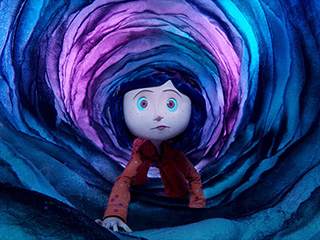
This Valentine’s Day weekend especially, hundreds of tweets were posted about “Coraline.” These text messages via Twitter say a lot with a little about the biggest little film in theaters.
Neil Gaiman, author of Coraline, is on there:
Interviews over. Getting ready to leave for CORALINE screening. Irish journalists remain my favourites in the world: actual conversations. — neilhimself, 2/15 tweet
Comedian Demetri Martin chimed in:
Flashmob at Arclight for 3D Coraline? Bring buttons for your eyes. Black is traditional. — DemetriMartin, 2/12 tweet
Jon Hodgman, actor, also uses Twitter. One of the tweets at Hodgman:
@hodgman have you seen it yet? The bloke playing the father is really good. You should check it out. — neilhimself, 2/8 tweet
Little details that often chime up on Twitter:
tinycoincidence dept — noticed this evening that I signed the CORALINE movie contract on Feb 7 2001 – 8 yrs to the day before it came out. — neilhimself, 2/8 tweet
Coraline opened on the 6th:
Good morning world. Um, if you don’t have plans today there’s a film called CORALINE you should check out, trust me on this. — neilhimself, 2/6 tweet
Now consider a second (or first) ticket. I get no extra $ from your ticket. But it sends a message that America is hungry for Gaiman/Selick — hodgman, 2/6 tweet
Originally, part of the marketing of the film was to send 50 hand-crafted boxes to 50 craft-savvy and film-friendly bloggers. Each mystery box also had a clue to access Coraline.com, which at the time needed a password to access. (They ended up being stopmotion, buttoneyes, puppetlove, armpithair, moustachio, and sweaterxxs.)
A fabulous campaign for ‘Coraline’ – 50 individualized boxes for bloggers with unique trinkets from character creation. http://bit.ly/HcB3 — eDougherty, 2/9 tweet
And today marked the last day of the 3-week exhibit at San Francisco’s Cartoon Art Museum, which featured nearly 80 props created by over 300 artists:
At the cinema and the Cartoon Art Museum for an awesome day of Coraline. The craftsmanship is truly inspiring- great fodder for kinetic art! — mprados, 2/15 tweet
Finally released into the YouTube HD wild — the Koumpounophobia Trailer (the one with me talking about buttons) http://bit.ly/msLe — neilhimself, 1/29 tweet
An archive of our collective blog on creatives and their work in film, web, and design.
Browse our topics or explore the archive of 385 articles since 2007–2020.