FWD:labs

Blog

  • Published in Film + Web

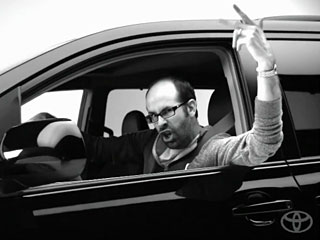
Toyota’s latest commercial campaign ups the ante to sell the minivan as an object of desire, not just necessity, by emulating a hip-hop video. It’s hard to imagine behavior like this getting anything but laughs in reality, but will this peddle minivans? I betcha it puts a demographic or two over the fence.

“Swagger’s” director, Jody Hill, is behind HBO’s “Eastbound & Down” and the film, “Observe and Report.” His story is pretty empowering: after starting as a PA in Los Angeles with dreams of directing, he left town where he had better opportunity to do his own work, starting with “The Foot Fist Way.” Success with the feature reached Will Ferrell and Seth Rogen, who brought Hill back, now above the line.

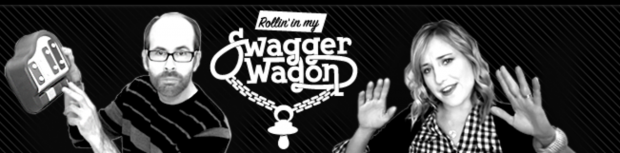
Banner at ToyotaSwaggerWagon.com [NO LONGER ONLINE]

Complete with extra videos on YouTube [NO LONGER AVAILABLE], the self-described “self-absorbed” couple is the center of this campaign from Saatchi & Saatchi Los Angeles. The microsite [NO LONGER AVAILABLE] plays along by offering up the MP3:

With lyrics like “Where my kids at? / No, seriously honey, where are the kids? / They’re right there, see? / Oh, cool beans,” it’s nice to see the recall-ridden company having fun improving its image.


Toyota “Swagger Wagon”
Actors: Brian Huskey, Rachel Drummond
Agency: Saatchi & Saatchi, Los Angeles
Client: Toyota
Executive Creative Director: Mike McKay
Director: Jody Hill
Creative Director: Erich Funke
Production Company: Caviar Content
Associate Creative Director: Donnell Johnson
Copywriter: Donnell Johnson, David J. Evans V
Art Director: Stephan Baik
Director of Integrated Production: Tanya LeSieur
Director of Multimedia: Tanya LeSieur
Broadcast Producer: Karena Dacker, Gil DeCuir
Senior Integrated Producer: David J. Evans V
Executive Producer: Michael Sagol
Producer: Jasper Thomlinson
Editing Company: Butcher Edit
Executive Producer: Rob Van
Editor: Teddy Gersten
Assistant Editor: Amanda Elliot
Music: Black Iris
Mix Company: POP Sound
Mixer: Peter Rincon
Telecine Company: CO3
Telecine: Siggy Ferstl
Online Company: Butcher Edit
Online: Ben Looram

(via Mickey Finnegan)


Author

Aaron Proctor
Founder, FWD:labs
Director of Photography site
Contact


  • Published in Film

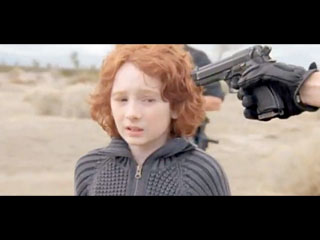
Today I came across M.I.A. “Born Free,” directed by Romain Gavras and shot by André Chemetoff. I was reluctant to watch in fear of choking on another “Slumdog,” but I clicked anyway, curious to see what Gavras has been up to since the Jus†ice “Stress” video.

At first I was blown away by the stunning visuals and use of motion. I was also taken back by what seamed like random apartment raids and acts of police brutality. The lack of plot had my mind racing in all directions as I tried to figure out what was happening. The simplicity of each characters’ motivation put the visuals on a pedestal as very delicate soundbites weaved in and out of another blah M.I.A. song.

When the plot kicks in, it takes the video in a whole different direction. The reality of police brutality and genocide mixed with a white trash ignorant America steams with controversy. But once you look past the “redhead” cliche, dimly lit plot, and the novelty of violence, all you have is a series of beautifully choreographed scenes. And without the touch of André Chemetoff this would have been another film school thesis.

[NSFW]

[vimeo]http://vimeo.com/11219730[/vimeo]


Author

Chris Cuseo
Visual Artist
Website


  • Published in Film + Web

Hulu just announced a monthly fee of $10 to view part of their video portal:

  • Cost is a dollar higher than a basic NetFlix account, which provides a larger archive of disc and streaming media, plus an 11-million strong subscriber base (according to a onetrack.com whitepaper in 10/2009)
  • Quantity of advertisements on Hulu is slated to increase, not decrease, to be similar to the quantity on broadcast television
  • Subscription fee unlocks older episodes, rather than allowing users to see new episodes earlier or another kind of exclusive; right now a show is posted a whole day after its aired on television
  • Torrent and other bootleg sources make watching television shows for free (and often ad-free) easier than ever
  • Inventory is still slim and broadcast network-centric, whereas paying a cable bill gives you hundreds of options all day and night
  • “Train viewers to pay” is a statement mentioned in the Los Angeles Times report, but they’ve got it backwards: consumers have the upper hand online (see: “you” in YouTube)
  • Each show’s last five episodes is still free on Hulu
  • Most of Hulu’s offerings are locked to U.S. viewership only

Some recommendations for Hulu:

  • Compete with cable/dish providers by providing DVR-influenced ad-free experiences for paid subscriptions
  • Compete with series DVDs, where you can catch up on past seasons of a show, which follows the lead of some NetFlix offerings; follow the lead of TBS, as noted in recent New York Times coverage
  • Play nice with the Wii and other systems like Roku that can deliver HD media to your television; MediaPost has some coverage on NetFlix’s success with cross-platform usability on the Xbox 360, PS3, Apple TV, and Apple iPad
  • Provide ad-free and improve quality, offline viewing in order to one-up torrent downloaders
  • Figure out a way for the actors and crew to get paid fair royalties for all this

Time will tell if this is a successful business model for Hulu, which has $100 million in revenue from advertisers. Popular shows like The Daily Show and The Colbert Report are streamed on their official web sites and left Hulu about a month ago. Will NBC, ABC, and other network sites who stream their shows start charging?


Author

Aaron Proctor
Founder, FWD:labs
Director of Photography site
Contact


  • Published in General

The Gift by Carl Eric Rinsch

Philips TV partnered with Ridley Scott Associates (RSA Films) to make five films for their Parallel Lines project, which promotes their 21:9 aspect ratio television.

  • “The Hunt” by Jake Scott
    Watch on YouTube
  • “Darkroom” by Johnny Hardstaff
    Watch on YouTube
  • “The Gift” by Carl Eric Rinsch
    Watch on YouTube or below
  • “El Secreto de Mateo” by Greg Fay
    Watch on YouTube
  • “Jun and the Hidden Skies” by Hi-Sim (Chris Hawkes and Cheun Hung Tsang)
    Watch on YouTube

45 RSA directors submitted treatments. Five were chosen. Each uses the same lines of dialogue:

What is that?
It’s a unicorn.
Never seen one up close before.
Beautiful.
Get away, get away.
I’m sorry.

You can watch each full screen at philips.com/cinema and a customized YouTube channel page, each which uses the Ambilight effect that Philips offers with this line of television.

https://www.youtube.com/watch?v=XOZkLIwbRrw

This is part of a campaign from DDB London / Tribal DDB Amsterdam. They’re also hosting a competition to “tell it your way” using the same dialogue, using YouTube as a submission platform. Behind the scenes content is hosted on Facebook.

This is a follow-up to Philips’ 2009 project with director Adam Berg and Tribal DDB / Stink Digital called “Carousel,” which we covered in “Breaking New Boundaries with Cinematic Ads.”


Author

Aaron Proctor
Founder, FWD:labs
Director of Photography site
Contact


  • Published in Film + Web

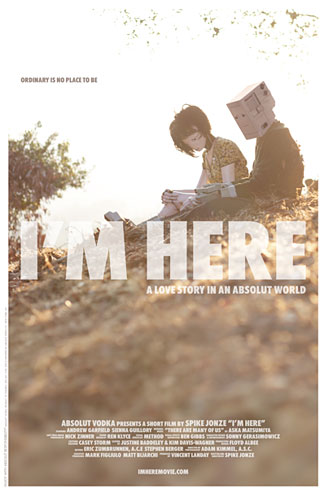
Spike Jonze was tapped by Absolut to make a short without their product.

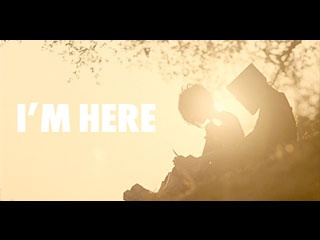
You’re in front of your computer, logged into a social network and savvy to instant messaging throughout your day. But the luxury of viewing a film with others at the same time is an experience left mostly for you at your local movie theater. Lately, that’s all in flux. Take the latest short film from Spike Jonze, I’m Here. As explained on the film’s Tumblr, there’s a theater-like experience to see the film before it’s “sold out” for the day:

“Social media functionality makes it possible to watch the film together with Facebook friends, and the cinema experience is highly realistic. But hurry on, the cinema only offers 5,000 seats a day. … Due to enormous interest in watching I’m Here at Imhermovie.com ABSOLUT [the film’s sponsor] has decided to increase the capacity from 5,000 to 12,000 viewers a day. Last weekend Imheremovie.com had 230,000 unique visitors, which was far more than expected.”

User Experience

Missing is the expected player-with-a-chat-window, which isn’t a realistic joy of your normal cinema experience anyway. In its place, via Facebook Connect, is a simple way to select ten Facebook friends (who are over 21) to be notified that you’re watching the film and “join” you. There’s no sensitivity to whether your friends are online or off and the social experience is a post to your wall.

One clever bit is when the site uses your Facebook profile picture to show you a more personalized “ticket,” along with generic first-person video of going into and out of a movie theater. One annoying control is the icon on the top right of the film’s player, which should have been marked an “exit” sign.

Time-Sensitivity

I believe the per-day limit provides a pleasant sense of urgency and timeliness, just like how a film has a certain theatrical run. The real benefit that’s uniquely online, however, is fostering community and cultivating conversation. Great for any product, large or small.

Take major events on television as another example. You’ve got a whole lot of people plugged into the grid at the same time of broadcast as, say, the Inauguration or the Super Bowl or the Oscars. Unless it’s strategically streamed live or semi-delayed on official sites or big players like CNN, Facebook and YouTube, the conversation is secluded to rooms on USTREAM and tweets on Twitter, all before old media catches up to meet the demand for content.

Movie Marketing Madness (link no longer available) publisher, Chris Thilk, recently wrote about the social viewing of such major events and how networks like PBS and MTV are looking online to curate timely conversation about their work:

“A higher level of engagement by the audience means more people are tuning in. Just like people are more inclined to watch a football game they otherwise have no interest in if they’re going to be in a crowd of friends, if you know people are going to be chatting on Facebook you may be more likely to tune in. And the benefits for those who are engaging in these chats is similarly obvious: They get a sense of community and the camaraderie that comes with watching something with others, even if those others are only watching it with them virtually.”

What’s Next

Give a listen to Chris Adams, who helped Participant Media become a “platform for change,” is now President/CEO of another venture, View2gether, which coined the term “social viewing.” Over a year ago, ABC tested out “viewing parties” with one show, “Greek,” where View2gether provided the platform. (Aside: NewTeeVee.com reports a party averaged 15 people.) His talk on fora.tv cuts to the chase:

“Video viewing is very linear. Video sharing is very linear. I see a video and say, hey you’ll love this. Send it off. A minute, a day, never later you look at it, you hate it, you like it. I may get a response back. The evolution is to take all of these social networking tools and create synchronization, so everybody is watching the video at the same time. They’re chatting against it. … It’s not about getting your friends together. It’s not about me and ten of my friends coming together and watching something. I may like UFOs. You might not. So am I going to recruit and haze you into a UFO lounge? No. I want to go to a UFO lounge where there’s other idiots like me. And I can chat about it.”

Next up for View2gether is to make users their own video programmers for MTV, an experience I found needs much improvement. Next up for Participant is continuing their TakePart.com microsites, like the Oscar-winning documentary The Cove, which is less about immediate social chatter as much as real-world social action.

And what about filmmakers with a sponsor who doesn’t require a product shot? ADWEEK has the lowdown:

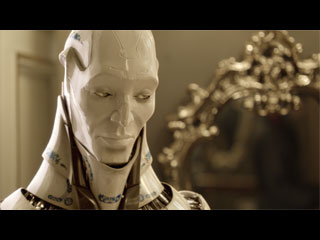
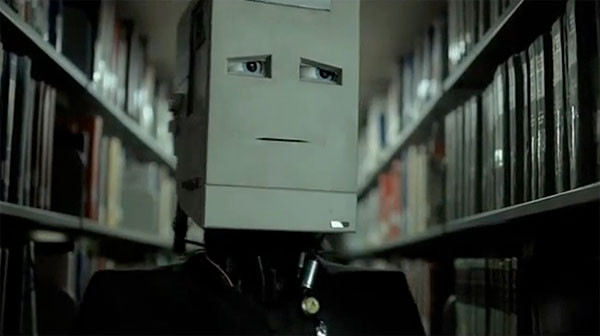
“‘This is an emotional expression of the brand,’ says Anna Malmhake, vp, global marketing at Absolut. ‘None of us could see what a shot of the vodka would have added.’ … The agency briefed Jonze on the strategy, brand values and history, and he wrote the script. … Set in a not-too-distant future where humans and robots are learning to co-exist, the film is part of the agency’s larger ‘In an Absolut world’ campaign, which has the tag ‘Ordinary is no place to be.'”

We’ll take more, please.


Author

Aaron Proctor
Founder, FWD:labs
Director of Photography site
Contact


Part of a series of posts about active artists with the tenacity to take their project to completion.

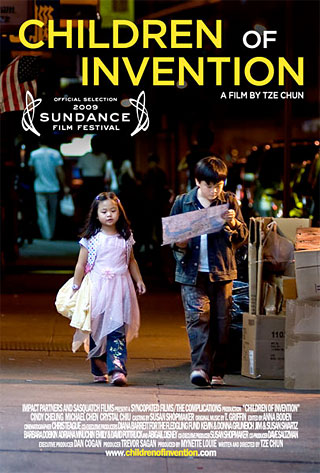
“Children of Invention,” screening this week in Los Angeles and New York, is a product of a 10-month hustle from first draft to its 2009 premiere at Sundance.

Writer-director Tze Chun, who did eleven no-budget shorts before having a short at Sundance two years prior, made all the right moves before going into Park City with his feature. He hired Anna Boden (writer/producer/co-director/editor of “Half Nelson”) to edit during their 25-day shoot to make Sundance’s extended deadline as well as bringing on other professionals to rep the film and to handle publicity.

Chun’s team also included a regular collaborator, acting coach and assistant director Sheila Dvorak. Together they’ve worked nearly a dozen times, literally as a two-person crew with her on the boom and Chun on the camera.

But without a solid distribution deal for this acclaimed film, Chun’s team has since been well on the way to recoup the under-$500k budget by self-distributing the film: they’re selling DVDs online via IndieBlitz and at their select screenings across the country.

From the interview with Film Independent:

“They knew that everyone responded well to the kids’ performances and they would become festival discoveries, so they decided to exploit that angle. Tze [Chun] designed a poster with both children on it, and [David] Magdael approved the design and the two young actors were brought to Park City and were in attendance at every screening. … While touring the festival circuit, Mynette [Louie] and Tze decided to sell DVD copies of the film themselves after consulting with Peter Broderick and Ted Hope, and getting encouragement from their investors. They designed and made DVDs (for around $1 each) to sell after festival screenings. Additionally, Mynette designed an online store on the film’s website to help push DVD sales. Ever committed to keeping costs low, their DVD sales efforts remain a two-person operation.”

From Chun’s D.I.Y. manifesto on the official site:

“As filmmakers, we need to be responsible and do everything we can to try to recoup the cost of making our films — we owe that to our investors, cast, and crew. If our little experiment works, great. If not, we’ll have some data that’ll help other indie filmmakers in the future, and hopefully get everyone closer to a distribution model that works. … People want to consume their media the way they want to consume their media, and that’s that. It’s more proof that the traditional release windows are becoming irrelevant.”

“Children of Invention” was also selected as one of the YouTube Rental films, a recent experiment in bringing Sundance films beyond the festival:

“And at 86 minutes long, it’s probably 85 minutes longer than most videos YouTube users log on to watch,” said Chun. “But we’re hoping that the YouTube audience, as well as viewers new to YouTube, will see this as a paradigm shift — we hope that they will come to the site to get immersed in a film for an hour and a half, and have the type of experience that one usually reserves for the theaters.”

From the article “10 reasons why they are glad they distributed DIY,” on Truly Free Film:

“We started selling DVDs at festivals immediately after Sundance. We found that about 10% of audiences will buy the DVD after each screening, and 20% of audiences will buy if it’s an Asian American fest. We’ve made back over 20% of our budget on the festival circuit by selling DVDs and collecting screening fees (another benefit of playing as many festivals as possible).”

For more information on upcoming and recent screenings, visit the official site.


Author

Aaron Proctor
Founder, FWD:labs
Director of Photography site
Contact


Part of a series of posts about great film, web, or design artists and their work abuzz online and in-person.

In its run-up to this year’s Oscar for Best Picture, “The Hurt Locker” is getting quite the push-around from both sides. Pundits either applaud its authenticity or frown its fictionalization. The New York Times published an essay, “How Not to Depict a War,” written by the photographer of a video following an explosive ordnance disposal team:

I understand the argument that Ms. Bigelow and her team should be applauded for tackling certain issues and bringing the war home to Americans. Yet with so many scenes and details untrue, the actual war in Iraq becomes merely a dramatic jumping off point for the filmmakers.

When a filmmaker gets that many details wrong, it’s hard to believe she got the war right. “The Hurt Locker” is not a drama about a make-believe event. This is a movie about an ongoing war that has affected millions, in which 100,000 Americans are still serving. It deserves a minimal degree of historical accuracy and attention to detail.

But also check out the opinion on the other side from regular columnist Meghan Daum in the Los Angeles Times:

Hollywood always plays fast and loose with reality. That’s why it usually makes dramas and not documentaries — and, let’s be honest, it’s also why Americans buy its products in such bulk. We’re not looking for facts; we’re looking for entertainment and (even at the movies) some deeper truth that art reveals.

In the end, the controversy over “The Hurt Locker’s” authenticity and its worth as an Oscar contender perhaps speaks less to the relationship between truth and fiction than to the relationship contemporary humans have to some mythical notion of “reality.”

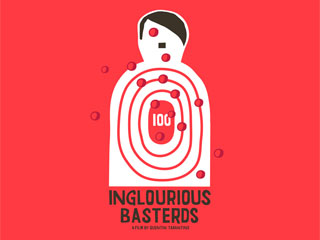
Upper Playground brought the Weinstein Company together with thirteen artists to interpret their own poster design for “Inglourious Basterds,” which is nominated for Best Picture, Best Director, Supporting Actor, Original Screenplay, Cinematography, Sound Mixing, Sound Editing, and Film Editing:

David Choe, Sam Flores, Estevan Oriol, Grotesk, Jeremy Fish, Patrick Martinez, Alex Pardee, Dora Drimalas, Munk One, N8 Van Dyke, Rene Alamanza, Morning Breath and Skinner Davis … create[d] their own poster art based off their interpretation of the film, “Inglourious Basterds” artwork. … Each print will be numbered and signed by Quentin Tarantino. Only six (6) of each amount will be made.

“Avatar” is up for nine Oscars and the James Cameron film is expected to pick up many. Harvard Business Review just published “Firing Is Too Merciful: How James Cameron Leads,” an insightful article by Rebecca Keegan, author of “The Futurist: The Life and Films of James Cameron.” Mantras like “good isn’t enough,” “break new ground,” and “lead from the front” work whether you’re rich and famous or not quite yet:

Cameron is almost comically hands-on. He does things elite directors don’t do — hold the camera, man the editing console, sketch the creatures, apply the makeup. The truth is, he would do nearly every job on a movie himself if he could. But any film, much less one as ambitious as Avatar, relies on collaboration. Forced to lean on others, Cameron sets the pace. Among his 3000-strong stable of artists and engineers, he’s the first to try a new challenge, the last to quit at the end of the day, and the hardest to please.

(Thanks to @GuyKawasaki for the Cameron link.)


Author

Aaron Proctor
Founder, FWD:labs
Director of Photography site
Contact


  • Published in Film

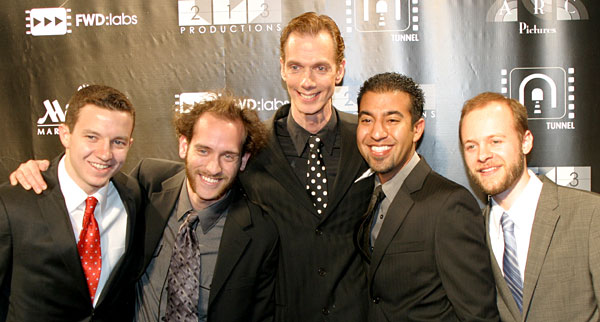
Chris Commons, James E. Roberts, Doug Jones, Jaraad Virani, and W. Alex Reeves at PROJECTIONS on February 18, 2010, which FWD:labs co-sponsored.

There’s a school of thought in business called the “Blue Ocean Strategy” which posits the following: instead of struggling to stake your claim in a crowded market space, create an uncontested market and thus render the competition irrelevant. This paradigm-shifting philosophy has succeeded in numerous industries, particularly for Apple with the iPod and Nintendo with the Wii. And while the Blue Ocean strategy has proven its efficacy in the world of commerce, could it also apply to art as well? I am more specifically referring to the exhibition of art, namely short films.

The film festival circuit, once the bastion of the hopes and dreams for burgeoning filmmakers, has quickly become an impregnable fortress of exclusion. Short films in particular have an incredibly challenging landscape to fight, survive, and succeed in as they must now compete with thousands and thousands of aspiring filmmakers and their labors of love, as well as star-studded shorts, big-name directors, and studio-backed features, all vying for the hearts and minds of hollywood players and audience members alike. What was once a daunting but potential-laden path has instead become a bit of a lost cause, with precious few shorts flourishing based solely on merit in an increasingly overcrowded marketplace.

So when I and three other filmmakers decided we were tired of waiting for someone to give us the opportunity to showcase our films, we chose to create such an opportunity for ourselves instead.

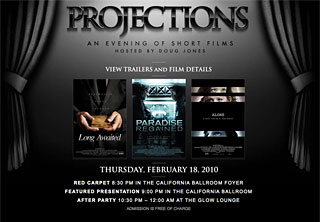
Last Thursday night at the Marina del Rey Marriott hotel we hosted “PROJECTIONS: An Evening of Short Films,” MC’d by Doug Jones (of “Hellboy” and “Pan’s Labyrinth” fame). It was a night planned, designed, and executed by filmmakers to showcase our work the way we’d always intended: no bloated playbill or sub-par viewing conditions, just 3 short films projected in high definition with properly EQ’d sound in a beautiful venue. The culmination of our efforts resulted in an unprecedented turnout with guests filling the 400-seat theater to capacity and overflowing into the aisles where over 100 more stood and watched for the entirety of the program. One stunned attendee remarked he had expected “a couple of fold out chairs in a basement,” not the slick red carpet, ample 16 foot by 9 foot HD screen, posh after party, and most incredibly, the over-500-strong crowd.

While I’m not suggesting our inadvertent creation of a “blue ocean” is on par with the examples listed earlier, what does matter is that the evening was a success in the most significant way to us as filmmakers: our films received the treatment and the audience they deserved. And that’s an opportunity that no one else could have or would have given us; we had to create it for ourselves.


Jaraad Virani
Member, FWD:labs
Directing site
Contact


  • Published in Film

Canal+ 'The Closet'

Part of their “Original Creativity” campaign, Canal+ has a history of developing original series, doc, and fiction content in-house, including writer Olivier Marchal (“36 Quai des Orfèvres”) and actor Jean-Hugues Anglade (“Léon,” “Nikita”). Here’s to encouraging the rest of us.

Canal+ “Wardrobe (The Closet)”
Director: Matthijs Van Heijningen
Production Company: Soixan7e Quin5e
Director of Photography: Joost van Gelder
Editor: Jono Griffith
Agency: BETC Euro RSCG, Paris, France
Agency Producer: Isabelle Ménard
Creative Director: Stéphane Xiberras
Creative: Eric Astorgue
Art Director: Eric Astorgue
Copywriter: Jean-Christophe Royer
Account Managers: Raphaël de Andréis, Alexandre George, François Brogi
Post Production: Mikros Images
Sound Production: Kouz Production
Advertising Managers: Beatrice Roux, Mathieu Mazuel, Fleur Ajavon
Original Title: “Le Placard”
Date of First Publication: 9/27/2009
Tagline: For you, we create extraordinary stories.

(via filmmaker Greg Auerbach)


Author

Aaron Proctor
Founder, FWD:labs
Director of Photography site
Contact


  • Published in Film + Web

Part of a series of posts about great film, web, or design artists and their work abuzz online and in-person.

Google Search Stories

I think we’re consistently making content with one goal in mind. Sometimes, after they’re put to bed, there’s a long tail of opportunity to find another audience.

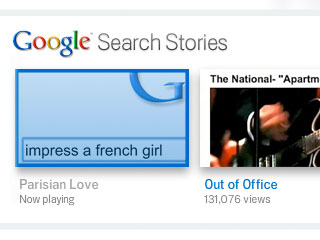
“Parisian Love” clocked a million views last month, so Google CEO Eric Schmidt let it rip on the Super Bowl telecast. “Be sure to watch the ads in the 3rd quarter (someone said “Hell has indeed frozen over.”),” said the advanced notice. Thousands of blog posts, comments, and tweets later, this video began as just one of a series of Search Stories, yet it resonated well beyond the web thanks to its simple message.

Embrace This PSA

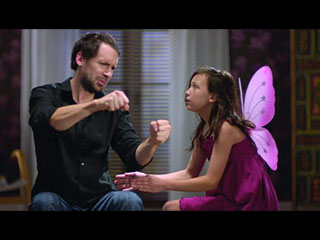
Another recent ad that skips out on talking heads is from Sussex Safer Roads Partnership. Creating a striking PSA is oft an unglamorous challenge, but writer/director Daniel Cox created “Embrace Life” to take on that challenge knowing the diversity of the audience.

According to the press release (link no longer available), he notes, “[o]ne key aspect to the storytelling is that we developed Embrace Life to be non-language specific, so that the message wouldn’t become lost when viewed by visitors to, or residents of, the UK where English might not be their first language.” With over 800,000 views online, the result is clearly viral with appeal beyond its original intent.

Nuit Blanche

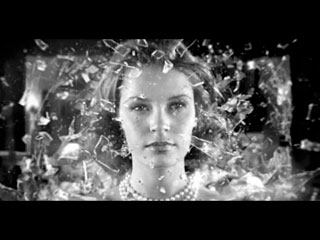
And then there’s “Nuit Blanche” by Arev Manoukian. Framed upon a simple moment in time, the short film uses slow motion to “explore a fleeting moment between two strangers, revealing their brief connection in a hyper real fantasy.”

In the making-of supplement, you can see how each shot comes together in post, using tools like Maya, Mental Ray, 3ds Max, V-Ray, Blastcode and instanced particles. Grand prize winner of the LG “Life’s Good” Film Festival, the Canadian-made film was completed in August 2009, but just this last week has been seen by over 70,000.

[vimeo]https://vimeo.com/9078364[/vimeo]


Author

Aaron Proctor
Founder, FWD:labs
Director of Photography site
Contact


Intelligentsia Series

Intelligentsia Series is 'an ongoing series that documents our search for the ultimate tastemakers.'

After working at Imaginary Forces with Kurt Mattila on Spielberg’s “Minority Report,” Matt Checkowski started his own production/editorial/vfx firm, The Department of the 4th Dimension. Between pitching against other ad agencies for work — and his own feature film projects, no less — he’s trying out a series of short-form content that feels right at home online. Listening to people who are passionate about what they do is engaging in its own right. Filming it with creative prowess and distinct visual style, now that’s something you’ve got to see, even if you’re not a coffee aficionado.

You came out of the gates from design school. How did that established your approach to filmmaking? Do you feel there’s a different process — say, considering things as form vs. function? With your film/tv partners, is it delivering pre-vis animatics/drawing and, with your brand/campaign clients, is it delivering modular options? Also, does it not matter where you start, but how you make it?

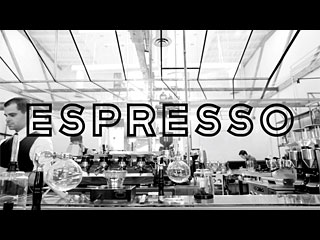
Matt Checkowski First off, thanks for even thinking about me for this chat. We connected through the Espresso short film and it’s amazing to me how the smallest things can open up connections online. It’s exciting.

There are a few things that are always in the front of my mind regardless of whether the project is “design” or “cinema,” and I imagine what’s left over after those similarities is what pushes a particular project into one category or the other.
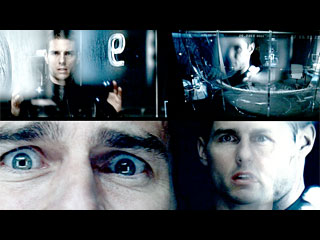
Minority Report

Screenshots from the work done on 'Minority Report'

The audience is up there on the list. Where are they sitting or standing? What will they be likely doing before and after they see what we’ve created? How are they going to engage with what we’ve done? In passing? Planted in a dark theater? Sitting at their computer? Why are they going to care? It’s really about contrast – in the service of grabbing attention and recalibrating our audiences point of view. This goes for the first 10 minutes of a film, television network branding, a website or an experience design project. I think a lot about the audience and how to reposition the context.

I read somewhere that someone said “Drama is more interesting than ideas,” and I like that. But I also like the ideas. They both serve different purposes at different moments. I’m stimulated by the concepts and the process and the possibility of ideas, but they’re meaningless to me if I can’t evolve them into something that inspires other people. I think the core motivation — be it an idea or a dramatic situation — is something that I sort out early on and needs to translate for the audience in order for the work to be successful.

I haven’t sorted out my final thesis on the overlap of design and cinema, but I know that my creative process is essentially the same for both. I will say that directing feature films has made me much more aware and appreciative of my audience and how they experience my work.

We pitch the hell out of projects and present as much as we can to sculpt this new world for our client and collaborators. Pre-viz, animatics, reference. Writing, concepts, stories. Each project is a multimedia extravaganza from the get-go.
You were at Imaginary Forces, then co-directed “Lies and Alibis,” and now do campaigns with ESPN Monday Night Football and Rock Band. How is your collaborative process on projects?

MC I collaborate like crazy. It seems that the key inspiration for each project tends to always come from an unexpected category. A branding project is built from a film excerpt. A virtual world starts with a photograph. That’s part of why I like working with really diverse teams at the beginning of projects. It opens the project up to new possibilities.

Sometimes the client doesn’t care about our crazy ideas, but that comes back to transforming those elements into something that is relevant for other people to spend some time with. More often than not, we’re sought out for this multidisciplinary process and thinking. It’s really how I think and thankfully it seems to be the way the world works now.
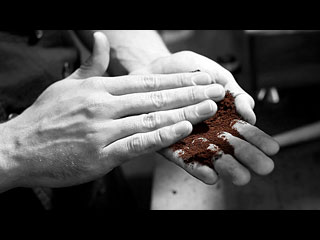
Where did the idea for the Intelligentsia Coffee short film series come from? Project on-the-side or clever commercial?

MC The short film series — the first three episodes of which are set at and about what they do at Intelligentsia — was just an original idea of mine whose time had come. Short, online episodes about beautifully designed objects or acts. I wanted to find people who were as obsessed about what they do as I am about what I do and hoped that passion would resonate with a broader audience. I’d been trying to get it off the ground for a while through a variety of different scenarios, brand or ad agency partnerships and nothing seemed to help it break through.

So we spoke with Kyle at Intelligentsia and just made it happen. It’s a crystal clear concept that just lets the star of the short do what they do best, without any logos or forced messaging getting between the story and you. We’ve got a ton of ideas for what to do next. I’m excited that people like it and hope that its early success will enable us to grow it wider and wider.

Two cameras, a Kino, color keying in After Effects and viola?

Yep. Super lightweight production process. Two Canon 5DMK2s. Tons of natural light and a small Kino. Then lots of love on the post side of things to really show-off the process and Kyle’s personality. The color treatment was tricky to execute but came from a simple spark: I loved the black and white footage but thought the coffee looked spectacular in color. It made so much sense with the story and I think that graphic treatment actually enhances the personality of our star. It’s the visual embodiment of his obsession.
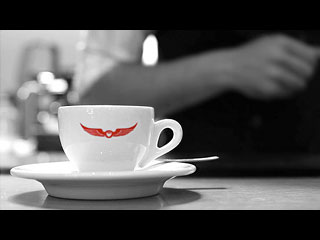
The series feels right at home online, with viewers discussing it on Vimeo, Twitter, and city blogs like LAist.com. What do you think is going to be the next big step forward in user-centric film?

MC I think so, too. It was a natural fit. I love this series in an online format. I’d love it even more if I could easily blast it onto other kinds of screens in a more effective way. XBox and Playstation downloads. iTunes channels. We’re working on some ideas now that will help us generate revenue to create more episodes in an effort to stay away from heavy-handed brand partnerships. I’m not opposed to branding and frankly think that the idea of “selling out” is long dead, but everyone in our industry knows it’s harder and harder to find people or clients who are willing to financially support content creation. That goes from commercials to shorts to feature films.

I think the biggest challenge is not only finding the great content online, but also developing ways to help the audience enable those content creators to make more great stuff. The success of this series has been super encouraging and I’m grateful to everyone who clicked the link and took the time to watch it. It’s really amazing for a truly viral project that doesn’t have a huge marketing budget secretly blasting links into the ether.

I’m not sure what’s next, but I’ve been thinking a lot about the money trail. Why does an audience have to go buy soap or a new car in order for their money to find its way through to the person who makes the motion picture content that they enjoy? That’s not a new question, but we’re working on some ways to explore our relationship with our audience in the online arena.

Thanks so much for the great questions. I enjoyed thinking and chatting about all this.

#

Episode 1: Espresso

[vimeo]http://vimeo.com/8709313[/vimeo]

Episode 2: Syphon

[vimeo]http://vimeo.com/8977253[/vimeo]

Episode 3: Cappuccino is coming soon


Author

Aaron Proctor
Founder, FWD:labs
Director of Photography site
Contact


  • Published in Film

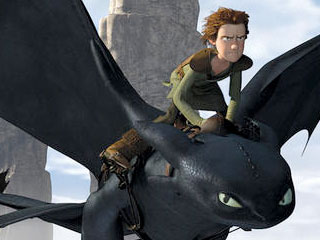
After 9 months of very challenging and very rewarding work, my employment on “How To Train Your Dragon” has come to an end. I am officially off the show, and am now gearing up for my next DreamWorks endeavor. The experience has been indescribable, and as recently mentioned here, I’m sure I will attempt to pass along some of the artistic knowledge I have gained through this journey.

This was a privileged opportunity to work with some of the most talented feature animation artists working today in all departments. Personally in my department, I got to work with layout veterans James Ryan Peterson of Kung Fu Panda, JC Alvarez of Shark Tale and Bee Movie among others, and our head of layout, Gil Zimmerman. Learning from these three gents was always a simultaneously humbling and empowering experience, both making me realize my bad habits, and yet showing me how to utilize my strengths. You can find an interview here on the official How To Train Your Dragon blog with Gil, where he briefly answers some questions about himself and the movie. Also, a brief clip in which he discusses the challenges and process that went into Romantic Flight, the first sequence I worked on in this film.

Tomorrow, I get to meet with the director of the next project I am starting on, where we will discuss the set dressing for one of the large landscapes we’ll be using. Always new and challenging work to be done at DreamWorks! More to come!

(Originally published on badgerart.blogspot.com.)


Author

David Badgerow
Member, FWD:labs
Official site
FWD:labs site
Contact