FWD:labs

Blog


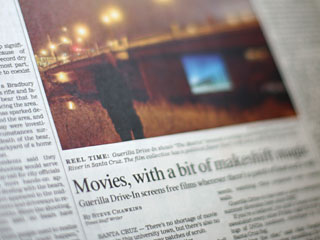
outdoor-film_la-times.jpg

Today, the Los Angeles Times ran a front-page story on the Guerilla Drive-In, a film movement in Santa Cruz, California, that screens films outdoors on a regular basis. The film collective event is “about getting people together to do something very deliberately outside the realm of commerce,” says organizer Rico Thunder. They screened The Matrix under a bridge.

Drive-Ins Tonight

San Francisco, California: tonight in a parking lot between 22nd and 23rd on Valencia Street in the Mission, the KFC Collective is presenting several short independent films. The group is all about “reclaiming public space for art, one parking lot at a time.” Word spread across Upcoming.org and Laughing Squid.

Los Angeles, California: tonight One Flew Over the Cuckoo’s Nest screens at Cinespia, a group which sets up camp at the Hollywood Forever Cemetery. Film-lovers arrive early, shell out $10 but get to bring their wine and cheese and watch the film on the uninhibited grass. Previous packed-lawn films have included Harold and Maude and Fast Times at Ridgemont High.

Brookyln, New York: tonight is Crossing the Line at the Rooftop Films, a community-focused “collective collaboration between filmmakers and festivals, between audience members and artists, between venues and neighborhoods. Our goal is to create a vibrant independent filmmaking community that bridges cultural boundaries. At Rooftop Films, we bring the underground outdoors.” Their “Summer Series” trailer is incredible:

Underground Movements

Berkeley, California: Mobmov is the “drive in that drives in,” which has free screenings nearly every two weeks. Their manifesto explains what’s required to play: projector, marine batteries, inverter, FM transmitter and DVD player. They also outline the legal issues, from copyrights to FCC rules and police. The site has a regurarly updated forum and sign up is easy and helpful, like selecting your nearest city to receive useful e-mail updates.

Simultaneously, in Chicago, New York City, Los Angeles, San Francisco and Oakland, SiCKO was projected on buildings on June 25th, 2007. Of course, the buildings were nearby the health care industry HMOs. Word was passed along on newsgroups and mailing lists.

Going Strong

Outdoor film screenings take the form of festivals, gatherings and just plain alternatives to otherwise anti-social, over-priced megaplexes.

Brooklyn, New York: the Movies With a View series gets the Brooklyn Bridge in the picture with screenings through August 2007.

New York, New York: you can’t pass up the Bryant Park Summer Film Festival.

Chicago, Illinois: they’ve had the free Chicago Outdoor Film Festival since 1999.

Boulder, Colorado: the city known for its outdoor recreation has the Boulder Outdoor Cinema; check out their site especially for the fun Flash animation with cowboys and aliens.

Marin, California: just a stone’s throw away from NorCal filmmakers like George Lucas and Francis Ford Coppola, there’s the Film Night in the Park through October 2007.

London, England: The Guardian recently reviewed five of the best outdoor film screenings for this summer in Stratford, Devon, Cambridge, London and Yorkshire, but take a look at the courtyard screenings outside London’s Somerset House in the Film4 Summer Series, from August 2 to 11, 2007.


Author

Aaron Proctor
Founder, FWD:labs
Director of Photography site
Contact


  • Published in Film + Web

Part of a series of posts about active artists with the tenacity to take their project to completion.

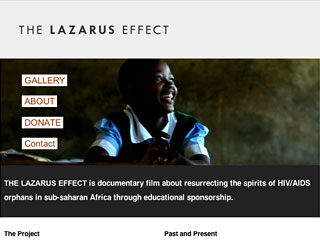
the-lazarus-effect.jpgMathieu Young, a young filmmaker whom I first met by hearing his pitch for an action movie in the Palm Springs desert, went to Kenya in 2005 to take on a documentary, “The Lazarus Effect.” The project’s site, which began as a way to chronicle the progress of the film but became something much more personal, was highlighted this month on VanityFair.com.

Problem

Before Mathieu left, we met up for drinks at Urth Caffe in Beverly Hills and he told me about last-minute worries for his five-month itinerary. The problem at large was about staying focused on the film, which he was running and gunning on his own, amid the larger challenges of creating a program in Kanga, Kenya to “resurrect the spirits of HIV/AIDS orphans in sub-saharan Africa through educational sponsorship.”

Solution

Mathieu was setup to use a small, custom CMS [content management system] to update TheLazarusEffect.org, where he blogged his tour, posted his photographs and used a shaky web connection in the middle of Africa to share his scribbled notes and impressions online.

Encouraged to post every day, the journals became a soul-bearing road map throughout his project. Projects like Yahoo!’s war correspondent site, “Kevin Sites in the Hot Zone,” use a similar approach.

The journals, which are no longer the key focus the site, may or may not influence the final film, but succeeded in connecting Mathieu with more than just friends and family: he took care of procrastination and focused on the core belief of his project. His film and his cause benefited from this small but persistent and strategic effort.

Results

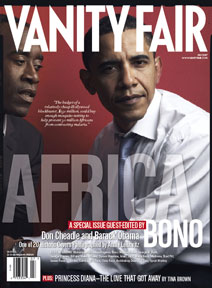
vanity-fair_0707.jpgThe site got recognition this month at VanityFair.com, as value-added linkage for the July 2007 issue about Africa:

The Lazarus Effect started as a documentary film about the H.I.V./AIDS pandemic in rural Africa, but the project’s focus has shifted to helping to start and maintain an innovative pilot program aimed at benefiting people living with the disease.

As a platform, the site directed $5,000 to the cause he ended up highlighting, where visitors PayPal’d after exploring the supporting material on the site. No more than $100 was spent on the web site over three years.

Despite the “live-blogging” phase being the five months in 2005, over 1,000 visitors have explored the site in the last year, spending an average of three-minutes taking it all in, with 40% coming in from search referrals.

What’s Next?

“The Lazarus Effect” is almost ready to premiere, while the cause, “The Kanga Project,” is ready for a site of its own.

Mathieu is also the new community developer for FWD:labs and will introduce himself in the coming month.


Author

Aaron Proctor
Founder, FWD:labs
Director of Photography site
Contact


  • Published in Film

Update (06/2012): Filtr is now offline.

Update (07/07): Since this was first posted, Filtr is now a registration-required publication.

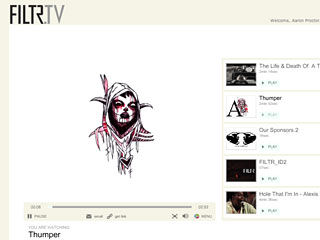
filtr-interface.jpgFiltr.tv, described as “a way for serious artists to reach new audiences and for those audiences to be rewarded with great art,” is a Brightcove-based video publication that plans to roll out weekly play-lists. Films are hand-picked, shown in a small series like a film festival for each “issue” of Filtr, and filmmakers are given brief profiles just like contributors in a magazine. Their first edition is up at Filtr.tv.

“[It’s] interesting. Different. Which is nice. A video site that just sort of takes you on a series of little journeys. … I love the way they talk about it … feels like it has a genuine point of view. I like the stuff that has a note of humble to it as well, which this does,” notes Simon Law on a blog post about Filtr. Law is a group planning director of WCRS and veteran of Goodby, Silverstein & Partners.

As a reminder, Goodby, Silverstein & Partners is the agency that created the Budweiser lizards, that handled Saturn and Isuzu for years, that created that fantastic Hewlett-Packard spot of a few years ago with people in picture frames, that consistently is considered one of the best creative shops in the world–and, not coincidentally, was named Agency of the Year in 2006 by both Creativity and Adweek, an honor it has won several times.

Flickr.tv has a five-person staff for “filtering” a selection of decidedly good short films, music videos and animations. Founded by Sheila Y. Shidnia, a young musician, “the staff, comprised of creative professionals, handpicks the content for this artist-friendly station…so no hacks allowed,” notes Creativity Magazine in their weekly e-mailer.

With complimentary aspirations, Filtr.tv has editor-picked artists with their best film (as streams) and a brief profile, whereas FWDlabs.com has artist-invited artists with their best projects (as micro-sites) and their own comprehensive professional profile. We hope some of the films here will filter into their next issue.

Thanks to Jack Feuer, former ADWEEK national news editor and current Mediapost.com columnist, for contributing.


Author

Aaron Proctor
Founder, FWD:labs
Director of Photography site
Contact


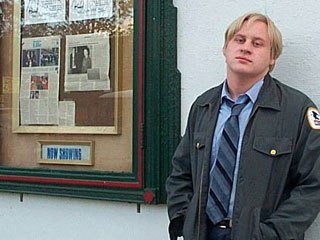
eric-szyszka.jpgAs a headstrong cinema studies grad of Suny Purchase, Eric Szyszka calls it like he sees it and knows what he wants; but for some collaborations, when he believes in his work and the people around him, means he’s the type to pulling the extra shifts to save up to help fund and fly out to Los Angeles, just to get his next short film made with the right players.

Eric started with do-it-yourself — when miniDV surfaced in the late 90’s as a low-cost medium — and have since trimmed the fat of glam expectations, ending up with a realistic and confident picture of the kind of cinema we want to pursue.

I have yet to actually meet Eric, but he and I have known each other for years. We share a unique interest online, beginning with a collaboration via the Star Wars character Boba Fett before discovering a shared passion for filmmaking.

1. What are you most proud of and what do you want to do next?

I’m most proud of my feature length script Bad Reception: “On the trail of a lost television set, an aging private investigator finds himself embroiled in the seedy world of snuff film and realizes that without any help, he might become the star of the next production.”

The script has become an obsessive passion project of mine as it started with a short 19-page script. In 2005, I expanded it into a 105-page feature that was very low-key, like if About Schimdt had been about a detective. In 2006, I decided to rework the entire script, throwing out nearly 80 pages. Now, it’s a lean 90-page noir/thriller. I really amped the drama and raised the stakes. While the script previously went down slice of life roads, it now just hits you one page after another until the end.

I’m currently working on a first draft of a war film which is coming along surprisingly well. It’s along the lines of all those classic ’60’s and ’70’s war films: Kelly’s Heroes, The Dirty Dozen and Where Eagles Dare. But the hook is, it doesn’t take place anywhere you might imagine.

2. What working a regular job taught me about art.

Day in and day out, it has shown me that art is the most precious outlet for my emotions. The major problem is that there never seems to be enough time for art during the daily grind and routine. I struggle each night to create something. In a way, while having such a structured life limits the freedom to create, it also gives you a constraint, giving myself a routine to say, this block of time is the time to write. Seize the day, everyday.

3. What real or imaginary technology in emerging media would you want to explore and why?

I think the biggest new force in filmmaking and television is definitely the internet as even the major networks are going the way of the web, i.e. displaying entire shows online. I would love to try and get in on this. I’m positive some show will hit it big on a network originating from viral video popularity. I have some of my short films on YouTube which have gotten some good attention there.

A short comedy TV show — YouTube series, excuse me — would be really fun to create and explore, say on a monthly basis. One season would be a year long — a 12 episode run, like some of the smaller TV orders that exist. (Shows like It’s Always Sunny In Philadelphia average about 10 episodes/season.)

4. With whom and how do you collaborate with best?

Unfortunately, I haven’t collaborated with enough people. I was the director, writer, DP, and editor on most of my short films. I really want to collaborate more and I think starting to focus more on writing will help me do that more in the future. It would be especially interesting to see how someone else would direct my words.

My first feature script, “Skits-A-Lot Bandingo,” was written with a co-writer, Chris Mead, which was so much fun because it was a comedy. We talked and scribbled on notepads. The piece became a really unique surrealist comedy. I think that was the best collaboration I’ve ever had because we kept it fun.

In general, collaboration is so essential to make something work. In 2004 I was an intern for Late Night with Conan O’Brien and I remember Conan pitching an idea to head writer Mike Sweeney. I actually thought it was a bad idea, which surprised me, “how can Conan come up with an idea like this?” But it turned out through collaborating with Mike, the director Alan, and everyone on the show it turned out to be pretty amazing and most importantly: funny.

It really taught me that every idea starts small and gets built up. This happens in the production of anything. During the creation of my short film Unsent, my lead actor Robert Lincourt pitched me an idea for a shot of him walking across a baseball field smoking and drinking. This was after we wrapped, but I thought he had a great concept, so we hit the road and shot it. Just the two of us. It turned out to be my favorite shot in the film. It really summed up the film and what I wanted to do by really presenting us with this pulpy tragic figure in the center of picturesque wholesome America.

5. Your top five regular influences for creative ideas

  • Film Noir – This type of filmmaking has really consumed my life in the amount of time I’ve spent watching the movies, writing about it critically for my Cinema Studies degree, and writing in its style for my screenplays. It made me want to make movies.
  • History – I know if I didn’t do film I would be some broke historian writing books about little known Eastern European occurrences that the rest of the world had since forgotten. When I read about just one insane thing that have happened in our time on Earth, I think: “This could be a movie!” I could probably come up with 10 or more historical events or people I would love to create a film around off the top of my head.
  • Errol Flynn – I never thought I’d become so interested in an actor. This guy changed my life. A lot of people have seen his 1938 classic The Adventures of Robin Hood, and after reading a little bit of his crazy life, I saw many of his other films. He plays such a wise-cracking lovable rogue that he makes me laugh, feel alive, and even gives me confidence. Flynn is also a great source of material for a writer having lived such an allegedly outlandish life and had been in some of the best films ever made, which seem like precursors to the blockbusters of today, that modern studios could never live up to such as Raoul Walsh’s collaborations: They Died With Their Boots On, Desperate Journey (co-starring Ronald Reagan), and Gentleman Jim.
  • Everyday Life – There’s nothing better than walking down the street and seeing or hearing something and making a mental note. This is a great place to capture little character quirks through the time-tested art of people watching.
  • Happiness – I can’t write, create, or do anything constructive if I’m not in a good mood. It is a major creative influence because I can’t function without it. My girlfriend, friends, and family are the source of this. Even through tough times they can manage to cheer me up enough to push forward.

Author

Aaron Proctor
Founder, FWD:labs
Director of Photography site
Contact


four-social_eyesondarfur.jpg

Think about the under-popularized satellite photos of genocide: that is where film is headed. Feel the sense of community through the under-appreciated moving images of film festival favorites: this is the web’s new digs. Flip traditional media around with under-read transparencies on social issues: this is how design is communicating new kinds of excitement. In some cases, film, web and design in cinema creates social advocacy, a conscious push emphasized here throughout FWD:labs.

Here are four degrees of social advocacy that can make the Washington Post, win Webby Awards and get friended on YouTube. They all relate to one another, one way or another, and definitely drink the same Kool-Aid:

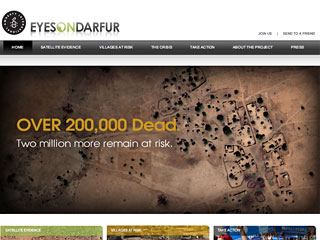
Eyes on Darfur

The site — a collaboration between Amnesty International and the American Association for the Advancement of Science (AAAS) — launched on June 6, 2007 with a bold approach, centered around satellite-image monitoring of atrocities in Darfur. Visitors can compare before and after photos, learn more about the conflict and the environment, as well as easily sign petitions and send the site virally by e-mail or social network. In the Washington Post’s coverage, Mona Younis, director of the Science and Human Rights Program at the AAAS, noted how “[this] initiative is an example of how science and technology can be applied to expose human rights violations.” The site is designed by Citizen Group.

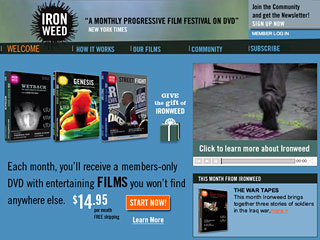
Ironweed Film Club

four-social_ironweed.jpg Ironweed pays independent filmmakers for DVD distribution with their film club. Filmmakers can submit their films to their office in San Francisco for consideration. Ironweed also encourages public screenings of their films “with anyone, anywhere: cafes, living rooms, libraries, communal centers, classrooms and even small theaters.” The web site, designed by Citizen Group and powered by the Drupal CMS, which provides their members with blogs, profiles and messaging. In the April 2007 issue of Good Magazine, Ironweed Films was included in their Marketplace column: “It’s like having someone sending you the best products of all the film festivals you don’t have the time or money to attend.”
Good Magazine

Good is the kind of magazine you really look forward to reading. One noteworthy subscriber blog’d her satisfaction on Have Fun – Do Good: “(t)he photos from the Border Film Project taken by migrants and minutemen were pretty cool, I appreciated the 8-page visual guide to the midterm elections, and the No Senator Left Behind chart comparing US Senators’ educational background and salary with the average person’s educational background was fascinating.”

Good Magazine also has regular video presentations, including “Nuclear Weapons Transparency” (embedded above) and “How the Government Spends Your Tax Dollars.” Their YouTube channel has over 850 subscribers. Their site is branded and built by Area17; Al Gore Jr. is an associate publisher of the magazine.

Current.TV

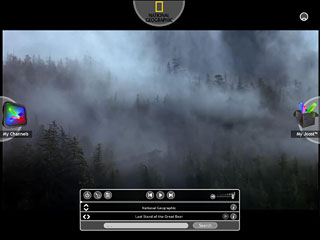
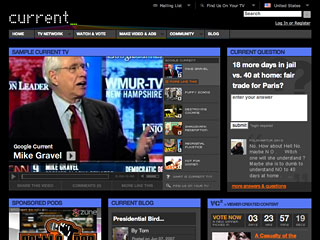
four-social_current-tv.jpg Ex-vice president Al Gore’s pet project, Current TV, just won a 2007 Webby Award. “Current is a global television network that gives you the opportunity to create and influence what airs on TV.” This network — broadcaster of pod-like user-generated video content that goes from online voting through to cable television — is a key player in interactive television, alongside Joost and Apple TV, notes a film student from UC Santa Cruz. At the 2007 Webby Awards, other film-related web site nominations included:

2007 Webby Awards – Television

2007 Webby Awards – Film


Author

Aaron Proctor
Founder, FWD:labs
Director of Photography site
Contact


  • Format

    Pomegranit business cardCool business card designs (creativebits.org)
    “Combine different papers. Use office scrap. Write fun copy. Free one way ticket to the moon.”

    Inkjet Printed Film Process (jemof.com)
    “Video frames printed onto transparency film.”

  • Titles

    The Art of Branding (guykawasaki.com)
    “Brands are built on what people are saying about you, not what you’re saying about yourself. People say good things about you when (a) you have a great product and (b) you get people to spread the word about it. … As much as a I love marketing, at the end of the day, customers ultimately determine what your brand means.”

    Garrett Dimon business cardDown With Titles (garrettdimon.com)
    For those without clearly defined roles: “With descriptions instead of titles, you really get down to explaining what it is that we do much better than any single word or phrase could do.”

  • Constraints = Creativity

    Willo O'Brien business cardsMoo Cards – “Competent, if Not Brilliant” (niallkennedy.com / willotoons.com)
    Podcast, interview with Richard Moross of Moo Cards: “They’ve been around for 300 years. They’re the single most successful networking tool of all time, bar none. … We could offer you a thousand different choices. However, it helps people move through the process quickly when they have fewer choices.”

    What’s in a name? (andybudd.com)
    “Everybody is either a ‘web designer,’ a ‘musician’ or a ‘DJ,’ and usually all three. … (But) you need to be able to explain to potential employers and clients what you do as succinctly as possible. Secondly you need to be able to differentiate yourself from potential competition, and the hordes of hobbyists out there.”

  • Design

    How to make business cards that people keep (valleywag.com)
    “Hire a real designer. They can pull off slick layouts that you won’t find in Microsoft Publisher.”

  • Considerations

    • Process – letterpress, printing press, photo copier, etc.
    • Shape – 3.5″ x 2″ norm in U.S., half-size, square, etc.
    • Color – one-, two-, four-color [CMYK], white space
    • Copy – too much vs. too little, serious vs. witty
    • Quantity – sustainable information, titles
    • Variants – differences in color, image, title, etc.

Author

Aaron Proctor
Founder, FWD:labs
Director of Photography site
Contact


  • Published in Film + Web

Nobody's Watching

Wired Magazine ran a blog post on May 21, 2007 about failed TV shows going big, thanks to their online potential. It’s no mystery anymore that TV programs new, old or still in development show up online — often in the same night, legally or otherwise — and people tune in. When you’re not “on the (studio) lot,” it’s no loss going online; the producers can at least get someone to watch and maybe recognize their sleeper success. And maybe if they plan it right, with the faux MySpace profiles, convenient “e-mail to a friend” sidebars, catchy official sites with community-building plug-ins and the cold calls to YouTube to “feature me,” the show might have a chance.

Where the money’s going

In New York City this last week, there was the networks’ annual “don’t-you-know-how-amazing-this-is” event for media agencies and advertisers called the “Upfronts,â€? where the TV network’s line-ups are announced and ad buys are made in a frenzy. The big change this time around — thanks to the advent of Tivo, YouTube, DVR’s and the increasing coolness of not watching TV anymore — they’re no longer buying just a primetime slot. AdWeek notes (link no longer online) that it’s now about “live-plus-same-day” or “live-plus-three-day,” since people aren’t glued to the tele at the original airtime.

Reinventing the remote control

joost-interface.jpg

Of course, one start-up that pleases both producers and advertisers — excluding the “user generated” echelon — is Joost. This soon-to-launch online video distribution platform is a big deal and its gearing up to take on your primetime viewing rituals. Think of it as how iTunes handles television shows: democratizing the solo episode, but for free. In the last two months, since their first commercial aired during the Super Bowl, Joost made deals where YouTube and News Corp. could not: they wrangled Viacom, CBS, Warner Music Group, CNN, Sony and others like Creative Artists Agency, Sports Illustrated, NHL and Hasbro. (Check Techcrunch’s regular coverage.) And in terms of advertising, the model for Joost is — for now — quality over quantity. (Read Wired Magazine’s interview [2/2007]; Kazaa and Skype are part of the track-record for Joost’s founders.) Since they’ll be able to target your show, zip code and recency of viewing, you’ll see a five- to ten-second ad pop-up over the show.

Ad-supported free TV is quite a turn on

Here are some example trends of existing ad-supported free TV:

  • 30 Rock
    Recent entire episodes on NBC.com’s own video player (Flash)
    Separated into 4 parts with single-sponsor ad 4 times per half-hour per show
  • Shark
    Recent entire episode on CBS.com’s own “Innertube� video player (Flash with RealPlayer)
    Separated into 5 parts with single ads 5 times per half-hour per show
  • Lost
    Recent entire episodes on ABC.com’s own video player (Flash with third-party plug-in)
    Not separated into parts with single-sponsor ad 2 times per half-hour per show

Fireside Chats

But for video producers without network distribution deals, making a big impression is key. You need millions of viewers, not dollars, to be taken seriously. The famous user-generated video distributor, YouTube, recently paid reward to their most subscribed original hits. (Many competitors — see our collective resource of social video sharing networks — already share ad revenue with their most popular distributions.)

Up-and-coming quality television

Example shows off the tube and on the internet, already in (or should be in) the news:

  • Gay Robot” (pilot only)
    Why watch? Adam Sandler team’s involved.
  • Nobody’s Watching” (pilot only)
    Why watch? The CW’s ol’ WB network passed it up.
  • Lonelygirl15” (on-going series)
    Why watch? 10 million viewers and 93,000 subscribers, even after it was exposed as fake early-on.
  • smosh” (on-going series)
    Why watch? YouTube’s all-time #1 broadcaster, for now, with 74 million plays.
  • DERRICKcomedy” (on-going series)
    Why watch? Self-described improv between “silly and awful.”
  • “Fireside Chats” (on-going series)
    Why watch? Regular screenings at UCLA are packed.

Other web shows thriving on- or off-line?


Author

Aaron Proctor
Founder, FWD:labs
Director of Photography site
Contact


max-sokoloff_cu.jpg

Max Sokoloff is a 14-year old director in San Francisco. His film, “Voyage of the Mind,” was recently awarded an honorable mention in the 2007 Northern California Television Academy Awards. I was re-introduced to Max on a trip to San Francisco in December 2006, at Ronald Chase’s Art & Film for Teenagers — a group that meets on Fridays and Saturdays and is open for anyone to attend, with a separate filmmaker’s workshop, of which I’m an alum. Astute, intellectual and serious, Max is a young award-winning filmmaker, studying and practicing with art films while in the midst of high school.

What are you most proud of and what do you want to do next?

Max Sokoloff I’m most proud of a film I made [in 2006] called “Intermissions.” Mainly, just because it is the most ambitious project I’ve worked on. It was filmed all in one day (9 hours) and surprisingly turned out really well considering the circumstances. This year I’ve been working on so many different projects. Slowly, some of them seem to be coming together and some seem to be falling apart. I just finished a dance film inspired by Wong Kar Wai.

“What ___ Taught Me About ___”

MS Watching the films of Wong-Kar-Wai have taught me so much about movement and how the camera can be used effectively. He is an expert when it comes to movement as emotion and his films have this visual poetry, which very few filmmakers can measure up to.

What real or imaginary technology in emerging media (mobile, web) would you want to explore and why?

MS I never have really thought about imaginary technology. Right now, I am still just trying to learn the basics and learn how to make a good film.

With whom and how do you collaborate with best?

MS I think one of the important qualities of being a director is being able to work with a variety of people under a variety of circumstances. I try and work with as many people as possible and I end up working in such different ways.

I have been working a lot lately with Oren Ratowsky on scripts and productions. He does fabulous camera work. And I always check my scripts by Isaiah Dufort because he is an outstanding writer (especially gifted when it comes to dialogue).

Your top regular influences for creative ideas?

MS I have been reading some short stories by Isak Dinesen, which have been really inspiring. She has wonderful imagery in her writing and it seems perfect for film. Yesterday, I just re-watched a film by the Dardenne brothers called L’enfant.

I wasn’t sure at first, if film was what I wanted to pursue, but after seeing [Frederico] Fellini’s 8 1â?„2 I was convinced. The imagery, symbolism, and metaphor, and the truthful qualities of the story are spectacular. The ending scene is burned into my brain, and I believe it is one of the most amazing scenes in film. All these people from Guido’s life come and start dancing with their hands held together on a circus ring, as if to say, “Life is like a circus.” In this way, the scene is a metaphor for his life, and his life becomes his film. He joins in this circle and dances with his life and dances in his work, and he is a part of his art and his art is inseparable from who he is. I feel exactly the same as Guido and Fellini. My art is apart of me and who I am.

One other big influence: [Krzysztof] Kieslowski. Kieslowski is god.

(Photo by Oren Ratowsky.)


Author

Aaron Proctor
Founder, FWD:labs
Director of Photography site
Contact


  • Published in General

joshua-bell-experiment.jpg

On April 8th, 2007, the Washington Post conducted an experiment during a Washington D.C. rush hour. A man with a violin started to play at the L’Enfant Plaza Station. Little did anyone realize, as they rushed past in judgment, the musician was world-famous Joshua Bell, competing for their attention. But most kept on about their day. To some, this is depressing; to others, this is understanding gratefulness.

“‘At a music hall, I’ll get upset if someone coughs or if someone’s cellphone goes off. But here, my expectations quickly diminished. I started to appreciate any acknowledgment, even a slight glance up. I was oddly grateful when someone threw in a dollar instead of change,’ (said Bell to staff writer Gene Weingarten.) This is from a man whose talents can command $1,000 a minute.”

You can read the full article online and watch video of the passers-by at WashingtonPost.com, who uses Brightcove to embed and serve up their video.

(via Andrea)


Author

Aaron Proctor
Founder, FWD:labs
Director of Photography site
Contact


  • Published in Film

apple-finalcut-server.jpg

A handful of professional editors recently contributing to the 2006 ACE survey. Final Cut Pro came in third, behind Avid Media Composer and Avid Adrenaline, for systems used in the industry. Last Sunday, on April 15, 2007, Apple announced a handful of pro-grade improvements at the NAB conference in Las Vegas:

  • Final Cut Server, new Apple-fied version of a video management system originally called Artbox by proximitygroup.com, which Apple acquired in December 2006
  • Final Cut Studio 2, new versions of video and audio editing software
  • Color, a pro-facing color grading app
  • AJA’s I/O-HD, up- and down-converting HD hardware to link up a Macbook
  • ProRes 422, new compression format ideal for broadcast(For live coverage in depth, see Engadget’s post.)

Joel Coen (O Brother, Where Art Thou?, Fargo), speaking in a promotional video for Apple, explains how these advances in technology speak more for the artist’s creative thinking. “As the machines get more sophicated, the thinking about it can get more sophisticated. That kind of symbiosis is interesting, that why all the new technology is interesting. We’re not interested in technology per se, but how it lets you think about new things and do new things.”

So, between announces like how Matrox is going to offer lower-cost HD resolution for non-HD monitors and how Panasonic has a new 1080i format camera (AG-HPX500 P2 HD) and portable field player (AG-HPG10), technology is rapidly evolving the workflow and aesthetic for faster, cheaper, and hopefully better works.

red-one.jpg

On April 10, 2007, on his blog at fuzby.com, director of photography Matt Uhry shares his opinion with how technology like the Red One camera — last year’s NAB favorite, plugged this year for it’s Final Cut compatibility — does not advance the quality of cinematic storytelling at large.

“These cameras will change everything and nothing. In the next 2 years they will displace film cameras at the low and middle ends of the market. At the high end, where the cost savings are less important aesthetic or practical choices will rule. Crews will change some, the film loader will still sit in the dark, but he/she will be copying drives and maybe making DVD’s for dailies in the camera truck. … Electronically shot films will start look much better, but the cameras won’t make better films, that will still be up to you and me.”


Author

Aaron Proctor
Founder, FWD:labs
Director of Photography site
Contact


  • Published in Web

all-flash_mycadillac.jpg

1. Linear lock-down

Problem: Start at the beginning. No user-empowerment. No “chapter skip,” even if there isn’t a splash animation. No persistent mute button. Frustration ensues.

Solution: You could break your Flash site into different chapters. You could use conventional approaches, like contrast and mouse-overs. You could put links to everything up-front. You could use Flash’s shared objects to store a preference for each visitor. This is a good place to use a flow chart if you’re the designer. Nothing concrete, more like a general description of each “page” or “user stop”, with lines mapping out expected, or forced, navigation to the next page(s). This also is irreplaceable when it comes to later versions.

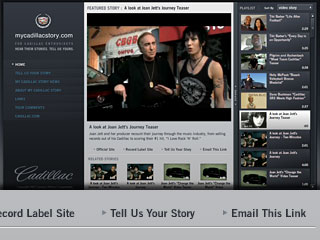
Example: mycadillacstory.com, a video site for brand enthusiasts to share their experiences, allows you to “Email This Link” for individual videos, so you can easily return to specific parts of the all-Flash site. “Permalinks” (jargon for permanent links) also help with tracking visits and returning to a page after it falls off a front page. (Site by Modernista.)

all-flash_designcanchange.jpg

2. Super-unusable uses

Problem: Web browser only, no “back” button, no print, no deep bookmark. HTML sites set up some rules and expectations, which help people judge a site’s efficiency in getting where they want.

Solution: On the heels of linear control, you could bring them into different HTML pages. This helps with going “back” and pulling up bookmarks. You could even offer up the print option if your content is laid out separately and piped into Flash with text files or a database.

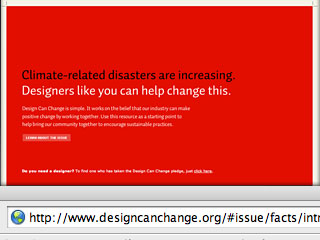
Example: Design Can Change, a recently-created site encouraging sustainable design, uses special addresses like “…/#resources/facts/intro” for getting around with ease. (Site by smashLAB.)

all-flash_aiga.jpg

3. Search engines? I don’t need no stinkin’ search engines.

Problem: Finds page one. No deep links. No keywords. Even small HTML sites can be found through the “back door,” finding your relevant content first, rather than go through the front door.

Solution: Along with control benefits, you could tag deeper pages, but you’re still missing the bonus points of contextual relevance. Optimize as many pages (HTML) as you need with routing to that frame/chapter/file. And test drive with “swf2html” in Adobe’s Flash Developer Kit.

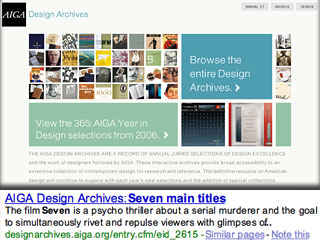
Example: AIGA Design Archives, an expansive and updated directory of jury-selected design work, has simply titled pages for every item, so searching for “Seven main titles” — to piggy-back on our recent film titles post — finds entry #2615. (Site by Second Story and thirdwave.)

Note: In March 2007, 40% of traffic to FWDlabs.com were organic referrals, or visitors coming from (often very specific) Google searches.

all-flash_imaginaryforces.jpg

4. Load, cache and two smokin’ versions

Problem: You’ve got to be careful to pre-load, auto-refresh the cache, and consider a lo-fi version, which can get out of date or miss the sell.

Solution: You could load files within files to save yourself and your visitors some time. You could use Flash ActionScript for randomly generated numbers, tag-teamed with an HTML no-cache reference. You could run your site off a CMS (content management system) to auto-generate two versions at once.

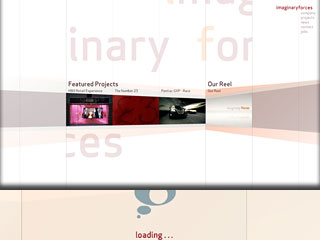
Example: Imaginary Forces, who updated their reel in March 2007, has multiple “loading” loops while going across the site, but runs out of one container – a single Flash file.

all-flash_newsmap.jpg

5. Build now, update later, right?

Problem: Once you’re set, how quick can you update? This is the number one problem with building first, asking questions last. Most Flash sites are static, like an informational kiosk, or map out their information architecture to plan for growth. It’s also a common problem with inexperienced software developers.

Solution: You could build your Flash site with a plan to grow, where it’s not stuck behind hours of update steps and instead ready to run right beside you. Text and links are easiest to update. Images and video are trickier. User interface elements like navigation can be trickiest. This is another good place for a simple flow chart. Break down by area, function, etc. using a “now, next, later” analogy.

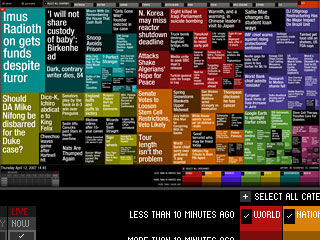
Example: Newsmap, which changes based on algorithms to judge the recency and repetition of news headlines, is designed to update automatically. (Site by Marcos Weskamp.)

More in Web

On deck with some established artists linked on FWD:labs will be more dynamic web sites running off our app, some which may choose to have Flash here and there or everywhere. All will be brandable to the user’s taste. This will be a premium feature.

Special thanks to Joe Carlson for editing assistance.


Author

Aaron Proctor
Founder, FWD:labs
Director of Photography site
Contact


  • Comments Off on 5 Problems with All Flash Web Sites


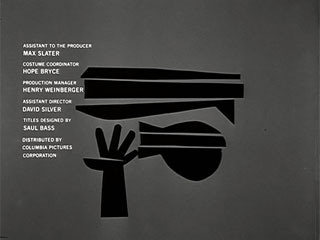
saul-bass-titles.jpgWith Otto Preminger’s 1959 film Anatomy of a Murder, film critic Leo Goldsmith — a contributor to Reverse Shot and The Village Voice — describes part of the stark opening sequence: “Echoing the deliberate manner in which the film dissects the circumstances of a murder case, the credits also provide some witty juxtapositions of titles and images: James Stewart naturally gets the head; Lee Remmick a leg; Duke an arm; and Preminger’s credit comes once a disembodied hand seems to cover the lens.” Goldsmith elaborates on an inspiring tribute site for Saul Bass at NotComing.com, featuring stills and overviews of his title design collaborations.

Bass, who passed away in 1996, was featured Bass as a design pioneer in Communication Arts magazine, who spoke with director Martin Scorsese about his designs. “Bass fashioned title sequences into an art, creating in some cases, like Vertigo, a mini-film within a film. His graphic compositions in movement function as a prologue to the movie–setting the tone, providing the mood and foreshadowing the action.” Bass did the opening titles for Scorsese’s Goodfellas, Cape Fear and Casino.

YouTube, as you can expect, has most of the opening sequences, amalgamated recently at BlogDeCine.com.

A short biography, stills and graphic identities are on DesignMuseum.org; a Bass retrospective took place at the London museum last year.

There are also many related links and books on TheDesignEncyclopedia.org.

A retrospective on Bass just ended at the Skirball Cultural Center in Los Angeles. Some images are on Flickr.

Upcoming April 11, in the world of opening film titles, Kyle Cooper (Se7en, Dawn of the Dead, Spider-Man series) will be speaking on the art of title design at an AIGA Atlanta event. Cooper and Bass are often compared, but take the introductions in very different directions, as elaborated in Jon M. Gibson’s article for Wired Magazine. He was interviewed last week by Curt Holman at CreativeLoafing.com.


Author

Aaron Proctor
Founder, FWD:labs
Director of Photography site
Contact