FWD:labs

Blog

  • Published in Film + Web

imdb-theaters

IMDb has a new gimmick for independent filmmakers. The legitimizer of film and television project and professionals alike figured out what to do with their new acquisition, Withoutabox, the all-in-one dashboard of film festival deadlines. They’re introducing IMDb Theaters, the latest late bloomer to join the social video network bandwagon with its cheap bandwidth and wait-for-it monitization.

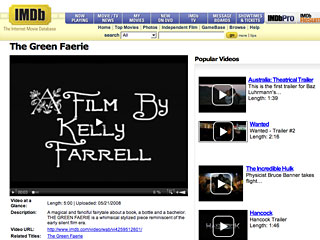
Just this week, an unknown handful of users with films on both IMDb and Withoutabox were invited by e-mail to upload a trailer or the entire short film, check off a non-exclusive agreement, and soon enough see video grace their project’s IMDb Title Page. Previously, video would be a dull hyperlink away or reserved for studio clips and trailers.

Missing in IMDb Theaters are the social standards of like video networks, the so-called nuts and bolts like comments and ratings. It’s also void of any buzz, like Vimeo’s venture with high-def, which raised the bar for free video hosts for artists that care about quality.

What’s working is the backbone credibility of the IMDb listing itself. But that’s where it ends for now. Reaction might be best explained by the survey accompanying the e-mail announcement tailored to non-participants: “I think the Conditions of Use are too hard to understand,” “I only like to license my work in deals where I get paid something,” and the straight-forward, “IMDb is not a place that I want to exhibit my film.”
imdb-theaters_example

An example film on IMDb.com, The Green Faerie

Being listed on IMDb has been essential street cred for years. But with a hundred and one options of social video networks, why use IMDb Theaters? Their current offering isn’t innovative, but it’s also hardly noteworthy except for one thing. It’s progress. Short of studio projects, where IMDb fast-tracks your changes, additions and edits to the database require a lot of the hurdles. Since you’re going through all the hoops anyway, their one-form process — the new sync of IMDb and Withoutabox — is a good first step.

Unless you’re using IMDb as a top destination for your work, their offerings can be much more competitive. Greater quality of resolution or exposure to traffic could separate IMDb from the rest and, through a catalog of video-included projects, be a route for added exposure for being a forerunner in trying out Theaters.

Author

Aaron Proctor
Founder, FWD:labs
Director of Photography site
Contact


salon-gathering-001

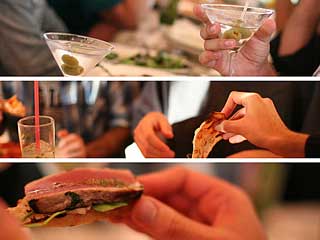
“Muse me: inspiration drawn from foreigning the familiar. … It’s a beautiful thing when two people can share a conversation but not a conclusion,” noted one of tonight’s salon gathering attendees, Tamara Jackson, earlier this year on her blog. Tonight, over cocktails at a bustling bar in Los Angeles, a small and informal group of like-minds — ranging from young masters of the universe to wise men and women dabbling in 2.0 — converged to talk about film, web, design and so much more.

It was always the plan that FWD:labs would have an off-line balance with regular salon gatherings. Uniquely for FWD:labs, this bridges artists in film, web and design working with cinema. Six tenets of these salons, based on the book Creating Customer Evangelists, include:

  • Continuously gather feedback about our work, our goals and ourselves
  • Share knowledge freely between those ahead, behind and just plain curious
  • Build word-of-mouth networks for work or for play
  • Meet and share with the community beyond your comfort zone, your own rolodex and your own industry
  • Smaller, bite-sized offerings rather than big, oft-overwhelming extravaganzas
  • Rally behind a cause, be it FWD:labs or other: it’s all welcome

As of tonight, and after a long time on the back burner, it’s come full circle. Hardly at all about talking shop, which would have been all too easy, the group included some of the FWD:labs collective as well as some new faces, each of us comfortably stretching from our own social networks with stimulating drinks and intoxicating conversations.

One thing was clear: everyone was enjoying themselves. Tonight will be followed by Salon Gathering #002 and #003, powered by momentum and proximity. In just a few weeks across town, the next stimulant will be Saturday morning coffee at a quiet cafe, before another Friday evening cocktail at a boisterous bar.

Check the calendar for updates, as the time and place will change up to stay fresh.


Author

Aaron Proctor
Founder, FWD:labs
Director of Photography site
Contact


  • Published in General

mckinsey-quarterly_brad-bir

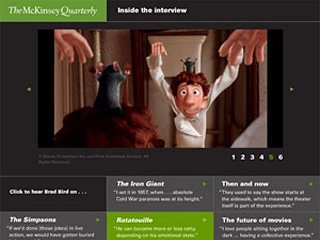
The McKinsey Quarterly interview on innovation at Pixar with director Brad Bird

Kaizen, Japanese for the philosophy of continuous improvement, is one method to stir up innovation and playfulness, which is especially useful in the business of creativity.

The three principals, according to the Wikipedia entry, include:

  • Consider process and results, not just results, to foreground actions to achieve effects
  • Think big picture, not just what’s in front of you, to prevent additional problems
  • Approach with a learning intent, not judgmental or blaming, to re-think the assumptions that led to the current process

Innovation

In a New Yorker article now on newsstands, “The Open Secret of Success,” car maker Toyota is singled out as most profitable and innovative and now the industry’s sales leader. Part of that is due to the core approach of kaizen, which Toyota began after the Second World War. As a continually successful car company, it’s in part due to “defining innovation as an incremental process, in which the goal is not to make huge, sudden leaps but, rather, to make things better on a daily basis. Instead of trying to throw long touchdown passes, as it were, Toyota moves down the field by means of short and steady gains. And so it rejects the idea that innovation is the province of an elect few; instead, it’s taken to be an everyday task for which everyone is responsible.” The article highlights how philosophy of kaizen contrasts with how most companies think about change.

In a May 4 post by Cameron Schaeffer, “How to Kill an Organization: 5 Barriers to Kaizen,” the life lesson blogger opens with a quote from the 2003 book, “The Toyota Way,” by Jeffrey Liker. “The greatest sign of strength is when an individual can openly address thing that did not go right, take responsibility, and propose countermeasures to prevent these things from happening again. … [Kaizen] pushes the decision making (or proposal making) down to the workers and requires open discussion and a group consensus before implementing any decisions.” Schaefer elaborates on the five thoughts — including insecure leadership, unmotivated employees, and promotion by numbers — and suggests that companies who keep ahead “must reward the mavericks, the innovative thinkers who question the norm and create new ways of doing things.”

Playfulness

In a May 4 article in the New York Times, “Can You Become a Creature of New Habits?”, M. J. Ryan, author of the 2006 book “This Year I Will…,” notes three zones for change: comfort, stretch and stress. When we try something awkward and unfamiliar, or stretch, change can happen:

“Whenever we initiate change, even a positive one, we activate fear in our emotional brain. … If the fear is big enough, the fight-or-flight response will go off and we’ll run from what we’re trying to do. The small steps in kaizen don’t set off fight or flight, but rather keep us in the thinking brain, where we have access to our creativity and playfulness.”

All together now

On May 9, blog Signal vs. Noise recapped the Times article and others in a post called “The small steps edition.” They also cited the McKinsey Quarterly interview from April with director Brad Bird (The Incredibles, Ratatouille) called “Innovation lessons from Pixar.” (Free registration required at mckinseyquarterly.com to read entire article.)

When The Quarterly asked of important elements to stimulate innovative thinking, Bird touches on having the faith to follow through:

“The first step in achieving the impossible is believing that the impossible can be achieved. … ‘You don’t play it safe–you do something that scares you, that’s at the edge of your capabilities, where you might fail. That’s what gets you up in the morning.'”


Author

Aaron Proctor
Founder, FWD:labs
Director of Photography site
Contact


  • Published in Web

abc-online-ads

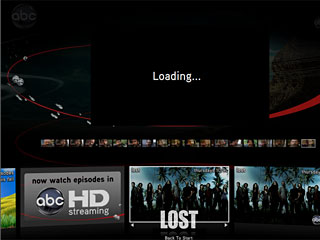
ABC.com’s online full episode player

Circulated today in the world of digital ad sales, an internal memo notified rival networks that a circle has been broken. Last Friday, ABC announced that it will “break from industry standard of single-sponsor online pods and test ad breaks with multiple commercials.” Currently, breaks usually include one :15 or :30 commercial.

Their experiment affects online video streams of full-episode content, including shows like “Lost,” “Desparate Housewives” and “Ugly Betty.” The memo also notes that “ABC was one of first broadcasters to offer episodes online and its viewers average 47.5 minutes on the site, more than 3x as long as any other broadcaster.”

Albert Cheng, executive VP digital media at Disney ABC Television Group (DATG), told The Hollywood Reporter that “[i]t would be premature for us to say people only want one ad. It’s a likely sort of thinking, but we want to push it a little bit to see how it would go. … If research shows that users don’t want more ads per break, Disney won’t pursue that strategy.”

It’s unclear how this model will work but this is a testiment to the TV industry’s commitment to providing its content online and transfer its business model for a digital world.

Will everyone follow suit? Why is ABC ahead with visitor trends of time on their site? How soon until new Internet is like old TV?


Author

Aaron Proctor
Founder, FWD:labs
Director of Photography site
Contact


  • Published in Film + Web

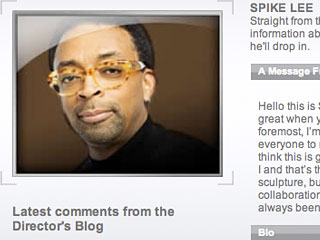
Spike Lee's page on the Nokia Productions web site

Spike Lee’s page on the Nokia Productions web site

Oscar-nominated director Spike Lee, teaming with Nokia, is calling his experimental filmmaking endeavour the “democratization of film.” In a recent article in the New York Times, the filmmaker expresses his interest in mobile contest “because it’s a great collaborative effort. Within five years, new movies will be made with devices like these. … We want people to send sounds, music, maybe a baby crying in the park.” The director will oversee the top 25 submissions of video, music, photos and text sent in by cell phone users to create a feature-length film.

Sharing Cinema

Film intentionally made, not just distributed, for mobile is gaining momentum as these devices have larger screens to see and easier accessibility to share. In 2004, Fox started, and trademarked, “mobisodes” with spin-off episodes of hit show, “24: Conspiracy,” which were comissioned by Verizon. In 2007, MTV Networks started the animated series “Lil’ Bush: Resident of the United States” and mtvU tried the live action “Suck Less, With Kevin Smith,” both partnered with Amp’d Mobile. Also in 2007, Robert Redford’s Sundance Institute and GSM worked to make the Global Short Film Project and its five short films for your phone. Director Maria Maggenti, whose film “Los Viajes de King Tiny” was included, shares her excitement on the new dialogue. “The thing that’s interesting about this format–about using this technology–is that there’s still a really strong impulse that people have to share. … The same way you do when you go to the cinema. I hope that people say: ‘Oh! Let me send you this little movie,’ or ‘Come over here and watch this movie that’s on my cell phone!’ That’s what I want people to get out of it: Sharing it.”

Cinematographic creativity might be on the rise, but online video is rife with incoherent randomness. It’s another capture medium and distribution platform for storytelling, but yet to gain the momentum behind webisodes and social video networks.

One of the new ways of thinking is the transparency of dialogue between audience and distributor. In the BusinessWeek article, “How Nokia Users Drive Innovation,”, suggests that “[i]nstead of people recording silly Web cam videos for YouTube or inventing frivolous advocacy groups on Facebook, [cell phone users] can help make the mobile Internet more useful.” These efforts need — and this one has — a roadmap with specific assignments. As noted in the press release for the Lee/Nokia contest, “each act will be announced online and people will then have four weeks to produce their submission.”

New School

Lee goes further to suggests that “[a]spiring filmmakers no longer have to go to film school to make great work. With a simple mobile phone, almost anyone can now become a filmmaker.” Film critic Eric D. Snider disagrees in his opinion on Film.com. “Hold the phone there, Spikeroo. There’s a huge difference between ‘making a film’ — i.e., pointing your camera or cell phone at something and pressing ‘record’ — and being a ‘filmmaker.’ No, you don’t have to go to film school to be a filmmaker. But merely possessing a device that can record moving images doesn’t qualify you as one either. I’ve got some pots and pans in my kitchen. Does that mean I’m a chef? If so, it’s going on my resume.”

Director David Lynch also had some curt thoughts on being “cheated” with cinema that ends up on cells. Ironically, the soundbite from the Inland Empire DVD extra found its way onto YouTube and, in January 2008, the mash-up became an iPhone parody.

New Relationship

Proximity is a big change, as noted on SlashFilm.com. The scale of audience to screen to a movie theater screen, to a living room television, to a personal computer screen, and to a cell phone in your hand divide each step of the way. Wired Magazine, in a 2004 article on cell phone filmmaking, asked director Joe Miale on that relationship. “You’re not going to make a short film that is character-based. It would be more caricature-based. … A two-minute Pixar movie, with animated fish, would be perfect. I don’t think there’s enough on that tiny little screen to give you a breathtaking performance with subtlety.”

In a recent interview with AdAge, Spike Lee said of his hopes for this feature film, “I never underestimate creativity in people.”


Author

Aaron Proctor
Founder, FWD:labs
Director of Photography site
Contact


criterion_last-emperor

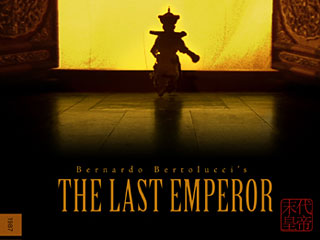
The Criterion Collection recently announced the re-distribution of Bernardo Bertolucci’s Oscar-sweeping 1987 film, “The Last Emperor.”

On the company’s blog, which dates back to early 2006 with quote enriched details on the creative and calculated choices for the collection, the multi-author posts often address specific customer feedback. In one case, about the aspect ratio of “The Last Emperor,” and how the new release has a new number. Even though it was originally seen one way, the production did not intend for the normal Academy ratio of 2.35:1, but instead planned for the ratio of 2:1. The slim but dense 70mm negative was the intended release format, which we also know in one form as IMAX.

Now, here was an opportunity to correct the film, to do justice to the injustice a whole 15% of the projected image. Criterion’s president, Peter Becker, boldly affirms in a recent post that “while some viewers may prefer the wider framing, the filmmakers must have the final say. This is not a case of our losing track of our mission, but rather one of being true to it.”

For a company known for his high-quality of film licensing, digital transfer, extra supplements and box packaging (as well as appropriately premium prices), it’s refreshing to have a valued line on the market. It’s like buying the hard cover edition when the soft would suffice. Or like designing the experience with the author in mind or in counsel: relevant rather than removed. The effort, especially with an art direction strategy of starting from scratch, serves the audience who cares about the art of the film.

For an in-depth comparison of this DVD release compared to others, from DVD menu, data bitrate and beyond, see a review for “The Last Emperor” on DVDBeaver.com.

Criterion’s 4-disc set for “Emperor” came out in February 2008. The company is re-releasing about 3 titles per month.


Author

Aaron Proctor
Founder, FWD:labs
Director of Photography site
Contact


  • Published in Web

Print by Sam Fuchs

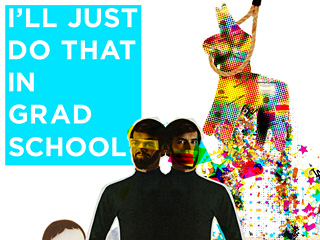
I’ll just do that in grad school. Print by Sam Fuchs available at HellaMoreFunner.com (link no longer available)

During a recent college basketball game, Sam Fuchs, designer and musician working in San Francisco, spotted a familiar face and sought out an answer online. He soon wrote on Facebook, “hey. i just saw the 76 commercial while watching the basketball game, recognized Liam, looked it up, and FWD:labs came up.” The commercial was directed by Chris Yi (link no longer available) and search engine traffic is the second most popular way people find him and his work online. (First place goes to direct links to chrisyi.com [link no longer available].)

Aaron Proctor: What’s it like to have this 76 spot — and the Green Dot School spots — running on television at age 22?

Chris Yi: I’m not going to lie, it’s pretty sweet. I still can’t believe it, getting phone calls from friends saying, “Hey I just saw your commercial during the game!” It’s more than I could’ve asked for, seriously. I’m really thankful for getting these opportunities and hopefully — fingers crossed — more will come in the future.

AP: How did the 76 project come together and with whom did you collaborate?

CY: Over the summer I was interning at an ad agency and my friend Natalie, who runs the UCLA Ad Team with me, heard about this commercial contest for 76. Natalie knew how I was into advertising and filmmaking, so she thought it’d be perfect for me.

When we found out, there was only a week before the deadline, so I threw together a small team. Jesse Epstein helped me write it and Liam Humble acted in it but also created the entire piece on the wall. I also had a lot of help from the people on my Ad Team and we all came together to pull this off.

AP: What’s your biggest fear with filmmaking and how do you deal with it?

CY: With all the creative work in my life, I’ve always been insecure about it. I always second guess myself and worry that it won’t turn out as great as I see it in my head. To combat that, I work my ass off to make sure that it turns out the way I want it to and I guess through some miracle. It always ends up working out.

AP: What are your goals for the near future?

CY: With filmmaking and advertising, I just always want to be better tomorrow than I am today. I just want to learn as much as I can and keep working on projects that help me grow my skills and keep growing as a filmmaker. So I guess my immediate goal is to find some cool people to collaborate with, make something awesome, and just learn from it. Any takers? Hit me up.


Author

Aaron Proctor
Founder, FWD:labs
Director of Photography site
Contact


  • Published in Film + Web

Updated 12/23: Looking to go Red on your next project? We’re in business. Updated 8/13: You can watch the finished music video at pleasejustsaymyname.com.

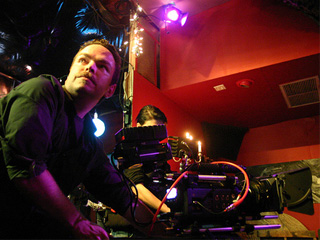
Director/DP Aaron Proctor and the Red One camera

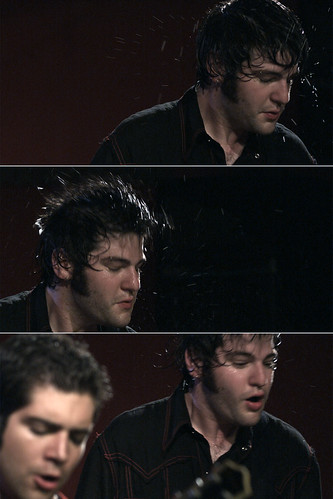
Directing and shooting with the Red One camera Photo by Tom Smith Jr., drummer for Negative Blue

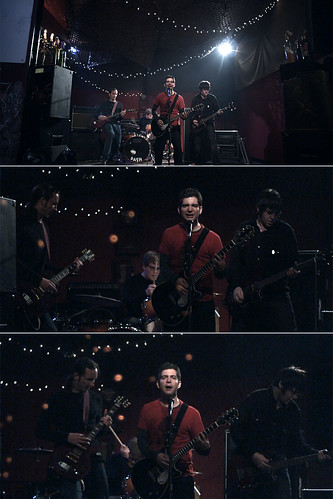
Stills from the Red footage

First Look: Negative Blue

First Look: 120fps

I just finished directing and shooting the music video for Negative Blue’s “Crash”, which used the new Red camera. Here is what I learned:

  • Do the right thing (on set)
    • Hire an owner/operator, like C.J. Roy, at least as your DIT: tips and tricks will spread through the crew all shoot long
    • Shoot 4K at the sure-thing aspect ratio of 2:1, instead of 16:9, but dial in your gridlines to operate
    • Learn what doesn’t work: there’s no viewfinder (yet), the product design is a lot of form and only a little function, and the film plane’s hook for measuring focus is right by the big red record button; expect to discover you’re own behind-the-scenes footage burning to disk
    • Suck it up and shoot at half the size — 2K at 120fps … or at the technology-limited 113fps if all you’ve got is CompactFlash cards and not hard drives
  • Know your place: you’re on the bleeding-edge
    • Use double redundancy backups with FW800 and/or eSATA from Fantom Drives; they’re handy to give one to an editor, too
    • Think of yourself in the same boat at Peter Jackson, Doug Liman, and Steven Soderbergh — their latest projects were shot with this camera — and then get over it
    • If you’re an owner/soon-to-be-owner, the camera really costs much more than the pricetag ($17,500)
    • Figure out your post production workflow, even though the Red post production workflow isn’t all that figured all out yet; support is mostly crowdsourced
    • Upgrade (or downgrade) the camera’s operating system: development (and bug-squashing) is fast
    • Everything you set, short of the focus and aperature, is metadata; the inside joke of “fix it in post” is no longer a joke
  • Familiarize yourself with the community
  • Be prepared to give up shooting film
    • Director/DP Steven Soderburg notes on the company’s web site, “I should call up Film on the phone and say, ‘I’ve met someone.'”

Author

Aaron Proctor
Founder, FWD:labs
Director of Photography site
Contact


  • Published in General

Ira Glass

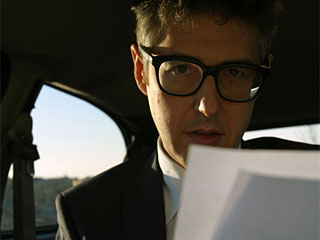
Photo by Nancy Updike

“Failure is a big part of success. If you’re not failing all the time, you’re not creating a situation where you can get really lucky. Maybe once every six week, you’re going to stumble on somebody so compelling and so great, it’s going to make the other five weeks worth it. You don’t want to be making mediocre stuff. The only reason why you want to do this, is because it’s going to be so memorable, it’s special.” — Ira Glass, host and executive producer of This American Life, speaking on the building blocks of great storytelling

For those of us who command creative control, yes indeed.

Ira Glass on Storytelling – Part 1
Ira Glass on Storytelling – Part 2 (embedded below)
Ira Glass on Storytelling – Part 3
Ira Glass on Storytelling – Part 4

https://www.youtube.com/watch?v=KW6x7lOIsPE

For others, look to people like writer/director Joe Carnahan (Narc, Smokin’ Aces). Last year, I wrote about how he kills his conceptual posters. He noted, “[a]s most film advertising art directors and designers will tell you, sometimes their best poster design work never sees the light of day beyond their own portfolios.”

(Speaking of posters, where are all the film posters from the cinematic works of FWD:labs artists? There’s a shortage of print in our design directory.)

Being a regular listener of NPR via KCRW 89.9FM, This American Life has been linked here before, when I covered a month-in-the-life of running FWD:labs. Coming on the first of May, 2008, the Showtime series of This American Life will be screened in movie theaters. The young librarian behind the Desk of Judy Dark has a fun take on the news: “The cost, finding parking, dealing with the annoying Cellphone McChatsalot who inevitably sits in front of me or the equally annoying Make Yerself Comfy Man who sits behind me and puts his stinky, Teva-clad feet against the back of my chair… yeah. Thanks but no thanks.”

(via Signal vs. Noise, who picked up our story on filmmakers using Basecamp)


Author

Aaron Proctor
Founder, FWD:labs
Director of Photography site
Contact


film-kitchen-poster.jpg

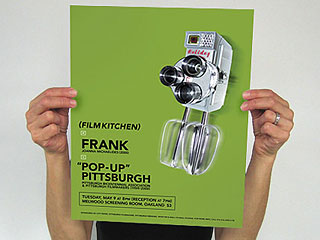
Poster for Film Kitchen by Brett Yasko

Last Tuesday, March 11, and for many second-Tuesdays of the month, Pennsylvania has Film Kitchen. For about $4 at the Melwood Screening Room, attendees experience a eclectic screening of shorts or features. Submissions are open to all, but the gathering is curated by Bill O’Driscoll, writer for the Pittsburg City Paper, who co-sponsors the event.

I found out about Film Kitchen thanks to designer Brett Yasko, whose work appeared in Communication Arts in December 2006. “Bill O’Driscoll has simple directions for these posters for his monthly screening: ‘Try to have a reference to film. Or have a reference to a kitchen. And make sure everything is spelled correctly.’ … Occasionally there’s a theme. This one was ‘appliances.'” Yasko is a Pittsburg-based designer and adjunct faculty member of Carnegie Mellon University’s School of Design.

The posters are silk-screened and color inkjet prints of various sizes, sometimes with “the text printed on stickers which were applied by hand.” 6 posters for Film Kitchen are on display at Yasko’s web site.

Beer and sandwiches are often donated by local sponsors, as noted in 2006 by one blogger on the highs and lows, perks and praises of the events. Incentives might push fringe newcomers but, in a world of buttered popcorn and syrup’d soft-drinks, certainly makes the audience feel right at home.

With simple expectations, these monthly meet-ups whet one’s appetite for avant-garde and independent cinema in the format of a year-round film festival. Like events in Los Angeles like the Downtown Art Walk (second Thursday afternoon-cum-evening), or events worldwide like likemind (once-a-month Friday morning), you can pass on berating yourself for missing one and vow instead to catch the next. Through this kind of continuity over the years, Film Kitchen provides a reoccurring opportunity to foster a society for local film-goers. It shares in the spirit of regional cinema while thriving as one community, one city, and in one venue.


Author

Aaron Proctor
Founder, FWD:labs
Director of Photography site
Contact


  • Published in Film + Web

Welcome everyone from the tweet on the 37signals Twitter! Check out the latest posts, post archive, or learn more about the FWD:labs collective. If you have any questions, comments or ideas, please drop me a line. — Aaron Proctor, FWD:labs founder
basecamp-dashboard.gif

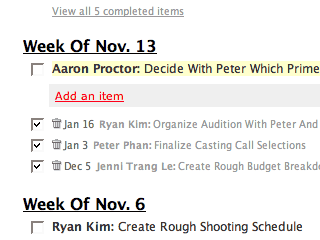
Dashboard page from the Basecamp project for Peter Phan‘s film, “This Will All Make Perfect Sense Someday”

[Update: This article is about what is now called Basecamp Classic. You may still be able to get an account for it at signup.37signals.com and it’s supposedly still maintained, despite a brand new Basecamp.]

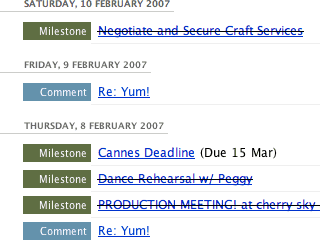
Every project has to-do’s, updates, and deadlines. Any filmmaker acquainted with Basecamp is already a step ahead in managing their next gig.

Basecamp is a web-based project management tool from 37signals. “[It’s] an amazing product. Very versatile. A little expensive but certainly worth it,” says director Jaraad Virani, who uses Basecamp. The tool breaks down a project into intuitive pieces: to-do lists, messages, calendar deadlines, and so on.

Yesterday at SXSW, Jason Fried of 37signals presented on what he’s learned from the success of Basecamp (presentation notes c/o ReadWrite Web), which included a slide on part of their company philosophy: “Be Successful and Make Money by Helping Other People be Successful and Make Money.”

basecamp-todo.gif

To-Do page

Success and money in mind, with any team effort, online collaboration improves productivity by focusing in one place all of the real, tangible goals. But adopting Basecamp is a real cultural shift, sometimes great enough to keep the status quo. I’ve noticed how everyone already has their own way to take notes, write e-mails, and add to calendars. For a team, it’s not efficient. The hardest challenge to newcomers is using a web tool instead of unfocused e-mails, handwritten notes, and long-winded meetings. After a demo or tour of the official site, I notice it sells the idea itself: everyone on the team, literally on the same page, without more meetings, more e-mail, or more misunderstandings. But, in practice, it takes early adopters and friendly encouragement.

The primary use for independent filmmakers and their complex film gigs is to use Basecamp for production. rav design, a full-service video production and graphic design firm, loves Basecamp. “We used it to organize our 48 Hour Film Project. … [W]e were working with crew members from across the state who had never worked together, and in some cases never physically met before the shoot. We posted workflows, guidelines, rules and shared location scouting info all in an elegant location.” For both clients and collaborators alike, how ideal of a work environment is that?

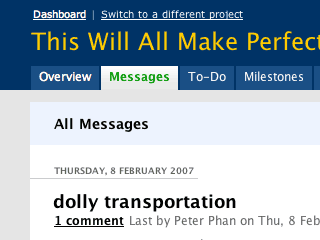
basecamp-messages.gif

Messages tab

Basecamp’s epicenter is the project, which is a familiar quantity for any kind of contract work. Rhett Dunlap, a Los Angeles-based producer and owner of Egomaniac Productions, has yet to give it a spin. “We haven’t gotten Basecamp yet … though it looks very very cool. We’ll get it if we land this bid. And use it for the production.” For one project, it’s free to use. For more, you have to pay a monthly fee on a sliding scale of “open” projects, which includes the perks of file hosting, chat, or more than two “Writeboards,” a Wiki-style document. Their business model is premium subscriptions, but there’s no individual cost per person, so it’s easy to add logins for your team or to share work-in-progress with your clients.

Any feature, short, commercial, or webisode can easily benefit from the focal point that an online project management tool provides. You can even get by without touching a credit card.

Google Sites offers a free alternative and ActiveCollab has a similar, paid plan to Basecamp.


Author

Aaron Proctor
Founder, FWD:labs
Director of Photography site
Contact


  • Published in Film + Web

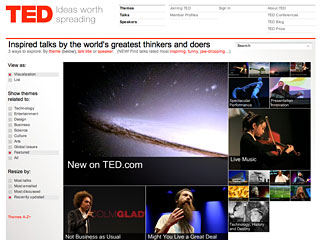
ted-com.jpg

Since I first heard about it, I’ve been a fan: TED — Technology, Entertainment, and Design — is a conference about spreading ideas and so much more. Their annual event in Monterey, California is their founding epicenter, where in 18 minutes apiece, “a group of remarkable people … gather to exchange ideas of incalculable value.” (Tickets are over $4,000 and only 1,000 people are invited; fortunately for us, most “TED Talks” can be viewed in five formats for free, sponsored by BMW.)

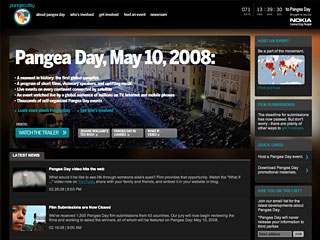
Today, day two of the 2008 TED conference included a new teaser for Pangea Day (link no longer available):

https://www.youtube.com/watch?v=LyPgHwB82xY

pangea-day-video.jpg

pangea-day.jpg

“What if…”

The teaser brings us back to 1989’s Tiananmen Square in Beijing, where the PLA’s advancing tanks met an unarmed civilian protestor. The video is called “What if…” and recreates the point-of-view of the tank driver. It intercuts the historical footage and ends with the message: “On May 10, 2008 see the world through someone else’s eyes.”

Coming Together with Film

Good Magazine calls it “a powerful collective action … when people around the world will come together to view films as a demonstration of global solidarity.” The history and goal are elaborated in one of today’s posts at the TEDBlog:

TED is also trying to do something to change the conversation. Actress Goldie Hawn is one of the many public figures around the world supporting Pangea Day, a project that was voiced as a “wish” by 2006 TED Prize winner [and filmmaker] Jehane Noujaim, when she wondered if it would be possible to create a “day when you have everyone coming together from around the world and sharing a communal experience of watching a film all together, all at the same time, from Times Square to Ramallah to the side of the Great Wall of China”. That day is going to happen, on May 10, when four hours of programming — films, user-generated videos, speakers, music, hosted by CNN’s Christiane Amanpour — will take place in several locations and broadcast by TV channels, shown on theatres, distributed over cell phones, streamed online, screened in village places and private homes all over the world. That’s Pangea Day. Movies alone can’t change the world: but the people who watch them can.

An earlier teaser, posted in September 2007, elegantly explains the call for entries, which can be sent in until February 15:

https://www.youtube.com/watch?v=Pl3xHIsvF9o

And back in February 2006, filmmaker Jehane Noujaim (Control Room) spoke at TED, and her talk is available online:

For more coverage of TED 2008, which goes until March 1, see TEDBlog, Wired Magazine, and Public Radio International.


Author

Aaron Proctor
Founder, FWD:labs
Director of Photography site
Contact