
FWD:labs

Blog


mark-coleran

Mark Coleran designs computer screens for the big screen. According to his record on IMDb, some of his work goes uncredited. But from his reputation — be it the colleague who enjoyed sharing her cubicle wall with him or the admirer (and co-initiator of Processing) who shared his thoughts of movie info graphics — you can quickly see why that doesn’t matter.

You’ve seen his work. He has made screen graphics for two of the three Bourne films; he’s designed the user interfaces within a Bond film and a Mission:Impossible, too. His showreel (embedded below) keeps a quick pace, but Coleran uses Flickr for us to linger on full-res stills of his work. Image sets include Children of Men, DejaVu, and The Island.

[vimeo]http://www.vimeo.com/1563485[/vimeo]

On Motionographer, where Coleran responds regurarly to questions and comments, he noted his toolset:

Well, sorry to disappoint you, but After Effects is a big part of the toolset.

Design and layout – Illustrator & Photoshop
3D work – Electric Image & Cinema 4D
Animation – After Effects
Post Process – Debabalizer
Playback – Quicktime Master (custom software from Useful Co), Director, Flash

Lately, Coleran has been building a tool of his own: Gridiron Software’s soon-to-be-released app called Flow. “We are going to public beta in the next few weeks,” Coleran noted in August. Even though it’s not released, the tool for creative professionals was an award winner at the 2008 Macworld Expo and the best in show by Videography Magazine at the 2008 NAB Convention. CreativePro.com described Flow as a “next-generation content-management system that automatically records relationships (such as import, export, copy, and paste) between a project’s assets and applications.” John Nack on Adobe.com blogged back in January that Flow is a big deal because “[a]ll the data collection and versioning is automatic and invisible, which is the only way designers will benefit from it. Creative people want to create, not type in metadata, fill out timesheets, etc. … The beauty of Flow is that it’s like an airbag — unobtrusive unless and until you need it.”

Coleran, whose background is in graphic design and motion graphics, elaborated further about getting into visual design for film and television:

I guess a combo of interest, preparation and opportunity. If your into, create something along that vein and then hit the people who do this. There is a high burnout rate in this work, for many reasons. When working, it can be very intense, then when not working, the gaps can be just as difficult. For those reasons alone there are continous opportunities opening up. Just do a bit of research on the playback companies.

In the next few months I will be starting a blog dedicated to this subject. Looking at the work done, who’s doing it and how, so keep your eyes open.

(via David Stripinis’ Twitter)

Author

Aaron Proctor
Founder, FWD:labs
Director of Photography site
Contact


  • Published in Film + Web

striketv

During the 100-day Writers’ Strike that ended in February, the idea of an online distribution model for industry screenwriters working outside their contracts to create shows of their own, retaining both copyright and ownership, circulated as negotiations over “new media” went unsettled. The idea drew the interest of the scribes of “How I Met Your Mother,” LonelyGirl15, “Star Trek: The Next Generation,” “The Office” and many others. And the idea became Strike.TV.

The plan is for a 40-show line-up for this Fall, all professionally made by WGA writers and union crews, yet made independently of studios. The shows will only be online, available for free with a brief pre-roll advertisement.

[vimeo]http://www.vimeo.com/1272858[/vimeo]

Right now, the general public can only see a sizzle reel (above) and some clips on Vimeo. Those able to see beta.strike.tv can view shows within a look-and-feel that follows the lead of Hulu, the industry’s tardy but generous response to the demands of online video. Their LiveJournal and Twitter show a slow but steady progress towards some kind of public launch.

Here is an overview of the blogosphere chatter about Strike.TV:

The Manifesto

Strike.TV is the first ever online network created by Hollywood storytellers that brings original, high-quality video entertainment to the world.

Strike.TV is a positive force on the forefront of the changing new media landscape.

We empower professional film and television story-tellers by offering them creative freedom, welcoming them to retain ownership of their material and helping them monetize and distribute their work across the Web.

We empower advertisers by connecting them with Hollywood creative talent.

We are an alternative incubator for studios and networks, as well as a premiere showcase for the clients of talent agencies large and small.

And we embolden audiences by offering them high-quality, original scripted programming they can watch when they want, how they want and where they want.

And we’re serving it all up for free.

Preview: Good and Bad of Strike.TV

“Good: The shows are, for the most part, lots of fun. It is particularly good to see that the shows span more than the ubiquitous comedy genre. … Bad: I’m not certain how some of these shows intend to continue with additional episodes. Some seem to have been fun one-off’s without much sense of future.” — Online Video Reviews blog

Involvement

“To participate in Strike TV you MUST be an active WGA member. But beyond that, we want everybody who is willing and able to take part. If all you’ve got is a writer friend with a camera and Imovie on your Apple laptop, we still want you to participate.” — StrikeTV.org Resource List, a sister site for industry professionals to register profiles

Review: Life in General

“[I]t was instantly more entertaining than anything I’m seeing on my television screen this summer. And even though it’s not an original concept, with all the backstage drama in daytime lately, now is the perfect time for a show that deals with the behind the scenes angst of putting on a daily soap. … The show was just under ten minutes and the time flew by. It left me wanting more, which is a good thing.” — We Love Soaps blog

Revenue and Independence

“Everyone involved knew that very little money would be generated initially. That is not the point. The point is to learn to create projects independently from the studio system and generate income from new media. The site was launched for less than 10K, not relient upon venture capital but on indiviual creators putting up their own money.” — ziboskwitz, “involved with the forming of strike.tv,” on Nikki Finke’s Deadline Hollywood Daily

Beta Preview

“The site is gorgeous, including some no-click interactions that encourage exploration of the cast and crew while the credits run. … The project makes good use of online social tools, like MySpace, Facebook and Twitter, casting a wide net that should attract an audience quickly.” — Blog Schmog

NewTeeVee.com’s Interview with Peter Hyoguchi

“What’s his secret for getting name talent to work for his little-known, not-yet-launched startup? Hyoguchi credits his encyclopedic knowledge of film — and confidence. His belief is that the more you act like a knowledgeable peer and less like a unworthy fanboy, the more likely big names will be willing to work with you.” — NewTeeVee

View the video on Blip.TV (link no longer available).

Variety’s Interview with Peter Hyoguchi

“‘The content we have ranges from comedy, drama, sci fi, horror, gameshows, soap operas to family films and animation … this is an opportunity for Hollywood professionals to experience and try something new with a very low risk factor.’ … Strike TV also will include a blog-like feature that will allow viewers to voice their opinions and criticisms of the content.Strike TV accepts submissions from anyone who is a member of a Hollywood professional guild or union. Down the road, Hyoguchi said he’d like to expand to a nonpro section where aspiring talent can post work and get feedback from industryites.” — Variety

Official Blog

“Why not pool all the money we have ($50 in Starbucks gift cards,) find some top-notch professional actors who will work for nothing, set up shop in a parking lot after convincing the security guards that we’re the new lienholders on the property, and try to shoot a ten-minute short in two days flat with a crew of three people? ‘What are we going to shoot?’ ‘How about that Daryl From OnCar thing?'” — Ron Corcillo and Russ Carney of America on Daryl from OnCar on the Strike.TV blog

Alongside, Not Underneath, the Studios

“The intention of the independent ventures was never to cut the studios out of the picture. … This is an opportunity to work alongside them rather than underneath them.” — Aaron Mendelsohn of Virtual Artists to the San Fernando Business Journal


Author

Aaron Proctor
Founder, FWD:labs
Director of Photography site
Contact


aiga

AIGA, the professional association for design, provides free professional resources applicable to all kinds of creative services

Some lessons never change. And some lessons can be applied across mediums, from design firms to film freelancers. The common mistakes of “creative service firms,” according to David Baker, principal at ReCourses, Inc., were republished as a white paper. (You can view all 12 at AIGA.org.) Three of the 12 are especially relevant:

Rely on Referrals: Enough good work does not come from two traditional sources: referrals and repeat business, but rather from new leads. The problem with referrals and repeat business in a growing, changing firm is that a prospect’s perception of you will not keep pace with reality. Many firms look for work. Some look for work that pays. Few look for work that pays…and that they enjoy.

Use Wrong Positioning: Most imply (though they seldom say): “If you come to us, we’ll do it quick, cheap, and you’ll get to work directly with a principal.” Instead, emphasize (in descending order of importance): category experience; a defined, proprietary process; strategic focus; leadership; and that you are fun to work with. It’s about generating stuff that works, and if it looks good, it’s gotta look good because looking good works. Results are too measurable anymore to get away with decoration and/or sloppy work, whether it’s PR, advertising, or design.

Stay a Generalist: Specialization occurs in every area of life. We stay a generalist, not because the marketplace demands it, but because we get bored easily and because we don’t have a marketing plan and thus feel compelled to cast the net wide. Firms that specialize thrive, especially in larger cities. We can focus in up to two areas (in terms of our own mental capacity). In cities that will be two specialties. In rural areas that will mean a general local provider, and a niche regional provider. What will this do? It will make it easier to find business, to service it without learning on the job, and to find employees.


Author

Aaron Proctor
Founder, FWD:labs
Director of Photography site
Contact


  • Published in Film + Web

gpsfilm

“Movies as derives,” notes D. Scott Hessels, media artist and filmmaker based in Singapore, on his Facebook. His latest work, GPS Film, is open-source software for filmmakers and developers to create stories for places. Instead of passively sitting in a theater, a storyline unfolding before your eyes, this experiments with the storyline being revealed by your path and the film being shaped by your surroundings.

Developed in a collaboration between engineering and art students at Nanyang Technological University’s School of Art, Design and Media, where Hessels teaches, the open-source software allows developers to “create story spaces as small as parks and as big as the globe.”

[vimeo]http://vimeo.com/1434557[/vimeo]

Geotagging is a central idea for this interactive experiment, but also walking through spaces on a derive. Similar to Baudelaire’s theory of a flaneur, French writer Guy Debord penned a Situationist essay called “Theory of the Derive” in 1958. He described a derive as the action of an individual to “drop their relations, their work and leisure activities, and all their other usual motives for movement and action, and let themselves be drawn by the attractions of the terrain and the encounters they find there.”

The first GPS film is the Singaporean chase comedy “Nine Lives,” written and directed by Kenny Tan and executive produced by D. Scott Hessels. The story involves nine neighborhoods and “how a confused exchange of 3 duffle bags at a public busstop causes a hapless office worker to be running from both the Police and a dim-witted crime gang.”

While the trailer is on YouTube (embedded below) and Vimeo, the entire film will soon be available for free online with the Windows Mobile software at GPSfilm.com. Walking the central business district of Singapore would demonstrate the artwork.

Several of Hessels’ previous work mixes cinema with emerging technologies, such as Brakelights, which I had the pleasure of shooting. His feature documentary film, The Pikme-up, was also a collaboration with P. James Keitel.

Related, the subject of watching film on mobile devices is polemic, especially if you ask filmmakers like Spike Lee and David Lynch. Developing applications, especially for the iPhone, is an up-and-coming gold rush, too. Geotagging, video and mobile have come together before: in theory with MIT’s M-Views (PDF) and in user-generated content on Flickr, Motionbox, and YouTube, which allow geotagging videos.


Author

Aaron Proctor
Founder, FWD:labs
Director of Photography site
Contact


  • Published in Film

hank-friedmann

Crew members Larkin Seiple and A.J. Whittaker working with director Hank Friedmann, right

Hank Friedmann is a director with an attention to detail and a craving for story. I remember a fellow director, Jaraad Virani, introduced us about 5 years ago when I was looking for a production designer. I hired Hank on the spot. His professionalism, punctuality and panache were untouchable at 18. Nearly every day leading to production on “The Plagiarist,” the most meticulous e-mails would chime in non-stop. “Here’s what I’ve collected from home: … Alcohol items (awesome leather decanter, steel ice bucket, goblet), Leather and Snakeskin satchel, Aztec head (amulet), Rabbit TAIL with Native American design …”

Needless to say, Hank has gone above and beyond ever since with great acclaim: his self-produced animated shorts, “Native with a Camera” and “The Creature from Beyond Time”; his founding and curating of the Transdimensional Short Film Festival; his collaborative roles in sketch comedy television show, “Fireside Chats”; and his latest creation, “Care for Some Whiskey,” the debut music video for rock musician Leerone.

[vimeo]http://www.vimeo.com/1366918[/vimeo]

Aaron Proctor: How did you get the gig? And how did Leerone become your number one fan?

Hank Friedmann: She’s close family friend and knew I did video work. One day our families went to the Katella Deli after temple and she brought up the idea of doing a music video for one of her songs. I stalled until I graduated from UCLA, and then we started putting this monster project together.

My bosses at Final Cut (the editorial company, not the Apple program) let me stay late at night and on weekends editing and compositing the vid, and all I had to do is show up at work the next day and pretend I wasn’t exhausted, and they’d be happy.

What inspired you to make this video?

I wanted to make my own Grimm fairy tale set to song, and also needed reason to learn more stop-motion animation and compositing techniques. For the most part, the story and style you see is what I imagined when I first heard “Care For Some Whiskey,” though Leerone and I did work out the details.

hank-friedmann_2

Two of Hank’s puppets starring in “Care For Some Whiskey”

The video took you over a year to do. Can you talk about the process? What kept you motivated?

It took so long because I made all the sets and puppets and learned to composite with Shake. I had a desk with paints, fur, armature wire, plaster, liquid latex, etc. Each cage took a day to make, each puppet had about two aborted prototypes, and I kept experimenting with materials that ended up blowing. I took over the dining table for 4 months, and each shot took anywhere from a half hour to a full day. (Watch for the full-body shot of the troll walking towards the camera.) Some complicated shots took more than a day to composite as well, but mostly because I was new to that type of work. The live action shoot only took two days, however, because of a small but helpful crew, and Leerone’s didn’t make us run out to get floor pads for her repeated falls.

My motivation came from Leerone, who didn’t deserve the long wait for her video, and from my roommates, who were sick of eating off the coffee table and wanted the dining room back. If I did a video like this today it would probably take 1/4th the time, because I’d cut most of the self-education out of the equation, and I’d get a lot more help.

hank-friedmann_leerone

Rock musician Leerone, who blogged and photographed the video production

You’ve got quite a lot of experience with creative filmmaking, especially coming off of Fireside Chats. How did your past experience influence the video?

My buddies and I spent a year working on Fireside Chats, writing, shooting, and editing sketches despite our busy school schedules. The show helped me tell a concise story, sell punch lines, and gave me a body of work to build off of. One of the reasons Leerone liked my work was the stop-motion intro to Fireside Chats, which I wrote, animated, and edited. That video took me only two days to do, but that’s because I used pre-made gnome puppets and used a woodsy trail and an old fireplace as backgrounds.

Do you follow the comments on the social video networks and the bulletin boards about the video?

I sure do — I have to write all the comments.

The video is on Vimeo, YouTube, Yahoo! Video, MetaTube, AOL Video, MySpace TV and IMEEM. It also got picked up on the music video blog Antville and as a Yahoo! Video Editors’ Pick. Other than online, do you know where the video is playing?

Online’s the place to be — though Leerone and I are pushing for film fests and other media.

What’s next?

Short-term: make more story-rich music videos. Long-term: die old.


Author

Aaron Proctor
Founder, FWD:labs
Director of Photography site
Contact


Part of a series of posts about great film, web, or design artists and their work abuzz online and in-person.
man-on-wire

“Man on Wire” poster by All City Media

London’s All City Media

“Man on Wire,” a new documentary coming out August 1 about Philippe Petit’s “artistic crime of the century” to tightrope walk in 1974 between the World Trade Center towers. All City Media, a “design for film” studio in London, has a shot of the poster on their site. All City’s site often includes images of initial concepts for the key art, from posters to DVD covers, such as “Control”, “Persepolis” and “The Lives of Others”, along with a case study of the key art for “Amores Perros”.

Radiohead’s Camera-Free Video

Aaron Koblin, artist/designer/researcher “focused on creating and visualizing human systems,” thought Radiohead might dig his new take on data visualization. Low and behold, their new music video for “House of Cards” is his work: made up of 3D images captured with a sonor-like data visualization. The behind-the-scenes video (embedded below) includes Koblin talking about the project. You can download the code at code.google.com to make your own visualizations. In March 2007, I interviewed the fellow UCLA alum about the SXSW-winning web site, “How Do I Say This?”

tarantinos-mind

Screenshot from “Tarantino’s Mind”

Tarantino’s Mind by Brazil’s 300ml

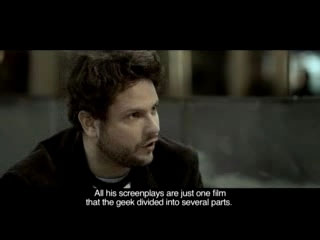
With its first U.S. screening in 2007 at the The Museum of Modern Art in New York, the short film “Tarantino’s Mind” is about a film buff (Selton Mello) who shares with a friend (Seu Jorge) that he’s broken “the code” of Quentin’s work, stitching together interconnections from “Reservoir Dogs” to “Kill Bill.” Hungry Man TV, a web video channel from director Bryan Buckley, currently hosts the film directed by 300ml (Manitou Felipe and Bernardo Dutra). The site also hosts other web series, like “Undercover Cheerleaders” and “Phistophicles, the Lesser Known Greek Philosopher.” To view the film full-screen, you’re better off seeing it on DailyMotion or YouTube. (via Coudal Partners)


Author

Aaron Proctor
Founder, FWD:labs
Director of Photography site
Contact


  • Published in Film + Web

Dr. Horrible

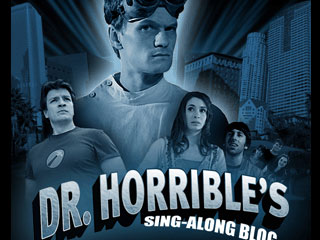
Dr. Horrible, the latest web series — a sci-fi musical, too — for the “low six figures,” Whedon told the Los Angeles Times

Joss Whedon (Buffy the Vampire Slayer, Firefly) decided to do a web project during the writers’ strike. It’s just hit the net and already come and gone in free form, but now the 36-minute three-part series is exclusively on iTunes (open in iTunes) for a flat $3.99.

It’s worth it.

Whedon’s project is Dr. Horrible’s Sing-Along Blog, an Internet mini-series event about a struggling super villain (Neil Patrick Harris) who falls for the girl next door (Felicia Day).

Some excerpts from his master plan, so get ready to feel empowered, and follow his lead just without the famous actors, big money, and industry connections:

It is time for us to change the face of Show Business as we know it. You know the old adage, “It’s Show Business – not Show Friends”? Well now it’s Show Friends. We did that. To Show Business. To show Show Business we mean business. (Also, there are now other businesses like it.)

I finally decided to do something very ambitious, very exciting, very mid-life-crisisy. Aided only by everyone I had worked with, was related to or had ever met, I single-handedly created this unique little epic. A super-villain musical, of which, as we all know, there are far too few.

The idea was to make it on the fly, on the cheap – but to make it. To turn out a really thrilling, professionalish piece of entertainment specifically for the Internet. To show how much could be done with very little. To show the world there is another way. To give the public (and in particular you guys) something for all your support and patience. And to make a lot of silly jokes. Actually, that sentence probably should have come first.

If you like the sound of that, read more on the official site.

This project as a whole asks us, can we change the way we do business as creatives? Will the Internet provide us filmmakers with actual income and communal support? It could mean you no longer hope some exec sees it on YouTube; you might not need him down the road. The middle man is long gone. Today the relationship is artist to viewer and distribution is bandwidth.


Author

Eric Szyszka
Member, FWD:labs
Screenwriting site
Contact


  • Published in Web

jungle-gym

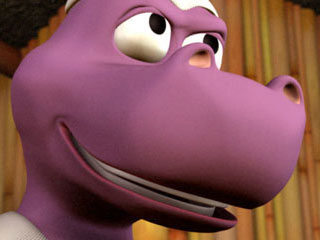
David Badgerow’s film, Jungle Gym

I’ve been intentionally avoiding posting Jungle Gym to YouTube because I was waiting for the festival run to end, and even then was a bit hesitant to share it on the online-video nebula. However, recently I was at a friends apartment and wanted to show them something silly that I had recently saved to my channel favorites. So in order to find this, my sub-intelligent brain thought the best way would be to search for my user account name and maybe it would show up in the listing. Yet instead, when I did this, what came up but my very own film, Jungle Gym, apparently posted 6 months ago now by someone else!

Almost 100,000 hits, over 100 comments, 300 favorites, ridiculous! All of this happening without my knowledge. I suppose I am happy for the added exposure, but a bit blindsided that this could occur under the radar. I of course realized that in my contract with Aniboom, they reserve the right to re-distribute / re-encode my film in any medium they got their hands on, so theres not much I can do about it, but I suppose this is a cautionary example of what happens when you don’t think about what the fine print actually means.

https://www.youtube.com/watch?v=PVRVw0CkaxM


Author

David Badgerow
Member, FWD:labs
Official site
FWD:labs site
Contact


  • Published in Film + Web

Attention: Check out the more-inclusive Apps for Cinema Artists to see even more iPhone apps for filmmakers.

Updated: August 7, 2009

The Apple iPhone, which just came out with a new iteration last Thursday, is the latest mobile platform for filmmakers. And no matter what David Lynch says about it, the latest geek chic is not just for calling people, browsing online, or watching movies: it can help the workflow on set, in post, and that’s just the beginning.

iPhone Apps

The iPhone, and the phone-less iPod Touch, are still new, expensive, and sometimes can mean standing in a line for hours this last weekend. But mobile is an emerging market (even Spike Lee is hot on mobile film) and Apple is making it easy to develop, share and sell small applications than other mobile or PDA devices.

In tandem with the new hardware, Apple released a new area of its online store for downloading free or low-cost applications, made by users themselves. Scott Simmons of The Editblog posted his hopes for post-production applications, from a timecode calculator to a post-specific footage/storage calculator. Jon Chappell of Digital Rebellion, which hosts several web-based applications for filmmakers (originally listed below), also asked for more filmmaker apps. As for now, due in part to Apple’s process to grant licenses to individuals to their Developer Program, there is only one:

Utilities

iPhone Web Apps

Prior to the iPhone App Store, Apple has been providing user-generated web applications (explanation) a listing in their directory. They also explain how to build one yourself, to then submit and share. All of the web apps below are free.

Paul Harill at Self-Reliant Film posted an initial list. We’ve swapped a few and added a few, ready for production or post-production:

Calculate

  • Aspect Ratio Calculator (mobile version) by Digital Rebellion LLC (12/2007)
  • Depth of Field Calculator (mobile version) by Digital Rebellion LLC (1/2008)
  • Depth of Field Calculator by Viewpoint Photography (1/2008)
  • Footage Calculator (mobile version) by Digital Rebellion LLC (12/2007)
  • Film Rate Calculator (mobile version) by Digital Rebellion LLC (12/2007)
  • Lens Angle Calculator (mobile version) by Digital Rebellion LLC (4/2008)
  • Pixel Aspect Ratio Calculator (mobile version) by Digital Rebellion LLC
  • Power Load Calculator (mobile version) by Digital Rebellion LLC (7/2008)

Weather

  • Stormchaser Cloud Reference Chart by Crossgates AC (6/2008)
  • Sunrise & Sunset by Piet Jonas (7/2008)
  • Also: see all Weather web apps on Apple.com

What’s Ahead

Penguin at the Ninja vs Penguin blog, who cites a recent Wired Magazine article on Google’s upcoming move in the open-source software arena to free up the mobile market, calls out to filmmakers to be pioneers:

“We need to understand where technology is bringing us and learn from what business and other content creators are doing with it. Yes we’ll make mistakes, but we make plenty already with our films.”


Author

Aaron Proctor
Founder, FWD:labs
Director of Photography site
Contact


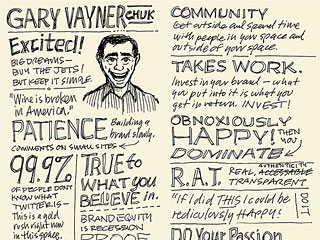
Recently at the SEED 3 conference in Chicago, Gary Vaynerchuk, host of Wine Library TV, a daily internet webcast on the subject of wine with a “unpretentious, gonzo approach”, spoke about the importance of fostering community with online networks. Mike Rohde, a designer and writer in Wisconsin, sketched his notes and posted them online:

COMMUNITY
Get outside and spend time with people in your space and outside your space.

That’s exactly what we did last Friday. (Minus the likes of Gary and Mike, at least for the time being.)

The latest FWD:labs salon gathering, taking up the outside patio lounge at the Wilshire on a luke-warm Santa Monica evening, was another success. The event brought together a mix of cinema-savvy creatives along with their afficionados and audiences. Several were repeat attendees of a previous salon, enthusiastic about coming again.

Unique to these gatherings, we fast-forward past the networking and shop talk and instead hit the slow-mo for embracing conversation and fostering community. Being a small invite-only group, most know someone who knows someone, but there’s still a lot of outspoken energy and enthusiasm about reinvigorating creativity and building friendships.

Nobody has to collaborate, but they all could, many have, and some just might in the future. But for these cocktails and coffees, it’s about celebrating community outside your bubble.

In two weeks, the next meet-up is on Saturday, July 12th. The coffee’s on me.


Author

Aaron Proctor
Founder, FWD:labs
Director of Photography site
Contact


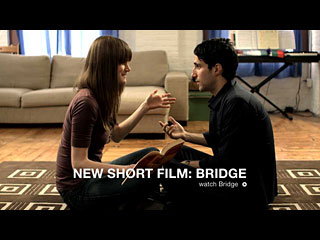
hillman-curtis_bridge

Bridge by Hillman Curtis

Hillman Curtis, resourceful trailblazer and playful maestro of online film and online design, has a new short film you have to experience.

Bridge, embedded below, “follows two friends as they move toward a discovery.” Blow Up, Roof and Embrace (2008 Webby nominee for online video) are just a few of his several other short films. Each beautifully photographed film explores a similar structure: you’re in the middle of a moment, observing the relationship, expression, and voice of the actors.

Curtis also has “artist series” films, whose subjects include filmmaker Mark Romanek and designer David Carson. His commercial clients include SVA (School of Visual Arts) and Adobe. Curtis’ environmental portrait works to provide a more intimate, authentic narrative.

When he’s not leading the creative direction of his Brooklyn-based company with sites like Metropolitain Opera and Yahoo, or cinema-savvy gigs like FoxSearchlight Pictures and Paramount Vantage Films, he also writes about design. His four books are all about new media and are quite highly regarded.

Asked in a 2002 interview on Sitepoint.com of the key message in one of his books, “MTIV: Process, Inspiration and Practice for the New Media Designer,” Curtis touches upon the creativity of a collective mindset:

“I wanted to consider the inclusivity of inspiration… the way we as creatives share and borrow and build upon the ideas of those around us, and those who came before us.”

In 2005, “Hillman Curtis on Creating Short Films for the Web” offered inspiration, instruction and personal touch to the early birds dabbling in online film. Since all have changed in the last three years, the evergreen quality is his approach, noted simply on the book jacket:

“Hillman explains how his flexible, often spontaneous filmmaking style is guided by certain principles–the value of leaving room for serendipity, the freedom found within self-imposed limitations, the importance of collaborating with others, and the possibilities for discovery and revision when reacting to unforeseen accidents.”

(via Motionographer)


Author

Aaron Proctor
Founder, FWD:labs
Director of Photography site
Contact


  • Published in Film + Web

girl-effect_1

Matt Smithson is the director behind the new viral video calling for social change, “The Girl Effect.” The spot was created for Wieden+Kennedy and is part of the $100 million-backed effort from Nike Foundation and NoVo Foundation to the cause, which is about being “the powerful social and economic change brought about when girls have the opportunity to participate in their society.”

The high contrast, upper-case and sans-serif type, along with the quick tempo and elegant strings, serve to communicate the issue clearly and quickly in the 2:23 video. It works as an introduction to the web site, but also stands alone:

By using two elements — such as typography and music — the message resonates. Simon Robson’s 2003 video, What Barry Says, combined the voiceover by Barry McNamara with computer-generated visual metaphors to make its point on social change. Pangea Day’s trailer, What If, which was posted here earlier, elaborated upon iconic video and realistic voice-over as focal points. Even Nike is known for this style, merging jump-cut edits and playful piano for their anthem spot during the 2002 Olympics.

https://youtube.com/watch?v=LyPgHwB82xY

But what message is this type treatment saying? Nike has been criticized in the past for associations with third-world sweatshops. This efforts with this campaign positions Nike as supporter, not exploiter, which helps appeal their image.

And why the girl effect — wouldn’t this theory work with anyone? The fact sheet for the effort notes that women reinvest 90% of their income into her family but a man will reinvest 30 to 40%.

Related, Matt and Sean Pecknold started “a small art and film collective called Pickles (link no longer available) to showcase the work of [their] friends.” From one collective to another, hello!

(via Motionographer)


Author

Aaron Proctor
Founder, FWD:labs
Director of Photography site
Contact