FWD:labs

Blog

  • Published in Film

https://www.youtube.com/watch?v=idirX-fZLD4

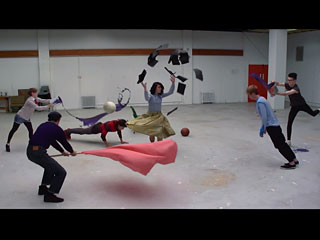
timesculpture

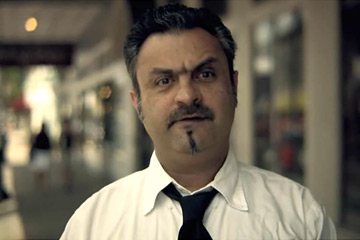
Is it an ad or the future of music videos? Leave it to the Antville.org music video community to argue semantics, but Crystal Castles‘ track “Air War” has a ticket to the big time in a new Toshiba ad.

The spot was directed by Grey, London and Hungry Man’s Mitch Stratten, edited by Christophe Williams at The Whitehouse and posted at The Mill.

Shot with 200 Toshiba Gigashot HD cameras (each just about $1,600), this “Timesculpture” takes the “Bullet-Time” effect ala “The Matrix” quite a bit further. According to the press release, and called out by tech blog Gizmodo or Engadget, this technique of “viewing looping action in 360 degrees has never been done before.”

The $4.6 million dollar spot posted online today and comes with a behind-the-scenes video to see how it all came together. This nouveau music video for “Air War” is currently airing in Europe.

You can see Stratten’s reel and another video for Nodern, at ohdiamonddiamondthoulittleknowestthemischiefthouhastdone.net.


Author

Aaron Proctor
Founder, FWD:labs
Director of Photography site
Contact


Part of a series of posts about active artists with the tenacity to take their project to completion.
danny-boyle

John Horn’s article in today’s Los Angeles Times on various challenges that faced director Danny Boyle, whose new film comes out in limited release on November 12th:

Some directors would have moved on and made do with what they had in the can. Others might have scouted another location. A few might have called up a special effects house to re-create the palace in a computer. Yet Boyle rarely has followed custom, and the outside-the-box thinking that has yielded his eclectic filmography also helped Boyle and his “Slumdog Millionaire” team conjure up a novel solution — they sent in a fake documentary crew to get the footage.

Anne Thompson’s interview for Variety:

Big-budget studio pics are great … for other filmmakers. Danny Boyle thrives when things are lean and focused.

Boyle’s challenge — one happily embraced — was to make $15 million look like a whole lot more. “I like that tension,” he says. “I don’t want to make a dirty indie film struggling with paltry resources. I want to make a film that looks like it cost $50 million or $60 million.”

To do that, Boyle jumped into a 12-week shoot on crazy Mumbai locations that changed overnight, deploying a nimble cameraman with a hard drive in a backpack and a gyro with an attached camera lens in his hand.

“It’s a different way of grabbing reality and it has an intensity to it,” he says. “It lets the mind float off places.”

“Slumdog Millionaire,” which will surely be an Oscar contender, is currently 100% fresh on Rotten Tomatoes, which links up 14 early reviews. Online, skip past the official site for a Twitter-like microblog for mini reviews, created by Real Pie Media. The official poster was designed by Bemis Balkind.


Author

Aaron Proctor
Founder, FWD:labs
Director of Photography site
Contact


  • Published in Film

canon-5d

“Reverie,” a short film by Explorer of Light/PrintMaster Vincent Laforet, shot on the Canon 5D Mark II’s HD video mode. See a making-of video from Laforet; on his blog, it’s noted he did the short in 72 hours with just the camera, a small budget, and no experience or how-to guide.

“With the Canon 5D’s video acquisition proving extremely impressive and with RED apparently unleashing something that will trump it in every way in little over a week I’m very excited about the potential for cost-effective but extremely high-quality digital cinema in the coming decade. Of course shooting on 35mm or IMAX is still the holy grail for most filmmakers but you have to admit the quality of the above video is pretty stunning!” — Jaraad Virani, director


Author

Aaron Proctor
Founder, FWD:labs
Director of Photography site
Contact


[vimeo]http://www.vimeo.com/2107116[/vimeo]

lhomme-100-tetes

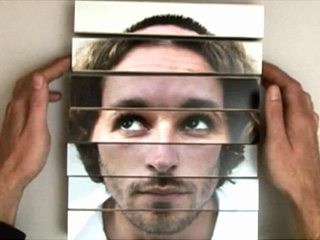
Directed by French artists, Julien Lassort (web design site, Vimeo profile), 27, and Matthieu Burlot (Vimeo profile), 19. Julien Fargo of Montreal composed an original score.

The stop-motion short — a finalist in Panasonic’art 2008 — is a “mosaic of portraits and emotions that plays off of the power of faces seen close up,” which the artists note is “the most exposed and personal part of the human body.”

(via Fubiz)


Author

Aaron Proctor
Founder, FWD:labs
Director of Photography site
Contact


  • Published in Film

synecdoche

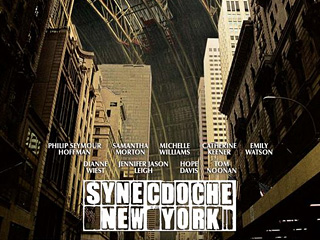
Charlie Kaufman said he always thought “Being John Malkovich” would be a sample. What happened instead was that it got made. Kaufman then gave us the off-beat “Adaptation.” He has experimented with the weird for a while but his magnum opus is now “Synecdoche, New York.”

“Synecdoche” is distinctly Kaufman but also as weird and refreshing as Lynch. It’s a movie you can see multiple times and have a different experience. It makes you wonder. Lately, cinema doesn’t let me wonder. It lets me know the bad guy is dead and the good guy gets the girl. However, I always knew that would happen. With the work of people like Kaufman, I never know. That is different. That is a real film experience.

This is a level of screenwriting that no new writer seems to tackle. It is the almost impossible. It is that surrealist film that your market-minded brain says you cannot sell. While there might be some truth to that, you probably won’t sell it, but also given statistics, you probably won’t sell your too-cool-for-school actioneer either.

People should tinker with symbolism, darker themes, and the unknown. If injected into a more conventional piece, it adds some edge. Or if it’s a writing experiment, it would be cool to have a trippy sample in your deck of cards. You can let your work flow and not be as worried about plot points and act structures.

A published poet and friend of mine, Stephanie Valente, took a stab at a semi-surreal script and managed to come full circle in a month. “The Space Between Dreams” is a feature script that is as tight as most thrillers, about falling in love with someone in your dreams and how to make those dreams a reality. It’s a refreshingly different read than most scripts floating around out there.

Everyone should feel okay with writing something different. I think it’s a very liberating experience for writers new or old to just go for it. It helps you grow as a writer and makes you think differently in the future.

You’ll have to see “Synecdoche, New York” for the full effect, but right now you can get inspired with the WGA’s Charlie Kaufman interview (embedded below), Wired Magazine’s two-and-a-half-hour interview, or Creative Screenwriting’s hour-long podcast.


Author

Eric Szyszka
Member, FWD:labs
Screenwriting site
Contact


  • Published in Design

nobodyssweetheart_mad-men

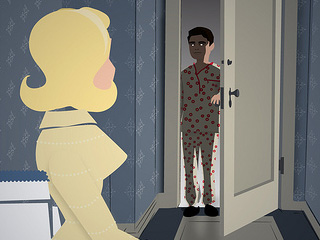
“This Room is Occupied,” Season 1, Episode 5

Dyna Moe takes on the personal challenge of creating an illustration for each episode of AMC’s hit show. Pure genius. Thanks Dyna!


Author

Jeremy Troy
Member, FWD:labs
Writer/Producer/Editor site


  • Published in Film + Web

princess-of-nebraska

On Friday, YouTube premiered its first full-length studio feature, the Wayne Wang film from Magnolia Pictures, “The Princess of Nebraska.” The film is a companion feature to “A Thousand Years of Good Prayers,” which screened in theaters last month.

In today’s New York Times, critic A.O. Scott touched upon viewership:

[Within three days,] the film had attracted more than 140,000 views, which is a larger audience than it would have found in a limited art-house release in New York and Los Angeles. (And the film is not notably worse than what you might see in those theaters.) Whether all those views reflect people watching until the end is hard to know, but some of their reactions are collected in comments on the site, ranging from thoughtful analyses to ‘THIS HAS NOTHING AT ALL TO DO WITH NEBRASKA.’

According to the Associated Press, Wang finished “Thousand Years” under-budget and “just went ahead and did” his next feature:

The film was made quickly with digital video and was “shot like a jazz riff,” Wang says. It’s hard enough getting one foreign language film into theatres, let alone two – so the opportunities for “Princess” in the U.S. were few.

“When the idea came up, I said, ‘Well, that makes sense’ – even though I didn’t intentionally make it for that,” said Wang, referring to YouTube. “The film is very much inspired by new media, by watching a lot of things on the Web and YouTube stuff.”

Wang told his local paper, The San Francisco Chronicle, how he likens his approach to music. “It’s a whole new alternative source. … Like in music. You know, Radiohead and Neil Young released new albums, they were all on the Internet for free first, and they were very successful.”

TIME Magazine spoke with Magnolia Pictures’ Ray Price on the challenge of marketing two films, acknowledging the lackluster ticket sales for “Grindhouse,” the Robert Rodriguez/Quentin Tarantino double feature. “People don’t want to watch double bills, and it forced us to be innovative … we wanted these films to have a concurrent release, but at the same time we wanted to be smart about defining success.”

Free distribution of a $200,000 feature isn’t too new anymore. The Wall Street Journal noted the other avenues of debuting a feature online, including Pete Schuermann’s feature “Haze” on SnagFilms.com and David Modigliani’s feature “Crawford” on Hulu.com. WSJ columnist John Jurgensen notes:

In response to all this, filmmakers are starting to come to terms with the idea of releasing their work on the Web. It’s a notion musicians grappled with years ago. Offering art online rarely earns a creator much up front, but it boosts the odds of broad exposure. With no need for old-fashioned film prints, going on the Web is cheap and quick. And directors can get instant feedback from online viewers.

The film originally premiered on 35mm at the 2007 Telluride Film Festival. Now available online, viewing appears to be limited to U.S. access only. Wired Magazine notes the free feature is for a week-long run.

YouTube’s Screening Room

The film-friendly Screening Room keeps comments and ratings separated to the secondary page, unlike the normal YouTube.com. The trailer for “Nebraska” is rife with trite, negative comments, but Wang weighed in. He likes the “accidental encounters” that are unique to online viewing, as he told The Wall Street Journal:

So far he’s noticed that those accidental viewers make more comments about the looks of the main character than the film itself. “I don’t see a whole lot of communication about aesthetic. That’s fine, too,” the director says.

YouTube has been wrangling in filmmakers, but this first studio film is a big step in further attention to the initiative. In a recent video interview, Beet.tv spoke with directors Torill Kove (“The Danish Poet”), Fredrick Emilson (“Love and War”) and Rob Pearlstein (“Our Time is Up”) about their interest and inclusion in the Screening Room.

To help monetize some of the distribution, YouTube allows the filmmakers to their preferred purchase links, be it DVD purchase, HD download, or iTunes, respectively. Since June 2008, each film has over 300,000 viewers to date.

Need to be different, take chances

Keen on new media, Wayne Wang told the Associated Press of his challenge to other filmmakers:

“You kind of have to think differently about (filmmaking),” added Wang. “It has to move faster, the images have to be tighter, you can’t really see a lot of details. If Thousands Years was shown on the computer, I would be kind of depressed… it has to be projected big.”

But as the distribution avenues for independent film become fewer, Wang thinks filmmakers need to explore different alternatives and, above all, make better films.

“We as filmmakers need to be smart about the kinds of films that we make and take more chances,” he said. “The problem is that most independent films are trying to make Hollywood films. They’re basically straightforward narratives and they’re a little more interesting, but not that much more interesting. Take a film like `Blair Witch.’ It’s not the greatest film, but it’s at least something really different.”


Author

Aaron Proctor
Founder, FWD:labs
Director of Photography site
Contact


  • Published in Film

mark-lewis

Lewis' 2007 project, Isosceles, can be viewed online. The 3 minute piece was shot on Super 35mm and transferred to high definition.

In June I had the pleasure of working with Mark Lewis, a self-described “moving picture artist.” Mark was in from London to finish the second half of his documentary about rear-projection and it’s longtime custodians, the Hansard family. Mark and his DP, Brian Pearson, had already shot half the documentary the year before as background plates upon which they photographed the second half of the doc.

In a warehouse in Sun Valley, technology old and new merged in an interesting way: the Red camera was used to shoot new footage of various Hansard kin in front of their rear-projection screen. At one end of the warehouse, the Red camera, firmware updated only the week before. At the other end, the carbon arc flame rear-projector, 9 feet tall as if it was an inch, iron clad and, visually, straight out of 50’s sci-fi. The operators of these two machines were separated by 300 yards and 40 years.

Adjacent to the Red, the so-called “data wrangler” station: 4 TB of blue-LED’d storage (why always with the blue LED’s on these drives?), gleaming Macbook Pro, young 20-something “wrangler.” Nearby, the analog analog: buttressed by stacks of film canisters, a Moviola, used by Mark to identify which bits to project behind which Hansards. It was truly a sight to see.

I recorded sound on this project and talked to Mark briefly about my role before we began shooting. He had little to advise me on as, of the dozens of films he has made over the years, only a small handful have sound. They are truly “moving-pictures” in the most literal sense of that phrase. However attached I am to the notion that motion pictures are approximately one-half sound, one-half picture (and I think that holds true for most narrative work) I must admit that nothing is lost from audio being absent in Mark’s films. Sound might even distract from the experience.

Mark told me that, for the most part, his works are installed as exhibits in art galleries, sometimes projected enormously. Computer LCD screens presently maxing out at 40 some-odd inches, we’ll have to settle. Have a look at marklewisstudio.com.


Author

Mike Weinstein
Member, FWD:labs
Location Sound site
Contact


  • Published in Film

50-people-1-question

“We didn’t know exactly why, I guess we were hoping to expose a slice human emotion (maybe). Just the simple act of reaching out and asking the question, is such a enthralling experience in itself.” — Benjamin Reece

An indie filmmaker, photographer and designer in New Orleans, Reece asked “if you could have one thing happen before the end of the day, what would it be?” 100 hours later, using an Canon HV20 with a 35mm adapter, he came up with this:

[vimeo]http://www.vimeo.com/1737450[/vimeo]

Another short film of his, Meet the Painter, met a similar, simple constraint: “whatever film I start shooting, I have to finish editing and upload by the end of the day.”

(via Christopher Sharpe)


Author

Aaron Proctor
Founder, FWD:labs
Director of Photography site
Contact


Part of a series of posts about great film, web, or design artists and their work abuzz online and in-person.
gary-vaynerchuk

Thousands of people tune in to every episode of Wine Library TV, a fast-paced web show hosted by Gary Vaynerchuk. To date, his 551 shows since February 2006 sound off on wine picks all week long, which are often shot in one quick sitting.

In episode #550 of the “Internet’s most passionate show about wine,” embedded below thanks to Revver.com, Gary shares his unique perspective on Chianti Classico and Parmigiano Reggiano:

From practical advice like decanting, to straight-forward education about grapes, Gary’s enthusiasm for wine extends past his passion for his fans to advice that anyone doing online video can swallow. Take this episode from August 2008 where Gary discussed “Content and Community: How to build a good show on the Internet.”

“It’s not the glitz and the glamour. … It’s not about the widgets. It’s about the two C’s: content and community. Pump out great shit as hard as you can, five days a week, even seven. … You need to give them what they want, not what you want to give. … It’s about giving from your heart, with content that you understand. … Never ever take a viewer for granted.”

Get a full-bodied sense of the guy from any of his latest video posts at his site or his tweets on Twitter.

Also, see a previous post which cited a quote from Gary about the importance of fostering community with online networks.


Author

Aaron Proctor
Founder, FWD:labs
Director of Photography site
Contact


  • Published in Film + Web

stuart-townsend_latimes

Photo by Jay L. Clendenin / Los Angeles Times

Stuart Townsend, actor-turned-writer/director, took his disenchantment with uninspiring projects and did something about it.

“Battle in Seattle,” which opened in limited release September 19, is a fictional take on the 1999 protests of the World Trade Organization, which mixes real footage of the peaceful scene that eventually turned into a violent riot.

View the official trailer for the docu-drama:

https://youtube.com/watch?v=YmQzw-O8eRY

Calls to action

At a screening Sunday night which included an opening remark by Townsend himself, he noted it took six years “within the insane Hollywood thing” to get the film from idea to screen. He asked the audience to tell their friends about the film, but in Sunday’s Los Angeles Times, he also noted the options online to engage with his audience for the greater cause. Offering ways to become active participants works especially well with this film since the WTO Protests in Seattle, 1999 were “the first Internet protest in history.”

Townsend hopes that the film will serve as a jumping-off point for a new generation of protesters and citizen activists. Townsend has created … websites — including whocontrolstheworld.com and 5actions.org — where people can network, sign petitions, organize protests or simply become informed about issues related to the film.

“Ultimately, I’m trying to make this film for all those young Barack Obama supporters who are energized, who realize the stakes are high, who are becoming political, becoming aware and educating themselves,” says Townsend. “It’s those younger, more idealistic people who see this movie as a clear example of how change really happens. It’s actually putting your boots on the street and using your voice. That’s how change happens.”

For comparison, view one of the many actual accounts of the protest:

When change works

A regular theme of socially conscious films, change works when the audience can make a difference in evangelizing the film beyond downloadable ringtones and wallpapers. Participant Media is one “provider,” as they call themselves, that for every narrative and documentary it distributes, they emphasize the social follow-through actions. They even created a social network to wrangle action for all of their projects, TakePart.com, such as Brett Morgen’s “Chicago 10”. Another Participant film, Davis Guggenheim’s “The Inconvenient Truth,” made use of ClimateCrisis.net and WeCanSolveIt.org. The ending credits, embedded below, help to transfer the end effect of the movie to next steps.

See previous posts about the passion-centric efforts of the environment documentary “11th Hour” as well as the social advocacy angles of EyesOnDarur.org, Ironweed Film Club, Good Magazine and Current TV.


Author

Aaron Proctor
Founder, FWD:labs
Director of Photography site
Contact


  • Published in General

untitled-screenplay

The infamous blank page

Part of a series of posts about adventures in screenwriting.

These are some lessons that I’ve picked up in my four years of screenwriting. They might not help you at all, but here they are nonetheless.

Writing is essentially making a series of choices. I choose where my characters are. I choose what they say. I choose what they do. I choose what happens to them. Writer’s Block happens when I can no longer make a choice.

Now, why I can’t make a choice will determine how I handle my writer’s block. Is that I am mentally unprepared to make that choice? Or is there some detail of the story I can’t quite figure out?

Let’s deal with the second case first. Since the problem arises from the material of the story, we’ll call this case material writer’s block. Here are some ways to get through it.

  1. Start writing. I know, you’re thinking, “But I don’t know what to write.” I don’t care, the most important thing is to not get stuck. Writer’s block is habit forming. The longer you have it, the harder it is to break because the more you think about it, the harder it becomes to make that next choice. So treat it like quicksand and choose anything. Have your characters say anything. It can suck. That doesn’t matter. You can always rewrite it later once you’ve figured out where you’re going. Unfortunately, that doesn’t always work, so here’s number 2.
  2. Make a list of every possible outcome for your scene. List everything anyone can do in that scene. Then choose the most interesting thing and write it.
  3. Figure out where you want the story to go. What do you want to happen next? Where do your characters need to go? What needs to be said? What does your story need to happen? Then write the scene to take you to that moment.
  4. Draw. Draw a picture of where your characters are in relation to each other. Draw a map of how you want the scene to progress through time. Draw the sequence of actions that you want to happen. Then line them up in the most dramatic order and write that scene.
  5. Rewrite. Sometimes, you can figure out where you want the scene to go, but you can’t figure out how to get there from where you are. Save a new copy of your screenplay, so you’re not worried about throwing anything away and never getting it back and start the scene over again. Rewrite it from the beginning with any new insights you have gained from the previous steps. You don’t have to have the whole thing mapped out. You don’t have to know exactly where you’re going. In fact, the most interesting writing happens when you only have a vague idea where your going. If you know your characters, they’ll tell you how to get there. Plus, you’ll be surprised how many new ideas come to you as you get your fingers moving again.

The trick to this last step is that you can work in the new directions you want the story to take into early moments in the story and it’s easy to get moving again because you’re not writing new material. When you get to where you were stuck before, you’ll have those new plot beats to get you past it.

Okay, that’s it for today. If I wasn’t clear on anything or if you have any questions, comment below and I’ll respond. Next time, I’ll talk about psychological writer’s block and how to get into a good mental state for writing.


Author

James Granger
Member, FWD:labs
Screenwriting site
Contact