FWD:labs

Blog


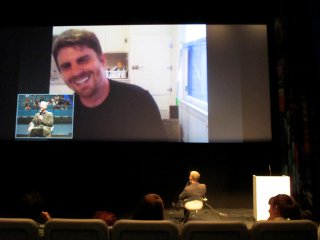
Last night at a preview screening of “Bellflower” at the Museum of the Moving Picture, director Evan Glodell did a 30-minute Q&A skyping from a friend’s kitchen with chief curator David Schwartz and the audience directly, which FWD:labs member and screenwriter Eric Szyszka attended.

The auteur, who made this first feature for $17,000, claims to have never even heard of director Wong Kar-wai and vaguely knows the name Jim Jarmusch.

“Bellflower” premiered at the 2011 Sundance Film Festival and picked up distribution. Part of his contract is to build two flamethrowers for the distributor, which Glodell has been building since the age of 12. The film screening was followed by a 35mm print of the original “Mad Max.”

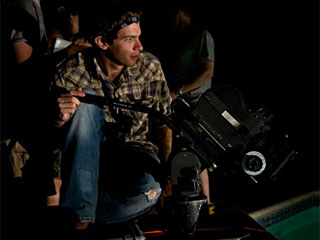
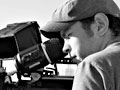
According to an interview with Fast Company, he built his own view camera based around a SI-2K mini, which he calls the Coatwolf Model II:

The Model II combines the SI-2K’s digital cinema chip with an utterly enormous 4×5 imaging plane — the same size favored by fine-art still photographers. That’s why the (it) looks almost like two cameras Siamese-twinned together: It’s essentially a large-format view camera whose ground glass is “filmed” by a Hollywood-quality digital camcorder.

“This camera does things that no other camera on the planet can do,” Glodell says. “It can do tilt-shift effects with any lens. It can make a Steadicam shot from five feet away look like a telephoto shot from 100 feet away. It’s like looking out of a whale’s eye.”

In the film’s review in the New York Times, “Bellflower” is aptly compared to Robert Rodriguez “El Mariachi:”

Mr. Glodell is working distinctly different story terrain, however — in this case, an affair gone apocalyptic — and with technical virtuosity and beauty. Playing with color, he washes “Bellflower” in a warm orange that soon heats up, and lets grime spatter the lens to accentuate Woodrow’s increasingly murky thinking. Unlike many young filmmakers, Mr. Glodell, working with his cinematographer, Joel Hodge, fully exploits the plasticity of the image. The intentional roughness of his visuals, their literal dirt and distortions, underscores that this is handmade, personal moviemaking.

https://www.youtube.com/watch?v=j3KX2IPTbjE

Related, check out the car’s appearance in three recent 5 Second Films: Burning Rubber, Joy Ride, and Film Permit.

Author

Aaron Proctor
Founder, FWD:labs
Director of Photography site
Contact


  • Published in Design

Photo by Tim Palen

Hollywood exec Tim Palen recently made Fast Company’s Top 100 Most Creative People in Business. In addition to being the head of Theatrical Marketing at Lionsgate, which had a record year of success in 2010, he also photographs the posters for his films, including Saw, Precious, and Hostel among others. He offered some inspiration in the profile:

“The best advice I got was from a mentor who told me to ‘not make my passion a secret.’ He encouraged me to give my work away, paste it on the walls, and share it with as many people as I could.”

In a 2007 review of Hostel II marketing in the Los Angeles Times, columnist Patrick Goldstein explains the reaction to Palen’s authentic but controversial work:

The photo, which appeared in an ad in our paper on Sunday, stops you in your tracks, which, of course, is what great advertising is meant to do. If you want truth in advertising, this is it — you couldn’t possibly walk in to see “Hostel: Part II” thinking it is a harmless teen comedy. But while I admire the art of these posters, there’s a fine line between an image that deftly captures the spirit of a gory film and an image that glamorizes the degradation of women.

While Palen’s work is often over the top, it’s demographic appropriate. And it sure beats floating heads.


Author

Aaron Proctor
Founder, FWD:labs
Director of Photography site
Contact


Part of a series of posts about great film, web, or design artists and their work abuzz online and in-person.
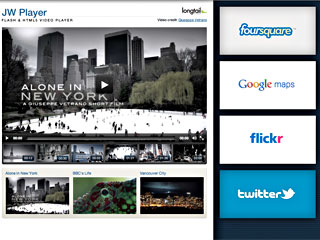
  • The latest JW Player demonstrates how video can sync with social media via JavaScript queries based on its timecode and metadata. Alternatively, Popcorn.js is an HTML5 framework by Mozilla (makers of the Firefox browser) for better integrating the web with video. (We proudly use JW Player, in addition to Quicktime, in the FWD:labs web app.)
  • John Pavlus at Fast Company interviews the cinemagraph duo — Jamie Beck and Kevin Burg — on their beer project, which illustrates “process value vs. production value.” (Pavlus also elaborates more on his idea of process value, “This is How We Do It” and “Process Value and Physical Explainers.”) Check out the finished cinemagraph work for Dogfish Beer.
  • Computer scientist and writer, Dan Farfan, writes on Quora about “how Netflix missed a chance to address [(the issue that) streaming content is only 25% of the entire catalog] at the same time it changed prices. If Netflix can give users a voice in what can be streamed, that will go a long way.” (via adage.com) Farfan recommends a voting system to improve what content streams, which is both valuable to customer satisfaction and business with film owners.

Author

Aaron Proctor
Founder, FWD:labs
Director of Photography site
Contact


  • Published in Film + Web

[vimeo]http://vimeo.com/18275127[/vimeo]

NYC-based Brainstorm Digital breaks apart their VFX work on “Boardwalk Empire’s” first season. The show, nominated today for an “Outstanding Drama Series” Emmy and winner of two Visual Effects Awards, comes back in September for a second season.

(via animator David Badgerow)


Author

Aaron Proctor
Founder, FWD:labs
Director of Photography site
Contact


Doug Pray

I first met director Doug Pray shooting an interview in 2009 for UCLA Theater, Film and Television, while his film “Art & Copy” premiered at the Sundance Film Festival. Last month, he shared his 7 basic rules about making documentaries with Jonathan Wells at Flux, a creative community similar to ours here at FWD:labs. Here are three points that I’ve found especially relevant on recent doc shoots:

Research is essential, but pre-interviews with your subject can kill good interviews.

Short, simple questions in interviews are much better than long, rambling ones (which tend to be more about you, than your subject). The best question of all time is “why?”

Don’t ask your interviewees to “repeat the question in their answer.” Besides stressing them out and making them do your job for you, it leads to boring answers. When they give you one word, un-editable answers, just act stupid and ask them what they’re talking about, as if you forgot. Repetition is fine.

Got something to add or a whole new tip entirely? Post it in the comments below.


Author

Aaron Proctor
Founder, FWD:labs
Director of Photography site
Contact


  • Published in Film

https://www.youtube.com/watch?v=VXepNCs_iZo

Final Cut Pro X

“Everything just changed in post,” the Apple site proclaims. Yet overheard in editing suites near and far, the changes of Final Cut Pro X for its professional user base sound like this:

  • “After suffering the last two very disappointing updates, this new FCP X finally confirmed to me that Apple has no intention of making it a truly professional app. In the meantime, Adobe Premiere has reinvented itself into a serious piece of software. Now I’m looking to switch apps.” – Jeremy Troy, editor and FWD:labs collective member
  • “The new Final Cut is a step forward and 2 steps backwards.” – Tim Cruz, director
  • “Did you hear they gave iMovie a new name? Final Cut X! Super cool dudes!” – Hank Friedmann, director/editor and FWD:labs collective member
  • “Yep, everyone was right. FCP X blows – it’s like a slightly enhanced version of imovie. For instance: what the fuck is an ‘event?'” – Daniel Steiner, filmmaker and FWD:labs collective member

The Apple Store, which sells the software for $299, temporarily turned off reviews as users rated the program 1-star. One commenter, Pretty J, notes the dupe: “[t]his application should not be called FINAL CUT PRO as it is in NO WAY COMPATIBLE with older versions of FCP. Basically rendering the app useless if you are in need of accessing older FCP projects. Its basically IMOVIE with a few improvements.” Apple is also uncharacteristically offering refunds, even though the App Store notes that “all sales are final.”

Meanwhile, Scott Simmons at ProVideo Coalition provides a thorough analysis of the product. “[I]t is not ready for professional use. … To completely start from scratch and build a new, modern application is commendable but when it lacks many, many features that its predecessor had and you’re still calling it pro and a newer version then you can expect a lot of negative feedback from current users who rely on those features.”

Walter Biscardi at Creative Cow digs a little deeper at what all is missing for the pros, including how it’s a deal breaker for a once-evangelist. “Just the fact that we can’t open old FCP projects alone would be enough for me to stop, but … there is just no way that any amount of fancy new tools built inside a stand alone app that traps you in said stand alone app is going to make it in our workflow. It’s easier to move the projects into Avid or Adobe Premiere than it is to move them into the new Final Cut Pro.”

David Pogue, tech columnist at The New York Times, helps explain where some things went — according to Apple — in a clear-cut Q&A. The solutions are either expensive plug-ins, future releases, or no planned support.

In the Times, one commenter from London, magnusben, maybe sums it up best:

“People are upset because they have grown, economically and creatively, attached to a tool which they have developed with Apple over a decade. Clearly it needed to be reworked – for instance with 64-bit support and to fully use multicore Macs. But … any professional editor will tell you that the drift of these changes is in the wrong direction. It’s not just the features, it’s the total disregard for the things we actually need.

“It feels, from our perspective, like arrogance on the part of Apple to disregard the working practices of our industry. It’s upsetting because there will be a time-limit on how long Final Cut Pro 7 will remain usable, and people have a lot of money and time invested in this software.

“It’s either massively cynical on their part or a total balls-up. I’m putting my money on the cynicism and will switch back to Avid MC after my witless evangelism for FCP over the past 6 years.”

What are your thoughts? How can Apple repair their stake in the professional editing market? How will filmmakers overcome this hurdle?


Author

Aaron Proctor
Founder, FWD:labs
Director of Photography site
Contact


From a recent Fast Company article, “Why David Fincher Is the Best Design Thinker in Hollywood,” by John Pavlus:

Calling a director a “designer” is almost a tautology: indeed, anyone making creative choices about what to leave in or leave out, in any medium, is designing. But Fincher’s coolly intelligent eye, laserlike attention to detail, and (in his best work) apparent fascination with storytelling as problem-solving, all set him apart from other filmmakers as a true designer-auteur. He makes films like Jony Ive makes iMacs: They just work — with style to burn.

Take The Social Network. Fincher has said in interviews that he personally related to Zuckerberg’s character: the young punk who thinks he’s smarter than everyone else in the room, and actually is. (Makes sense: Fincher was directing Madonna videos when most dudes his age were still playing video games in Mom’s basement.) But the film is a classic Fincherian puzzle, too: is it possible to make a film about pasty dorks tapping away on computers into something visual? That’s a design problem through and through — a product-design problem, no less. (That analogy to Ive was no accident.)

Read the whole article.

(via Chicago Sun-Times, “Let’s get social: Networking frames”)


Author

Aaron Proctor
Founder, FWD:labs
Director of Photography site
Contact


  • Published in General

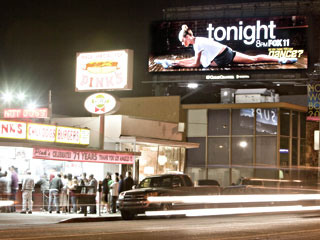
I set a goal to have a billboard up in Los Angeles by the end of the year, and here in June I’ve got my first.

It was a long journey. I started as the behind the scenes photographer for the auditions of So You Think You Can Dance three years ago. It was one of my first assignments for FOX, so I went all out and brought a medium roller rigged with a p50 magnum on one side and a beauty dish on the other (so the same rig would work for portraits of dancers inside and out). I got great feedback from the show’s publicists and the next year I was asked to shoot the live show. This was a new challenge for me: over the previous year I had spent a lot of time on set photographing all sorts of TV shows, but nothing with the energy, excitement, and stress of a live show. I suppose it’s a lot like shooting a sporting event, except that instead of dozens of photographers all capturing the event, I was the only one shooting the show each night, so if I was to ever miss a shot, that shot simply wouldn’t exist. It was pressure, but fortunately I love pressure.

At the same time that I was working on sets of TV shows, I was working on my lighting and group portrait skills, and the next season I was asked to shoot the publicity gallery, which was an incredible opportunity. I started my photography career as an assistant on these types of big publicity shoots and had always wanted to walk on set one day and know that it was going to be my eye behind the camera. Five years later, it was finally happening.

But, it wasn’t until this year that I got the call to work on the marketing campaign. It was going to be a challenging shoot because we were piggybacking on the motion commercials they were shooting for the show. Same location and same models means saving money, but it also means a much more hectic day as two crews balance around each other to get everything they can in the time allowed. And of course, since the photo shoot was happening at the good grace of the motion shoot (who was footing the majority of the bill), we had to defer in terms of locations and timing. But we thrive on challenges, so in the course of the day we managed to shoot 5 different models in 4 different set ups. Not bad.

We got great feedback on the shoot, but of course we didn’t see anything for quite a while as the creative wizards at FOX worked their magic on the files. Then one day, driving up La Brea, boom, there it is.


Author

Mathieu Young
Member, FWD:labs
Photography site
Contact


  • Published in Film + Web

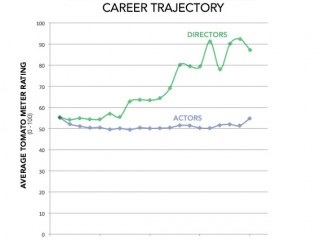
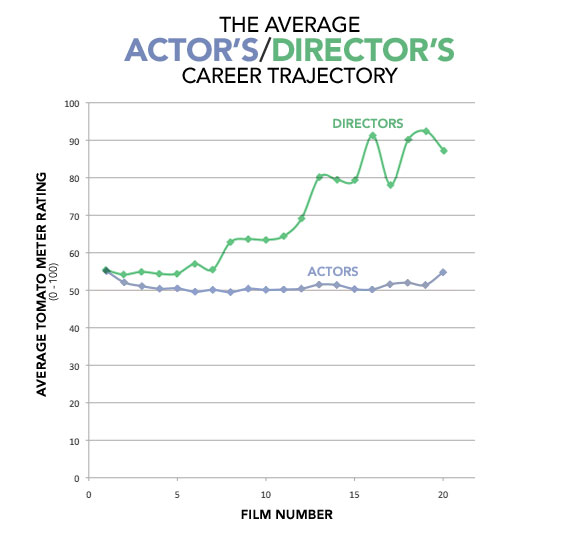
According to Slate.com’s “Hollywood Career-O-Matic,” a mash-up of select RottenTomatoes.com statistics from 1985 *, their data visualization suggests actors have to make it great first, whereas directors have to keep getting better.

The average actor’s critical reception gets slightly worse over the course of his first few movies, then plateaus. The average score for an actor’s first film is about 55 percent. By his fourth movie, that score slides to about 50 percent, where it hovers for the rest of his career.

Directors’ careers follow a different trajectory. Like actors, a director’s first movie averages a Tomatometer rating around 55 percent. But the average ratings for the next few movies don’t drop much at all, never falling below 54 percent. Then, between the average director’s seventh and eighth movie, the Tomatometer ratings jump dramatically, from 55 percent to nearly 63 percent. That score stays steady for the average director’s ninth through 11th films and then jumps again to the 80s and 90s for the rest of his career.

Most actors have to appear in good movies early in their career. Those who don’t risk being flushed out of the business. Once they’ve established themselves with a good film or two, they can safely make some bad ones. But all in all, they don’t have nearly as much control over film quality as directors do. Directors’ scores spike over time, presumably because only the best ones stick around long enough to make so many films.

Is this still accurate in today’s film industry? Or are there exceptions now more than ever? Does this pressure for acclaim exist for actors or is there merit to quantity over quality?

* RottenTomatoes.com has been online since at least 1999 and some critique of this data is its accuracy back into the 1985 cutoff of their mash-up.


Author

Aaron Proctor
Founder, FWD:labs
Director of Photography site
Contact


  • Published in Film + Web

'Meet me at the bar…' by Jamie Beck and Kevin Burg

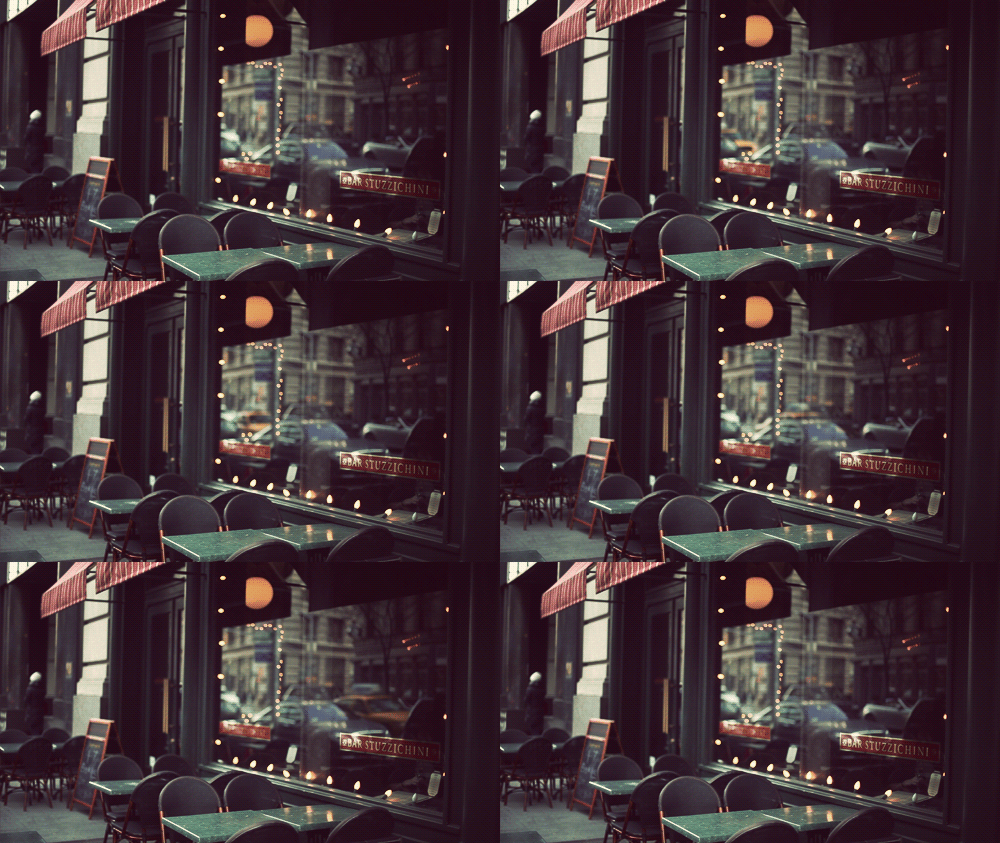
Nowadays, somewhere between photography and video is the art form coined the “cinemagraph,” which comes to us as a looping animated GIF. Jamie Beck shoots and Kevin Burg edits. The work is abuzz, especially on Tumblr, a platform where photoblogging thrives. Separate from tutorials on this technique (1, 2), I spoke with Kevin Burg about their process.

1. Did this start as a happy accident or deliberate practice? What’s the creative criteria for making one of these?

Kevin Burg It came out of our coverage of New York Fashion Week this past February. We were looking for a different way to show Jamie’s readers what the experience of going to Fashion Week is like and we briefly considered video but ended up doing rapid sequential shots. This evolved into more fluid motion and eventually to what you see now. The criteria is fairly strict and we need to shoot with the specific intent of creating a cinemagraph otherwise there are a myriad of chaotic things that can happen that make a shot tough or impossible to edit.

2. The work is amazingly seamless in their loops. What’s the technical process? Multiple frames per second or one? Masking or something more surgical?

KB It’s different each time – I often begin to edit one and have to come up with new techniques to make a loop. It’s usually a frame by frame process to make something seamless so there isn’t really a broad explanation of how to make it work.

3. In a world of Flash and HTML5, why the 256-color GIF?

KB Jamie’s blog is on Tumblr (From Me To You) and there’s a kind of GIF renaissance happening there. The internet is overloaded with video so it’s a difficult task to decide what to watch in a limited amount of time so GIF has stepped in as a way to distill something from a video down to a quick moment that’s easy to ingest. A big part of this is due to Tumblr’s image hosting capabilities as well as their social platform – it makes the images very easy to share and since GIF is so universal and accepted as a file format it can be shared and linked to very easily.

When we work commercially most often utilizing HTML5 video makes the most sense. Case in point is the images we did for Gilt Taste; click on the other categories to see more.

4. Describe this collab with photographer Jamie Beck.

KB I’d been making GIFs out of TV or video content for a couple years and when Jamie and I began collaborating I took that technique and applied it to her work and she in turn began shooting with the cinemagraph image in mind. Each cinemagraph begins as one of her photos then we combine that with the more fluid motion video in order to make an image come alive or tell something more about a scene. We work together at each step to create the best images but there’s a respect for what we each do best.

5. There’s a lot of press and blog coverage of this. What’s your reaction? Any notable comments from viewers that resonate?

KB We weren’t anticipating the level of press we received but it’s been very interesting to be part of and the experience of it has been so much fun. Comments have been almost all positive and in some cases sparked a debate over broad topics like “what is art” and that’s been fascinating to watch. The most common comment is a comparison to the living/talking images in the Harry Potter movies.

6. Where do you think “cinemagraphs” can go next?

KB We’re working on gallery shows, mobile devices like iPad, experimental techniques and higher quality output. We believe there is an opportunity to show people a different way of viewing an image and the exciting part is it’s purely digital so as new display technologies come to market the number of applications for a new type of photograph becomes greater.

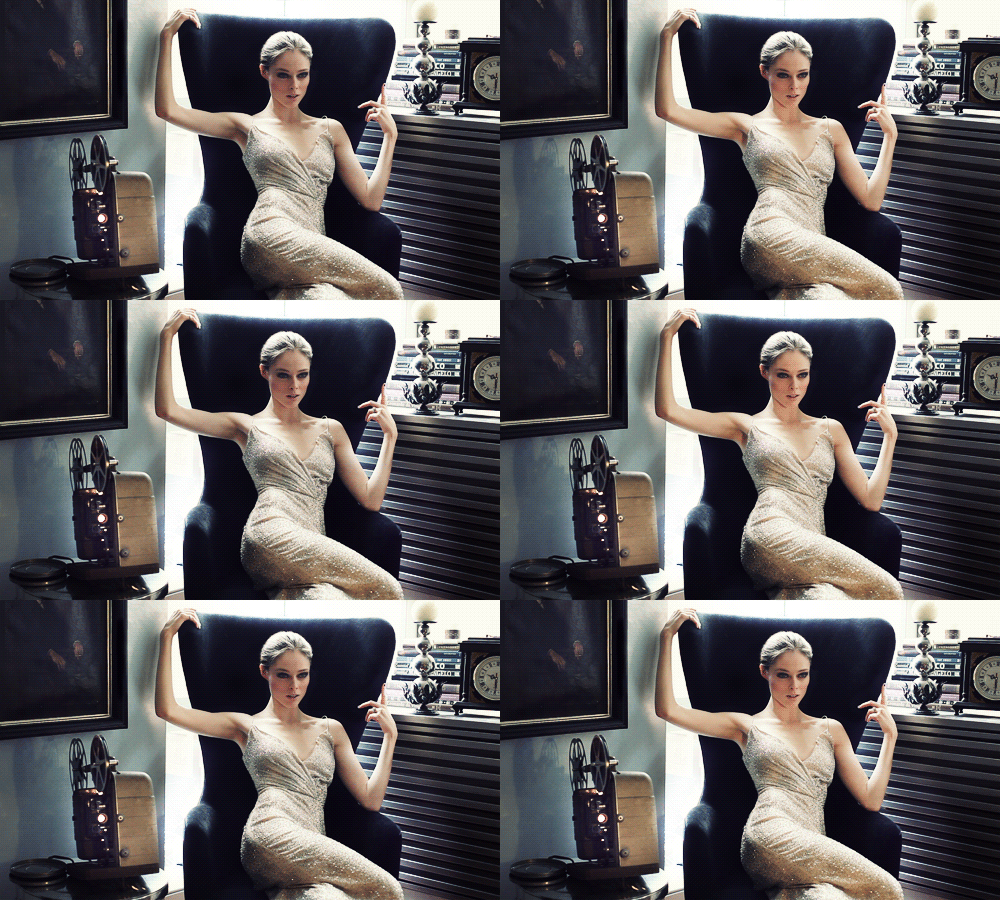
'Showtime' by Jamie Beck and Kevin Burg featuring Coco Rocha in an Oscar de la Renta dress

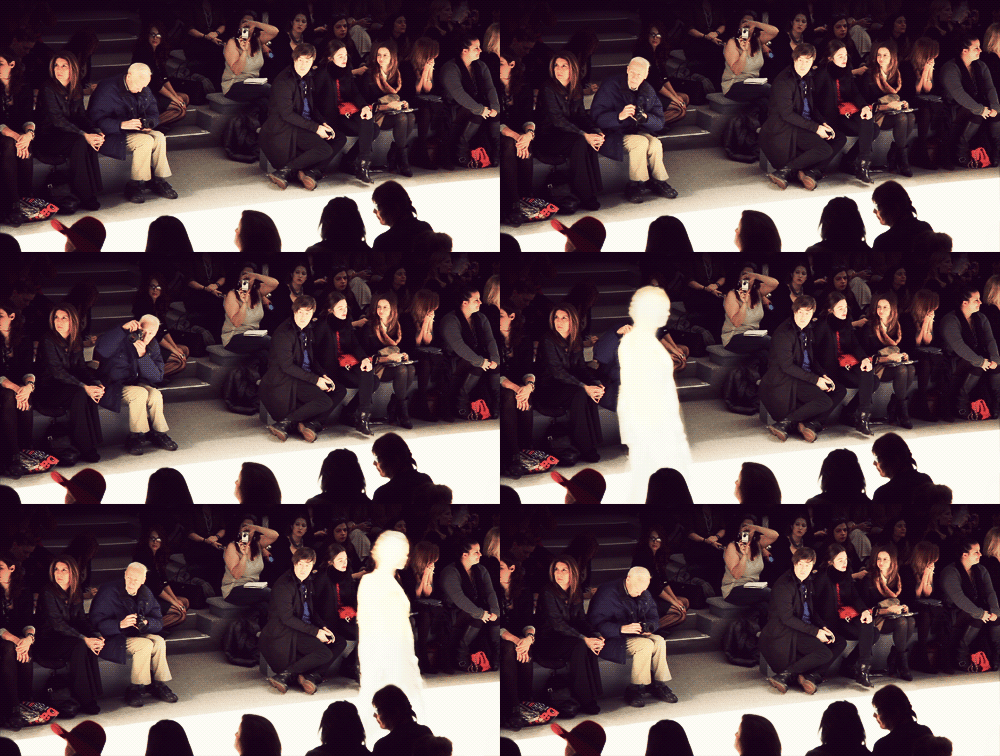
'We all get dressed for Bill' by Jamie Beck and Kevin Burg featuring Bill Cunningham at New York Fashion Week 2011

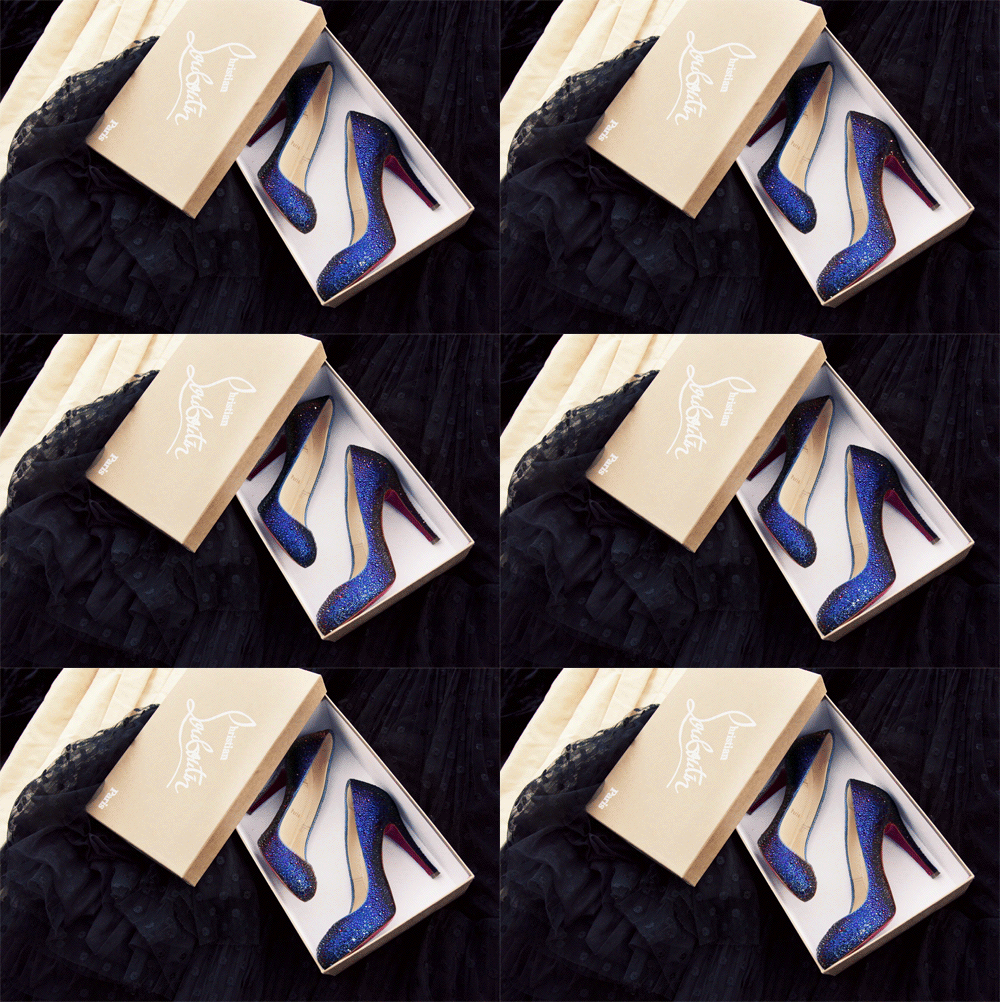
'It's time to hit the town' by Jamie Beck and Kevin Burg featuring Louboutin Samira Strass shoes

View all of their cinemagraph.


Author

Aaron Proctor
Founder, FWD:labs
Director of Photography site
Contact


Alex O'Flinn

With his work recently screened at the Young Director’s Night at LACMA, complete with glowing reviews, Alex O’Flinn — member of the FWD:labs Collective — is a filmmaker with strong vision and ceaseless momentum.

What are you most proud of and what do you want to do next?

Alex O’Flinn I think I am most proud to be in a place where I am surrounded by great artists and collaborators who inspire me by their work and their contributions to my projects. Film is 100% a collaborative medium, and a work lives and dies by the ideas of those involved, so I just feel incredible fortunate to have friends and collaborators who take visual storytelling to the next level.

What’s one thing you learned recently about filmmaking?

AF The most important thing I’ve learned lately is that you have to stick to your guns about the types of movies or art you want to make. Not to sound cheesy, but you really have to walk to the edge of the cliff with your idea and take risks. That’s when the really great stuff happens. There’s nothing worse than making a good movie that says nothing. The most beautiful thing a film can do is make people think for days after watching it.

What real or imaginary technology in emerging media would you want to explore and why?

AF I think we’re in an interesting time with technology and only time will tell how everything pans out. Obviously, the internet and what it has done for independent cinema is truly groundbreaking and remarkable. And the same goes for the digital camera technology that is out there. But I think what is important to remember is that the technology is only a tool that helps us tell stories. Just because one can theoretically make “Lawrence of Arabia” on the 5D, doesn’t necessarily mean they should. The technology and the story are directly related, and if one knows that they will be limited to a certain camera during production, the attributes of that camera must be planned out accordingly in the visual style, color palette and locations of the film.

I sometimes like to compare the time we’re in to the 70’s when all of these synths were coming out in the music industry, and they flooded all of these albums because they were a new toy that everyone was in awe about. Fast forward 20 years and that production value couldn’t be more dated on many albums. It’s important to keep the “wow” factor in check when dealing with technology, and keep the focus on what’s really important — the story and what best serves the story.

With whom and how do you collaborate with best?

AF I love having conversations. They don’t even need to be about film. If you and the people you work with were only brining their knowledge of film to the table for a project, so much would be lost. Finding out about each other’s interests, travels, favorite literature, hobbies, etc., proves invaluable when fabricating a world for a story, and also forms a bond between you and your collaborators. I also believe in having a lot of conversations/rehearsals about the project early on and then being more hands off as shooting approaches. I feel that once everyone is on the same page and gets the story, every collaborator does much better work when their isn’t someone constantly looming over their shoulder.

What are some of your regular influences for creative ideas?

AF I’m very influenced by literature and still photos. Sometimes I’ll get ideas from seeing a certain photograph at a museum. It can be the lighting, the composition, an expression in one of the characters faces, anything that gets me thinking about tone and backstory. With stories, it can be a sentence or sometimes a whole piece that speaks to me. In the best instances, I’m able to see images as I’m reading. As for artists who constantly influence me — Sam Shepard, Ryan Harty, Richard Avedon, William Eggleston, Philip Lorca di Cortia, Homer and Virgil, to name a few.


Author

Aaron Proctor
Founder, FWD:labs
Director of Photography site
Contact


  • Published in General

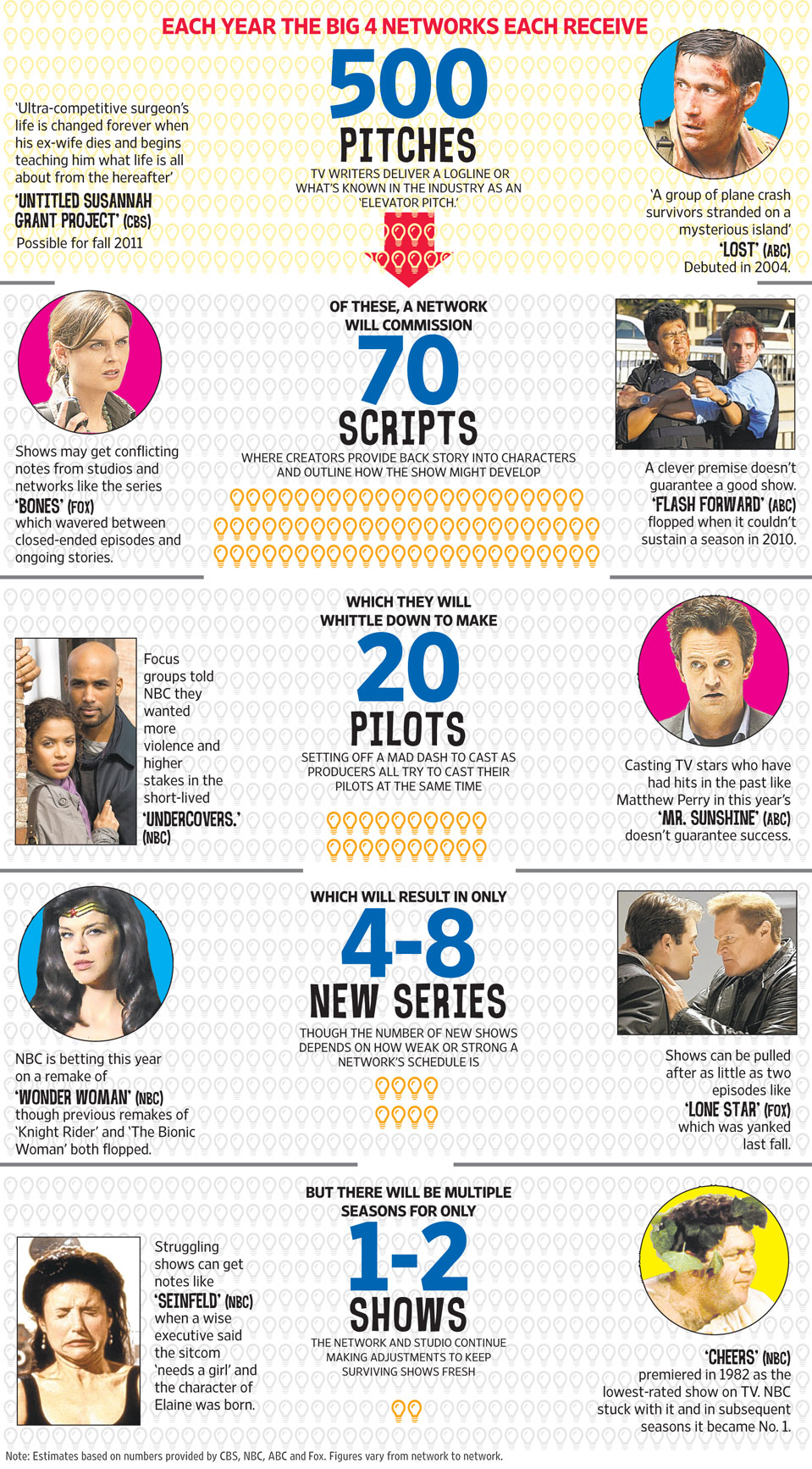
Infographic by The Wall Street Journal.

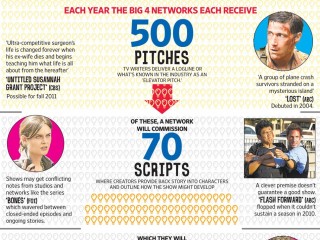
According to The Wall Street Journal, between CBS, ABC, NBC and Fox, each season brings each major network approximately 500 pitches, followed by requests for 70 scripts, shoots for 20 pilots, and airings for 4 to 8. Only one or two make it to multiple seasons.

This shortage of content has multiple culprits: too many decision makers, not enough time to flourish, and too few networks. Historically speaking, some of the most popular shows on television didn’t have to beat these odds.

“Some shows end up coming out of the development process like a camel, a horse designed by committee,” says Jeff Melvoin, a veteran producer who worked on “Alias,” “Northern Exposure,” and “Hill Street Blues.” Mr. Melvoin now works on cable, which has smaller audiences and fewer demands, as an executive producer on “Army Wives.”

Networks analyze how ratings drop off during commercial breaks, a sign that viewers have sampled, and rejected, a series. Last month CBS pulled its spy comedy “Chaos” after three episodes. The debut episode opened with seven million viewers. After 15 minutes, 6.3 million were watching, according to Nielsen Co.

CBS, the top-ranked network in total prime-time viewers, limits the executives who offer input on new series. In addition to Chief Executive Leslie Moonves, “it’s me, it’s the head of the department, it’s the show runner. We don’t have committees,” [CBS Entertainment President Nina] Tassler says.

So, what’s wrong with the networks in finding more hits? Here are my off-the-cuff observations.

  1. Find a longer gestation period, even if it means moving the time slot. Promising shows live or die by brash decisions. “Freaks and Geeks,” for example, cancelled after just twelve episodes, was asked by its network to include Britney Spears as a waitress in one episode, according to Wikipedia. Producer Judd Apatow and others disagreed, but added Ben Stiller to one show. But it was too late, cancelled before it had a chance. Apatow, and much of the cast of the show, went on to produce very popular features instead. On the other hand, “Seinfeld” originally didn’t have Elaine; an exec said “add a woman” and the show survived.
  2. Reward passionate audiences with shows that cultivate fan bases. Look beyond Nielsen to embrace content beyond their DVD/BluRay market. The industry-standard survey ranks the top-rated series of the last ten years as “American Idol,” “CSI” and “Friends.” Rankings are calculated by diaries or scanners that weigh each minute of a program. However, cancelled shows with big followings to this date include “Arrested Development,” “Twin Peaks,” or “Firefly.”
  3. Value discussability. I know so many people who took to watching shows like “Lost” and “Mad Men” way after they first aired. People don’t just watch anymore, likely due to mediocre advertising to broad demographics. According to Mashable, other metrics such as social media reveal programs like “NCIS,” “Criminal Minds,” “Glee” and “House” were popular to discuss, which is worth something to someone. The article notes how “Glee” doesn’t make Nielsen’s Top 40, but continues to be renewed, after winning a Golden Globe and nearly 40 million viewers after the Super Bowl this last year, as noted on Wikipedia.

Author

Aaron Proctor
Founder, FWD:labs
Director of Photography site
Contact