FWD:labs

Blog

  • Published in Web

facebook-film.jpg

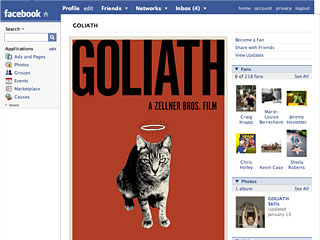
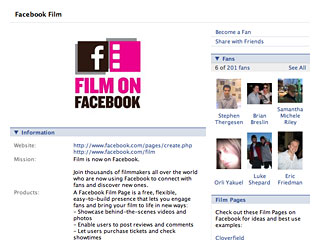
Today, social networking leviathan Facebook introduced “Film on Facebook,” along with “Music on Facebook.” Both are a hyped-up “Page,” their term for a profile about your brands or businesses, which has been around for a while. However, both efforts have a few adjustments relevant to each crowd.

Adding Your Film

When you log into Facebook, you can create a Page. Under “Brand or Product,” select “Film.” There, you’ll have a “Page Manager” or “Ads and Pages” application. This “Page” you’re creating on Facebook for your film will be a way to now visualize, message, post to, and push over updates to your audience.

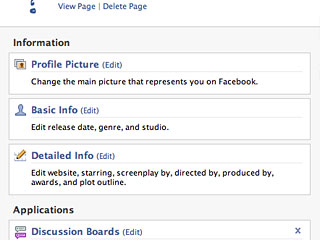
Specific to the Film page, basic information collects the release date, genre, and studio. A detailed view asks for the website, stars, screenwriter, director, producer, awards, and plot outline. “Discussion Boards” and “Reviews” are other applications immediately available for your Film page, along with “Music Player” and “Movie Tickets and Times” (powered by Fandando).
facebook-film_2.jpg

You can also pimp the film’s profile with everything else familiar on Facebook today: videos, photos, events, notes, wall postings, and any third-party application like “Movie Theater,” where fans can also “favorite” films or “gift” them to their friends.

Examples

Toted examples of films using Pages, says the Film On Facebook page:

…and studios:

facebook-film_3.jpg

…and Sundance 2008 films:

Coverage on ReadWriteWeb goes into further detail about how movie marketing is already commonplace on MySpace. Mint Communications blogged about how MySpace often previews film clips for new releases; this doesn’t appear to compete with Facebook’s approach. And VentureBeat noted Facebook’s broader move as a media platform and mentioned the upcoming talk at SXSW — a huge festival for film and music — with the “head of market development in entertainment,” Matt Jacobsen.

Social Promotion

Pages are tied hand-in-hand with Facebook’s Social Ads network, as a reminder of one way to drive click-traffic to the page. Buying ads is per click or per impression, and targeted to specific demographics. For example, if the demo for your film was women under thirty in Los Angeles, your ad will show up on the side of some of their Facebook visits. You set a price per day, pay by credit card, and bid on the click-through value of your audience from a penny on up.

An alternative D.I.Y. approach to finding your Facebook Film page is when you search Facebook.com. Aside from searching people’s profiles, it searches Pages. When you click to the Film of choice, you can comment on the page’s “wall” or “fan” it. Being a fan of a film adds a box to your profile, and pushes fresh “mini-feed” content from the film’s page to the subscribed user when you log in. Your film’s fans are passively evangelizing your film, in exchange for subscribing to updates and showing support.

Unlike normal Facebook profiles, Pages have graphs of pageviews and counts of fans over time, so you can audit the effectiveness of marketing.

Author

Aaron Proctor
Founder, FWD:labs
Director of Photography site
Contact


  • Published in Film

martin-scorsese_att-psa.jpg

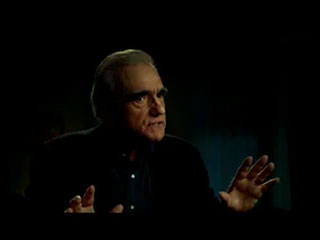
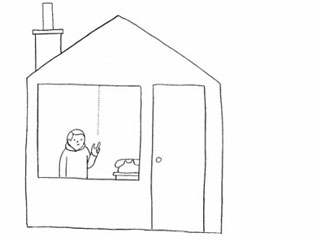
“Please don’t interrupt our movies” punctuates the new public service announcement featuring Martin Scorsese, now running in movie theaters. The 60-second ad — from AT&T and BBDO New York — features the director interrupting a mother and son during a bedtime call with his traveling father. “The plot of this phone call is just not working for me. I’ve seen it a million times,” warns the Academy Award-winning director.

In response to the ad, the press release on February 11 notes that “[i]n a recent survey of moviegoers throughout the United States, an overwhelming 93 percent reported that they either silenced their wireless phone, put it on vibrate or turned it off as a result of AT&T’s Be Sensible public service announcements.” Scott Marks of the Emulsion Compulsion blog jokingly noted, “[n]ot since his cameo in Taxi Driver has a camera lens channeled the true force of Scorsese on screen.”

The ad is featured today on the home page of Creativity Online, which hosts a larger-format embed with full list of credits. On February 20, the ad was ADWEEK’s Ad of the Day (link no longer online). It can also be seen and requested in AT&T’s own corporate multimedia gallery.

The “Be Sensible” campaign has included similar ads with other Academy Award winners: director Sydney Pollack and actor Forest Whitaker.


Author

Aaron Proctor
Founder, FWD:labs
Director of Photography site
Contact


  • Published in Film + Web

social-video_hulu.jpg

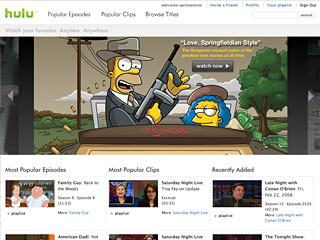
Love at first sight? Hulu, the industry’s response to the user’s demand for video, looks good even if you don’t show up again for seconds. There’s a surprisingly deep selection of old and new programming, void of anything “user generated.” The video is big — as film and television should be — and it’s way easier to search than the Google-owned YouTube.

Chances are you are yet to know this Hulu site. It’s been closed off as a “private beta” since October, not yet ready for the masses. If anyone wants to take a look, I have 5 invites up for grabs.


Above: Hulu.com embed of The Simpsons – “Joy of Discovery” (Excerpt, 00:39)

social-video_stage6.jpg

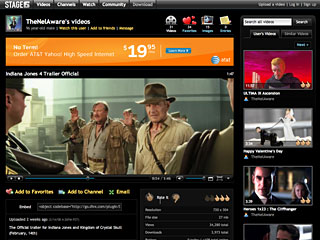
On the flip side, Stage6 just gave 72 hours notice: it’s closing up shop this Thursday. Maybe it was all of the pirated content and the competitiveness of streaming video, but the official word is cost — as much as $1 million a month. A project of DivX, makers of the high-definition codec for video (and competitor to Joost and Flash), the product blog noted that last year they were “explor(ing) strategic alternatives, which is a fancy way of saying we decided we would either have to sell it, spin it out into a private company or shut it down.” Today’s post on the product’s blog had over 4,000 comments from distressed Stagers, some saying they would pay up to keep their videos up.

(For more coverage on the Stage6 closure, see NewTeeVee (link no longer available), 3by9.com (link no longer available), The Business of Online Video, and Webware.)

Footnote: Hulu is a collaborative project of NBC Universal and News Corp. Earlier this month, NBC waved goodbye to the annual Upfronts, as part of a strategy to debut pilot shows online and let them fight it out all year round. No other studio joined with them. Real Pop has a post about this year-round season and a chart that shows why NBC’s on to something. We also posted last May about the upfronts and quality content succeeding online.

For more alternatives to YouTube, see our directory of social video networks.


Author

Aaron Proctor
Founder, FWD:labs
Director of Photography site
Contact


  • Published in Design

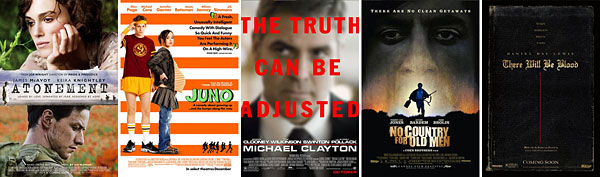
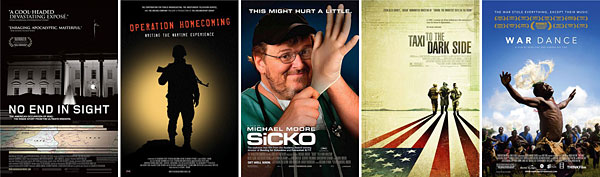
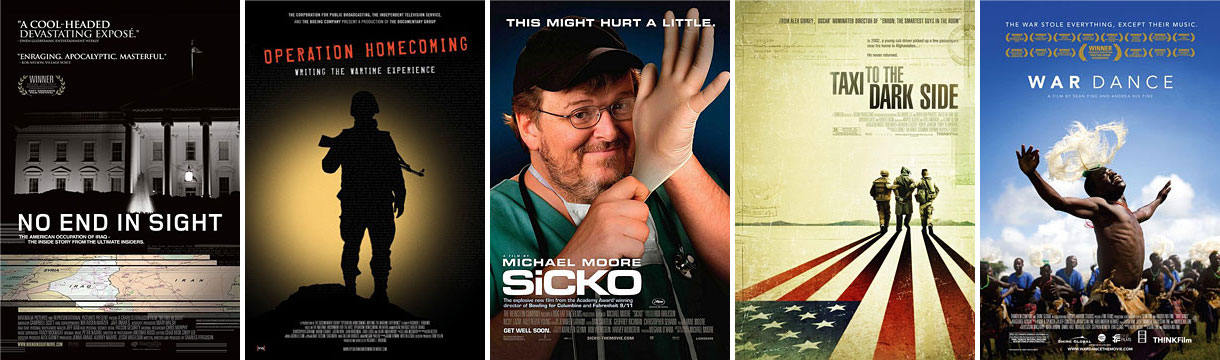
These are the picks for best films of 2008: fiction juxtaposed with non-fiction, side-by-side alphabetically.

Nominees for Best Picture

2008-oscars_best-pic2.jpg

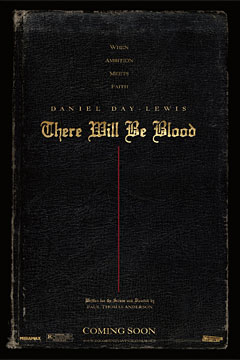
Enlarge | Credits for Best Picture Nominees: “Atonement” poster by Mojo LLC, “Juno” poster by BLT & Associates, “Michael Clayton” poster by Pulse Advertising, “No Country for Old Men” poster by BLT & Associates, “There Will Be Blood” poster by Concept Arts

Nominees for Best Documentary

2008-oscars_best-doc2.jpg

Enlarge | Credits for Best Documentary Nominees: “No End in Sight” (credit unknown), “Operation Homecoming” (credit unknown), “Sicko” poster by Bemis Balkind, “Taxi to the Dark Side” poster by cold open, “War Dance” poster by cold open

With the Oscars coming this Sunday, February 14, which films would win if it was just up to their poster? Would you watch a film based on its cover?

2008-oscars_savages.jpg

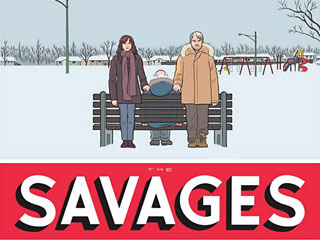
On a related note, posters can actually win awards. In June, the Hollywood Reporter has its annual Key Art Awards. Categories include action-adventure, animation, comedy, drama, horror, teaser, and international; the awards also include trailers and other marketing collateral. In January, movie poster weblog Posterwire.com had its annual awards, while recapping industry trends and linking to every print you can imagine. This year, they decided on “The Savages,” which was illustrated by Chris Ware.

Reference: Internet Movie Poster Awards

P.S. If you’re a new reader to this blog, see how we covered Juno, No Country for Old Men, and There Will Be Blood.


Author

Aaron Proctor
Founder, FWD:labs
Director of Photography site
Contact


Part of a series of posts about the FWD:labs web platform for cinema artists and their work.

new-feature_collaborators.jpg
One of the missions of FWD:labs is to easily expand your network or reconnect with past collaborators. At FWDlabs.com, you can now describe your relationship with other collaborators.

Our response to the social graph — the “friending” or “linking” on social and professional networks like Facebook and LinkedIn, respectively — is to cut to the chase with the film industry’s “who you know” mantra: it’s about your collaborators.

The goal is to highlight the repeat or first-time collaborations between creatives working with cinema. We also want it to be dead-simple to find talent between one another, as FWD:labs is built around every member knowing someone else.

When you’re working more than once with the same actor, editor, or costume designer, it describes your relationship in the shortest, simplest way. Besides, explaining the specifics are best left to personal conversation. And you also don’t have the time to describe this at length online.

The goal is to compliment Facebook, LinkedIn, and any other social network:

  • Like Facebook, one highlights their social reputation. Unlike Facebook, with FWD:labs it’s your “calling card” site highlights your professional reputation.
  • Like LinkedIn, one highlights their professional network. Unlike LinkedIn, with FWD:labs you can freely view and contact FWD:labs members to ask about their professional network.
  • Like _____, one puts effort into a member’s only silo. Unlike _____, with FWD:labs your efforts get indexed by search engines, found by word-of-mouth, and promoted day and night.

The social graph on FWDlabs.com is simple because each cinematic work has credits. No project is done by just one person. Adding names and their roles just once has a domino effect: it fuels each project’s credits page, each profile’s collaborators page, and also each record in the Creative Directory. All three are public resources for anyone to access at FWDlabs.com.

Related: See VisualComplexity.com for visualizations of complex networks


Author

Aaron Proctor
Founder, FWD:labs
Director of Photography site
Contact


  • Published in FWD:labs

Part of a series of posts about free resources from the FWD:labs collective.

new-feature_venues.jpg

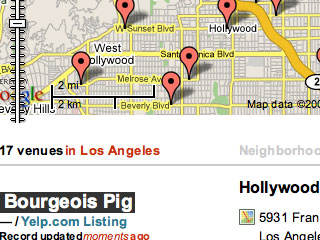
Maybe you’re looking to finish your screenplay, check your YouTube comments, or just get drinks after a hard day’s work in a artist-savvy space. This public resource on FWDlabs.com is a painkiller for creatives when starting from scratch to try somewhere new.

More specifically, Artist Gathering Venues is a collectively-maintained database to share artist gathering/networking venues around the world, tagged with Wi-Fi (free/paid/no), alcohol (wine/beer/B.Y.O.B./no) and coffee (yes/no) offerings.

To start, there are 27 hand-picked places in the cities where current FWD:labs members live: Los Angeles, New York, and San Francisco. Records are made helpful with links to official sites and Yelp.com, one-click driving directions from Google, Yahoo and MapQuest, and a mash-up of pinpoints via Google Maps.

The resource is for everyone and easily updated by members of FWDlabs.com and readers like you.


Author

Aaron Proctor
Founder, FWD:labs
Director of Photography site
Contact


  • Published in Film + Web

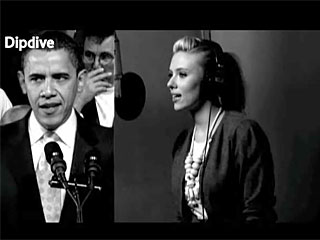
viral-political_dipdive.jpgPolitical ads, made independently by supporters and detractors alike, are abundant in the run-up to inform and engage before the upcoming Super Tuesday. Such user-generated content (UGC) is popular this year, unlike tomorrow’s Super Bowl commercials, where UGC is passe after an abundance in 2007. Also, many feature original songs.

Below you’ll find at most two videos for each candidate still in the primary race, with “pro” videos where available.

(Please comment on the use of user-generated campaign videos, not on personal political opinions. Updated 2/16.)

Democrats

Obama

https://www.youtube.com/watch?v=BHEO_fG3mm4

Pro: “Mr. Dippy – Yes We Can” (official site, dir. Jesse Dylan, prod. Will.I.Am, feat. Scarlett Johansson, John Legend, Herbie Hancock, Kate Walsh, Kareem Abdul Jabbar, Adam Rodriquez, Kelly Hu, Adam Rodriquez, Amber Valetta and Nick Cannon)

Pro: “Obama Girl” (dir. Ben Relles, feat. Amber Lee Ettinger)

Clinton

https://www.youtube.com/watch?v=HGxTk6XEWf0

Pro: “Hot4Hill” (dir. David Garrett and Matt Oates, feat. Taryn Southern)

Anti: “Vote Different.” (dir. Philip de Vellis — a mash-up of “1984,” dir. Ridley Scott)
Gravel

Pro: “The Word: Mike Gravel”

Republicans

McCain

Parody: “McCain Mama” (dir. CNN’s Headline News with Glenn Beck)

Romney

Pro: “Mitt’s Our Man!” (dir./feat. Melissa JoAnn Spiegel and Ashton Brittney Schmidt)

Huckabee

https://www.youtube.com/watch?v=DksofcROmXs

Parody: “Huck Really Matters”

Paul

Pro: “Ron Paul Is” (dir. Adam Franklin)

Pro: “Ron Paul Brickfilm”

###

Related links: Cartoon Brew blog post “The Animated Political Campaign”


Author

Aaron Proctor
Founder, FWD:labs
Director of Photography site
Contact


  • Published in General

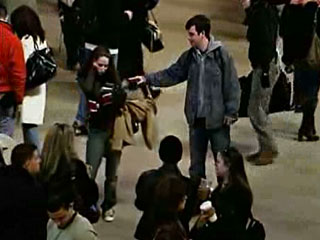
frozen-grand-central.jpg207 “agents” of Improve Everywhere recently stopped in their tracks at Grand Central Station, pulling off an afternoon stunt for five minutes. The viral video, posted today on YouTube, is on fire.

“Over 500,000 people rush through Grand Central every day, but today, things slowed down just a bit as commuters and tourists alike stopped to notice what was happening around them,” notes their press release.

Agents chose five-minute kissing, “bunny ears” photographing, paper dropping, shoe tying, and map looking.

Of the stunt, one police officer said, “That is the craziest shit I’ve ever seen in my life, and I’m a cop!”

Past flash mobs have included no pants 2k8, no shirts at Abercombie and Fitch, slo-mo at Home Depot, and cell phone symphony.

Related coverage: Gothamist, Gawker

(via CPluv)


Author

Aaron Proctor
Founder, FWD:labs
Director of Photography site
Contact


  • Published in Film

sundance-experience.jpg

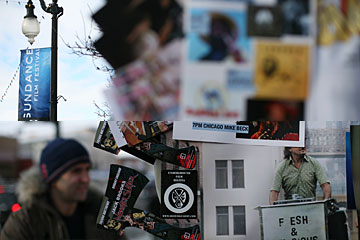
  • Early birds: parking galore in Park City before 9am
  • Wi-Fi is hit-or-miss outside lounges and libraries, which are sure things
  • Political groups and activists counter some of the celebrity gossip
  • Bistro 412’s upstairs bar and Java Cow’s back room offer escapes from the crowd
  • Everyone’s shooting video; only a select few beam it up to YouTube on location (like your’s truly)
  • Buy tickets in advance or risk waiting in the cold for hours for a few spare tickets
  • Staying in Salt Lake City and trucking it to Park City is rare; look for rooms at the small cities along the main highway instead
  • People come for to sell-out their movies, to cheerlead their friends’ movies, to hawk their next movie, to report back to everyone else, or to ski and be about their own business
  • Most if not all parties are exclusive, rarely dealing with tickets and almost always dealing with influence
  • Enjoy the historical downtown: walk instead of taking the crowded bus every time
  • Sundance volunteers are amazing: informed, friendly, and dedicated
  • If you’re not at Sundance on business, prepare to find like-minds within the first couple days, follow them around with leads on this party or that screening, and consider shacking up or sleeping in the tub
  • Flyers that are passed out, involve condoms, or are well-designed get word-of-mouth attention, but might not translate into warm seats
  • Celebrity sightings are daily, if not hourly
  • There’s not quite any experience like Sundance: the sidewalks overflow, the films you pick are instead of five others that might be the next big thing, and you’re often in the wrong place at the wrong time
  • As a filmmaker, you’re going to leave inspired, discouraged, and/or exhausted

Author

Aaron Proctor
Founder, FWD:labs
Director of Photography site
Contact


  • Published in Film

regional-cinema.jpgPack the trunk, check the oil, and hit the gas. You’ve got a screening to make upstate, and you’re bringing the film, the projector, and the independent spirit.

Jay Craven, a Vermont film director, screenwriter, and professor of Film Studies at Marlboro College, is digging deep roots by traveling far. Interviewed today on NPR’s All Things Considered (listen now at NPR.org), they talked about packing community theaters — screening his films, which have included Michael J. Fox and Kris Kristofferson, working for free or for scale — where he knows his audience is.

Like our post on “Cinema Alfresco” last July, hat’s off to taking it to the community.


Author

Aaron Proctor
Founder, FWD:labs
Director of Photography site
Contact


  • Published in Film + Web

there-will-be-blood.jpgThe Academy Award nominee for Magnolia and Boogie Nights, and Best Director winner at Cannes for Punch-Drunk Love, took his chances with teasing There Will Be Blood on YouTube. Viral buzz ensues.

On the Friday in June 2007, director Paul Thomas Anderson uploaded a trailer of his yet-to-be-released film. After a note to Ain’t It Cool News, and by one day’s time, the tenacity of bypassing studio oversight turned into the “YouTube incident of 2007,” notes Anderson in an interview in the Los Angeles Times this weekend:

While editing the movie last summer, Anderson decided to enliven things by cutting a trailer, which he posted on YouTube. The simplicity of the process — not dealing with the studio or the Motion Picture Assn. of America — was “like a filmmaker’s fantasy.”

“And the studio went nuts,” he said, smiling about his mischief.

“We put it up on Friday and I remember they called on Saturday morning at 6 a.m.: ‘Do you know there’s this thing on YouTube?’ I said, ‘Yeah, we put it there.’ They were like, ‘What the hell are you doing? Are you mad?’ ”

The trailer’s warm reception pacified the executives, Anderson said, and ever since “There Will Be Blood” has ridden a wave of good publicity and honors, including a Golden Globe nomination for best drama.

The unique trailer direct from Anderson via YouTube has been seen over 435,500 times:

https://www.youtube.com/watch?v=SYW2ltW5SPo

Two weeks ago, the same “channel” had a midnight movie screening promo to stir up the buzz again for There Will Be Blood.

Meanwhile, the film’s studio, Paramount Vantage, “leaked” the screenplay (PDF) in October — two month before the film’s release, giving guild members and anyone else a rich-media overview of their projects.

There Will Be Blood started in limited release (read: 2 theaters) on December 26, 2007. On January 4, it went into 51 theaters, abuzz with attention and packing 3pm screenings on days like today.

Also web-savvy: P. T. Anderson fan site, Cigarettes and Red Vines, notes the production had a photo blog site. Today, only an Archive.org copy has a record of littlebostonnews.com before it turned into a trailer jump-page.

(There Will Be Blood poster is by Concept Arts.)


Author

Aaron Proctor
Founder, FWD:labs
Director of Photography site
Contact


  • Published in Film + Web

drawing-from-new-sources.jpgThis week is the annual “Year in Ideas” issue from The New York Times Magazine (12/9/2007). As a companion to the 70 “curious, inspired, perplexing and sometimes outright illegal innovations,” the magazine’s web site also produced an animation, “Drawing From New Sources.” The 2-minute piece, briskly narrated and clearly summarized, plays out like a modern-day newsreel.

One especially forward-thinking message in the piece, all of which focuses on saving and generating energy, is how package deliverer U.P.S. conserves 3 million gallons of gas by “removing left-hand turns from its operations.”

(via Core77)


Author

Aaron Proctor
Founder, FWD:labs
Director of Photography site
Contact