FWD:labs
  • Published in General

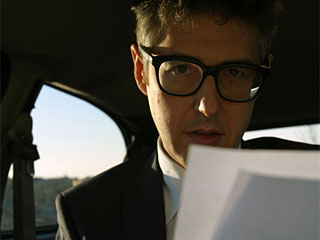
Ira Glass

Photo by Nancy Updike

“Failure is a big part of success. If you’re not failing all the time, you’re not creating a situation where you can get really lucky. Maybe once every six week, you’re going to stumble on somebody so compelling and so great, it’s going to make the other five weeks worth it. You don’t want to be making mediocre stuff. The only reason why you want to do this, is because it’s going to be so memorable, it’s special.” — Ira Glass, host and executive producer of This American Life, speaking on the building blocks of great storytelling

For those of us who command creative control, yes indeed.

Ira Glass on Storytelling – Part 1
Ira Glass on Storytelling – Part 2 (embedded below)
Ira Glass on Storytelling – Part 3
Ira Glass on Storytelling – Part 4

https://www.youtube.com/watch?v=KW6x7lOIsPE

For others, look to people like writer/director Joe Carnahan (Narc, Smokin’ Aces). Last year, I wrote about how he kills his conceptual posters. He noted, “[a]s most film advertising art directors and designers will tell you, sometimes their best poster design work never sees the light of day beyond their own portfolios.”

(Speaking of posters, where are all the film posters from the cinematic works of FWD:labs artists? There’s a shortage of print in our design directory.)

Being a regular listener of NPR via KCRW 89.9FM, This American Life has been linked here before, when I covered a month-in-the-life of running FWD:labs. Coming on the first of May, 2008, the Showtime series of This American Life will be screened in movie theaters. The young librarian behind the Desk of Judy Dark has a fun take on the news: “The cost, finding parking, dealing with the annoying Cellphone McChatsalot who inevitably sits in front of me or the equally annoying Make Yerself Comfy Man who sits behind me and puts his stinky, Teva-clad feet against the back of my chair… yeah. Thanks but no thanks.”

(via Signal vs. Noise, who picked up our story on filmmakers using Basecamp)

Author

Aaron Proctor
Founder, FWD:labs
Director of Photography site
Contact


film-kitchen-poster.jpg

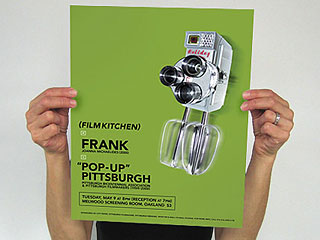
Poster for Film Kitchen by Brett Yasko

Last Tuesday, March 11, and for many second-Tuesdays of the month, Pennsylvania has Film Kitchen. For about $4 at the Melwood Screening Room, attendees experience a eclectic screening of shorts or features. Submissions are open to all, but the gathering is curated by Bill O’Driscoll, writer for the Pittsburg City Paper, who co-sponsors the event.

I found out about Film Kitchen thanks to designer Brett Yasko, whose work appeared in Communication Arts in December 2006. “Bill O’Driscoll has simple directions for these posters for his monthly screening: ‘Try to have a reference to film. Or have a reference to a kitchen. And make sure everything is spelled correctly.’ … Occasionally there’s a theme. This one was ‘appliances.'” Yasko is a Pittsburg-based designer and adjunct faculty member of Carnegie Mellon University’s School of Design.

The posters are silk-screened and color inkjet prints of various sizes, sometimes with “the text printed on stickers which were applied by hand.” 6 posters for Film Kitchen are on display at Yasko’s web site.

Beer and sandwiches are often donated by local sponsors, as noted in 2006 by one blogger on the highs and lows, perks and praises of the events. Incentives might push fringe newcomers but, in a world of buttered popcorn and syrup’d soft-drinks, certainly makes the audience feel right at home.

With simple expectations, these monthly meet-ups whet one’s appetite for avant-garde and independent cinema in the format of a year-round film festival. Like events in Los Angeles like the Downtown Art Walk (second Thursday afternoon-cum-evening), or events worldwide like likemind (once-a-month Friday morning), you can pass on berating yourself for missing one and vow instead to catch the next. Through this kind of continuity over the years, Film Kitchen provides a reoccurring opportunity to foster a society for local film-goers. It shares in the spirit of regional cinema while thriving as one community, one city, and in one venue.


Author

Aaron Proctor
Founder, FWD:labs
Director of Photography site
Contact


  • Published in Film + Web

Welcome everyone from the tweet on the 37signals Twitter! Check out the latest posts, post archive, or learn more about the FWD:labs collective. If you have any questions, comments or ideas, please drop me a line. — Aaron Proctor, FWD:labs founder
basecamp-dashboard.gif

Dashboard page from the Basecamp project for Peter Phan‘s film, “This Will All Make Perfect Sense Someday”

[Update: This article is about what is now called Basecamp Classic. You may still be able to get an account for it at signup.37signals.com and it’s supposedly still maintained, despite a brand new Basecamp.]

Every project has to-do’s, updates, and deadlines. Any filmmaker acquainted with Basecamp is already a step ahead in managing their next gig.

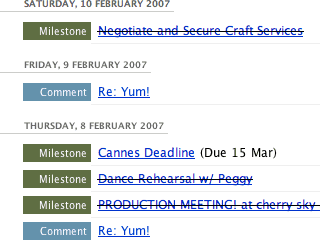
Basecamp is a web-based project management tool from 37signals. “[It’s] an amazing product. Very versatile. A little expensive but certainly worth it,” says director Jaraad Virani, who uses Basecamp. The tool breaks down a project into intuitive pieces: to-do lists, messages, calendar deadlines, and so on.

Yesterday at SXSW, Jason Fried of 37signals presented on what he’s learned from the success of Basecamp (presentation notes c/o ReadWrite Web), which included a slide on part of their company philosophy: “Be Successful and Make Money by Helping Other People be Successful and Make Money.”

basecamp-todo.gif

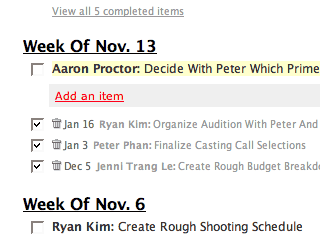
To-Do page

Success and money in mind, with any team effort, online collaboration improves productivity by focusing in one place all of the real, tangible goals. But adopting Basecamp is a real cultural shift, sometimes great enough to keep the status quo. I’ve noticed how everyone already has their own way to take notes, write e-mails, and add to calendars. For a team, it’s not efficient. The hardest challenge to newcomers is using a web tool instead of unfocused e-mails, handwritten notes, and long-winded meetings. After a demo or tour of the official site, I notice it sells the idea itself: everyone on the team, literally on the same page, without more meetings, more e-mail, or more misunderstandings. But, in practice, it takes early adopters and friendly encouragement.

The primary use for independent filmmakers and their complex film gigs is to use Basecamp for production. rav design, a full-service video production and graphic design firm, loves Basecamp. “We used it to organize our 48 Hour Film Project. … [W]e were working with crew members from across the state who had never worked together, and in some cases never physically met before the shoot. We posted workflows, guidelines, rules and shared location scouting info all in an elegant location.” For both clients and collaborators alike, how ideal of a work environment is that?

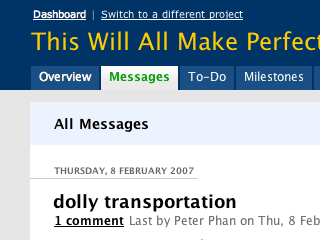
basecamp-messages.gif

Messages tab

Basecamp’s epicenter is the project, which is a familiar quantity for any kind of contract work. Rhett Dunlap, a Los Angeles-based producer and owner of Egomaniac Productions, has yet to give it a spin. “We haven’t gotten Basecamp yet … though it looks very very cool. We’ll get it if we land this bid. And use it for the production.” For one project, it’s free to use. For more, you have to pay a monthly fee on a sliding scale of “open” projects, which includes the perks of file hosting, chat, or more than two “Writeboards,” a Wiki-style document. Their business model is premium subscriptions, but there’s no individual cost per person, so it’s easy to add logins for your team or to share work-in-progress with your clients.

Any feature, short, commercial, or webisode can easily benefit from the focal point that an online project management tool provides. You can even get by without touching a credit card.

Google Sites offers a free alternative and ActiveCollab has a similar, paid plan to Basecamp.


Author

Aaron Proctor
Founder, FWD:labs
Director of Photography site
Contact