Now you can find out in one place, in our newly re-aligned exclusive resource at FWD:labs, “Social Video Networks.”
This collaborative resource began in March 2007 as a step-by-step guide for getting your films online. But that wasn’t enough. It needed to be a real utility, sortable for your needs, freshened up to do justice to the movers and shakers out there. And now it is: our “museum” of social video networks is open. Additions and edits to the data are in your hands; ideas for searching, comparing or sharing the data are also encouraged.
In November 2005, Techcrunch compared the “Flickrs of video,” where Michael Arrington geared them for his Web 2.0 audiences. Our resource is appropriately suited for our audience: active participants in cinema, creatively and/or financially interested in the future utility of online video.
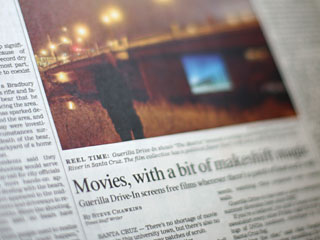
Today, the Los Angeles Times ran a front-page story on the Guerilla Drive-In, a film movement in Santa Cruz, California, that screens films outdoors on a regular basis. The film collective event is “about getting people together to do something very deliberately outside the realm of commerce,” says organizer Rico Thunder. They screened The Matrix under a bridge.
Drive-Ins Tonight
San Francisco, California: tonight in a parking lot between 22nd and 23rd on Valencia Street in the Mission, the KFC Collective is presenting several short independent films. The group is all about “reclaiming public space for art, one parking lot at a time.” Word spread across Upcoming.org and Laughing Squid.
Los Angeles, California: tonight One Flew Over the Cuckoo’s Nestscreens at Cinespia, a group which sets up camp at the Hollywood Forever Cemetery. Film-lovers arrive early, shell out $10 but get to bring their wine and cheese and watch the film on the uninhibited grass. Previous packed-lawn films have included Harold and Maude and Fast Times at Ridgemont High.
Brookyln, New York: tonight is Crossing the Line at the Rooftop Films, a community-focused “collective collaboration between filmmakers and festivals, between audience members and artists, between venues and neighborhoods. Our goal is to create a vibrant independent filmmaking community that bridges cultural boundaries. At Rooftop Films, we bring the underground outdoors.” Their “Summer Series” trailer is incredible:
Underground Movements
Berkeley, California:Mobmov is the “drive in that drives in,” which has free screenings nearly every two weeks. Their manifesto explains what’s required to play: projector, marine batteries, inverter, FM transmitter and DVD player. They also outline the legal issues, from copyrights to FCC rules and police. The site has a regurarly updated forum and sign up is easy and helpful, like selecting your nearest city to receive useful e-mail updates.
Simultaneously, in Chicago, New York City, Los Angeles, San Francisco and Oakland, SiCKO was projected on buildings on June 25th, 2007. Of course, the buildings were nearby the health care industry HMOs. Word was passed along on newsgroups and mailing lists.
Going Strong
Outdoor film screenings take the form of festivals, gatherings and just plain alternatives to otherwise anti-social, over-priced megaplexes.
Brooklyn, New York: the Movies With a View series gets the Brooklyn Bridge in the picture with screenings through August 2007.
Boulder, Colorado: the city known for its outdoor recreation has the Boulder Outdoor Cinema; check out their site especially for the fun Flash animation with cowboys and aliens.
Marin, California: just a stone’s throw away from NorCal filmmakers like George Lucas and Francis Ford Coppola, there’s the Film Night in the Park through October 2007.
London, England:The Guardian recently reviewed five of the best outdoor film screenings for this summer in Stratford, Devon, Cambridge, London and Yorkshire, but take a look at the courtyard screenings outside London’s Somerset House in the Film4 Summer Series, from August 2 to 11, 2007.
Part of a series of posts about active artists with the tenacity to take their project to completion.
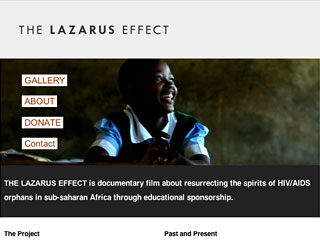
Mathieu Young, a young filmmaker whom I first met by hearing his pitch for an action movie in the Palm Springs desert, went to Kenya in 2005 to take on a documentary, “The Lazarus Effect.” The project’s site, which began as a way to chronicle the progress of the film but became something much more personal, was highlighted this month on VanityFair.com.
Problem
Before Mathieu left, we met up for drinks at Urth Caffe in Beverly Hills and he told me about last-minute worries for his five-month itinerary. The problem at large was about staying focused on the film, which he was running and gunning on his own, amid the larger challenges of creating a program in Kanga, Kenya to “resurrect the spirits of HIV/AIDS orphans in sub-saharan Africa through educational sponsorship.”
Solution
Mathieu was setup to use a small, custom CMS [content management system] to update TheLazarusEffect.org, where he blogged his tour, posted his photographs and used a shaky web connection in the middle of Africa to share his scribbled notes and impressions online.
Encouraged to post every day, the journals became a soul-bearing road map throughout his project. Projects like Yahoo!’s war correspondent site, “Kevin Sites in the Hot Zone,” use a similar approach.
The journals, which are no longer the key focus the site, may or may not influence the final film, but succeeded in connecting Mathieu with more than just friends and family: he took care of procrastination and focused on the core belief of his project. His film and his cause benefited from this small but persistent and strategic effort.
The Lazarus Effect started as a documentary film about the H.I.V./AIDS pandemic in rural Africa, but the project’s focus has shifted to helping to start and maintain an innovative pilot program aimed at benefiting people living with the disease.
As a platform, the site directed $5,000 to the cause he ended up highlighting, where visitors PayPal’d after exploring the supporting material on the site. No more than $100 was spent on the web site over three years.
Despite the “live-blogging” phase being the five months in 2005, over 1,000 visitors have explored the site in the last year, spending an average of three-minutes taking it all in, with 40% coming in from search referrals.
What’s Next?
“The Lazarus Effect” is almost ready to premiere, while the cause, “The Kanga Project,” is ready for a site of its own.
Mathieu is also the new community developer for FWD:labs and will introduce himself in the coming month.
An archive of our collective blog on creatives and their work in film, web, and design.
Browse our topics or explore the archive of 385 articles since 2007–2020.



 As a creative, you care about control and trust. In the frenzy of build-ups and buy-outs in social video networking, there’s a lot of competition, compensation and communities vying for your best work. Building a relationship with an online service may take some informed schooling. I get asked all the time, “Which online networks put ads on my work?” “What’s the alphabet soup?” “Who’s neck-and-neck in popularity with YouTube?”


 Mathieu Young, a young
  The site got